Why do so many patients come back within 28 days?
What can a hospital actually send on WhatsApp?
What does a 30-day discharge follow-up sequence look like?
How should a hospital escalate when a patient says something worrying?
How do the rules differ across Hong Kong, Singapore, Malaysia and Indonesia?
How do you run this without creating a data-governance problem?
Frequently asked questions
A discharge is not an ending. It is a handover — from a ward that watched the patient hourly to a home where nobody is watching at all. In Hong Kong's public system, 11.0% of general inpatients were readmitted unplanned within 28 days in the year to February 2025, up marginally on the year before, with cluster-level rates ranging from 9.6% to 12.5% (Hospital Authority KPI report, June 2025). Roughly one in nine discharged patients comes back, unplanned, inside a month.
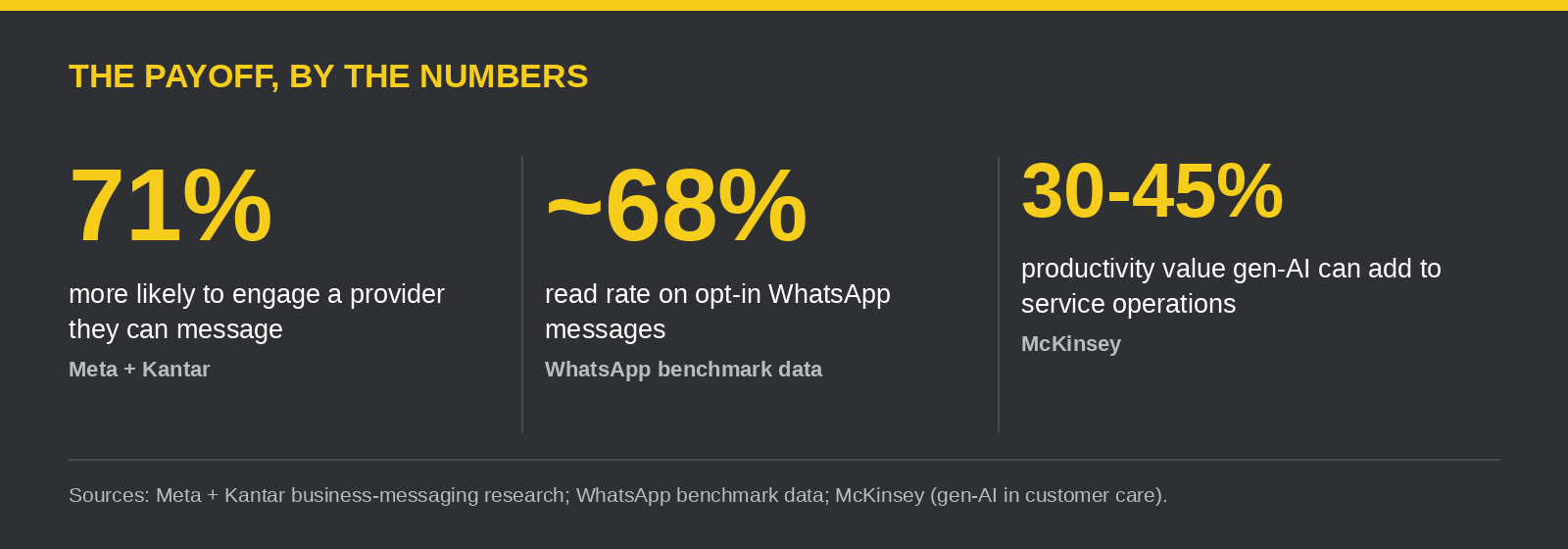
The payoff, by the numbers
Not every readmission is preventable. But a meaningful share is driven by things a conversation can fix: a medication misunderstood, a follow-up appointment missed, a symptom that frightened the patient at 9pm and was ignored by 9am. Messaging is where those conversations already happen — and patients are far readier to have them on WhatsApp than on a phone line they never answer.
This article is the operational playbook: what a hospital is actually permitted to send on WhatsApp, the five-checkpoint follow-up sequence that catches deterioration early, the escalation ladder that keeps clinicians in control, and the governance model that lets a compliance officer sleep. It is written for Hong Kong, Singapore, Malaysia and Indonesia — four markets where WhatsApp is the default channel and the privacy law is not.
Key takeaways
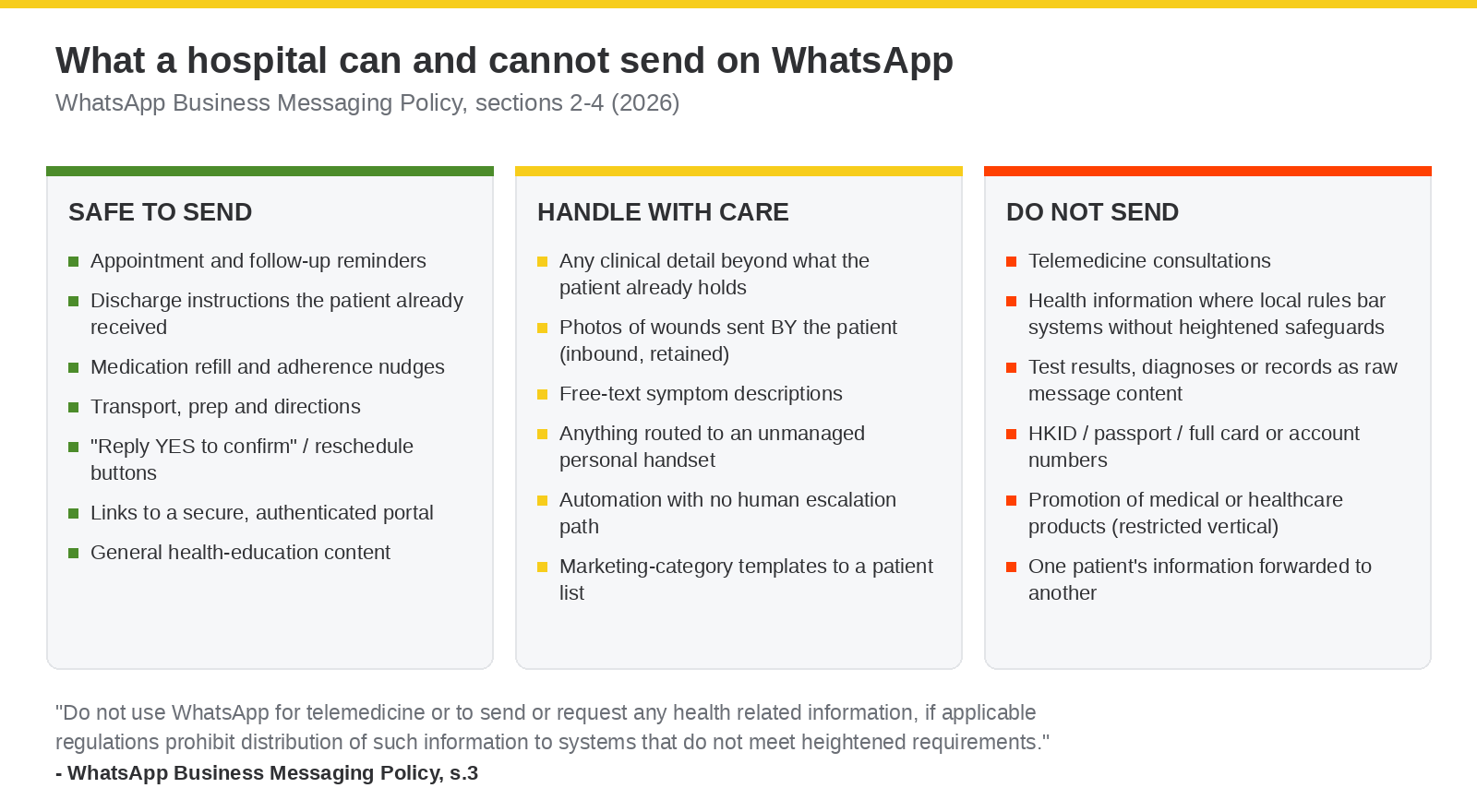
Start here, because most hospital messaging projects die at this question — or, worse, ship without asking it. Meta's WhatsApp Business Messaging Policy says, in section 3:
"Don't use WhatsApp for telemedicine or to send or request any health related information, if applicable regulations prohibit distribution of such information to systems that do not meet heightened requirements to handle health related information."
Read the conditional clause carefully. This is not a blanket ban on healthcare — it is a ban that switches on wherever local rules impose heightened handling requirements on health data. Meta reinforces the point in the WhatsApp Business Terms of Service, which make no warranty that the service meets the needs of entities subject to heightened confidentiality obligations. Section 4 separately lists medical and healthcare products as a restricted vertical: you may not use WhatsApp to promote or sell them.
The practical consequence is a clean design rule. WhatsApp is a coordination channel, not a clinical record. It carries the logistics of care — when, where, what to take, who to call. It does not carry the substance of care. Anything clinically sensitive lives behind an authenticated portal and is reached from the thread by a link, not reproduced inside it.
| Message | Template category | Allowed? | Why |
|---|---|---|---|
| Follow-up appointment reminder | Utility | Yes | Transactional, tied to an existing episode of care, expected by the patient. |
| Medication refill / adherence nudge | Utility | Yes | Restates instructions the patient already received on discharge. |
| Confirm / reschedule buttons | Utility | Yes | Interactive, no clinical content, drives a booking action. |
| Link to an authenticated patient portal | Utility | Yes | The sensitive data stays behind the login, not in the thread. |
| Test result or diagnosis in the message body | — | No | Health information in a system without heightened safeguards. Send a portal link instead. |
| Telemedicine consultation over chat | — | No | Explicitly named in the WhatsApp Business Messaging Policy, s.3. |
| Promotion of a medical or healthcare product | Marketing | No | Medical and healthcare products are a restricted vertical under s.4. |
| HKID / passport / full card or account numbers | — | No | Sensitive identifiers are prohibited by s.3, whoever sends them. |
| Forwarding one patient's message to another patient | — | No | Expressly prohibited by s.3. |
Two further mechanics from section 2 of the policy shape everything downstream. First, you may only initiate a conversation with an approved Message Template; outside the 24-hour customer service window, free-form replies are not permitted. Second, opt-in is mandatory and must be obtained in a manner that complies with applicable law — Meta's opt-in guidance recommends collecting it per message category, which for a hospital means separating "appointment logistics" from "health education" from anything promotional. Capture that consent on the ward, at discharge, on paper or on the tablet — the same moment you hand over the discharge summary.
If any of the platform vocabulary is unfamiliar, our explainer on the WhatsApp Business Platform covers templates, the 24-hour window and conversation pricing.
Most avoidable readmissions are seeded in the first fortnight after discharge. A programme that only calls at day 30 is an audit, not an intervention. The sequence below front-loads contact where the risk is, and every checkpoint is a single approved template — cheap to run, easy to govern.

| Checkpoint | What you send | Category | What good looks like |
|---|---|---|---|
| Day 0 — discharge | Confirmation that the discharge summary was issued, the medication list, the date of the next visit, and the opt-in confirmation. | Utility | Sent before the patient leaves the ward, while a nurse can still answer questions. |
| Day 1–2 — first check-in | One question with quick-reply buttons: "How are you feeling since you went home?" — options such as Fine / Some pain / Not good. | Utility, then session | Any non-"Fine" answer opens a 24-hour window and lands in a staffed queue within minutes. |
| Day 7 — adherence | Refill or dosage reminder, wound or device care prompt, confirmation that the follow-up booking exists. | Utility | The message names the medication and the action, not the diagnosis. |
| Day 14 — appointment | Confirm-or-reschedule buttons, transport and preparation instructions. | Utility | A reschedule updates the clinic calendar automatically — no phone tag. |
| Day 30 — outcome | A two-question recovery survey that closes the loop and feeds readmission analytics. | Utility | Responses are structured, so the data is analysable rather than anecdotal. |
Three design notes that matter more than the copy.
Ask a closed question first. A free-text "how are you?" invites a paragraph of symptoms that your policy says you should not be soliciting and your staff may not read for hours. Buttons give the patient a low-effort way to raise a hand, and give you a structured signal you can route on. The clinical detail comes after a human joins the thread — or, better, in the clinic.
Every reply opens a 24-hour window. Once the patient answers, you can converse freely without a template for 24 hours. That window is the single most valuable asset in the sequence: it is where a care coordinator resolves the confusion that would otherwise have become an A&E visit. Staff it deliberately, and see our note on how WhatsApp conversation pricing works in Hong Kong before you model the cost — utility conversations are inexpensive, and a single avoided readmission funds the year.
Write for the caregiver, not just the patient. In Hong Kong and Singapore the person managing an elderly patient's medication is frequently an adult child or a domestic helper. Capture consent for the number that will actually be read, record who it belongs to, and phrase instructions accordingly.
The most dangerous version of a discharge bot is one that answers a worried patient competently enough that nobody escalates. Meta anticipates this: section 2 of the policy permits automation inside the 24-hour window only where you also provide "prompt, clear, and direct escalation paths" — an in-chat human agent transfer, a phone number, an email, web support, an in-store or in-clinic visit, or a support form. For a hospital, that clause is not red tape. It is the design of the safety net.
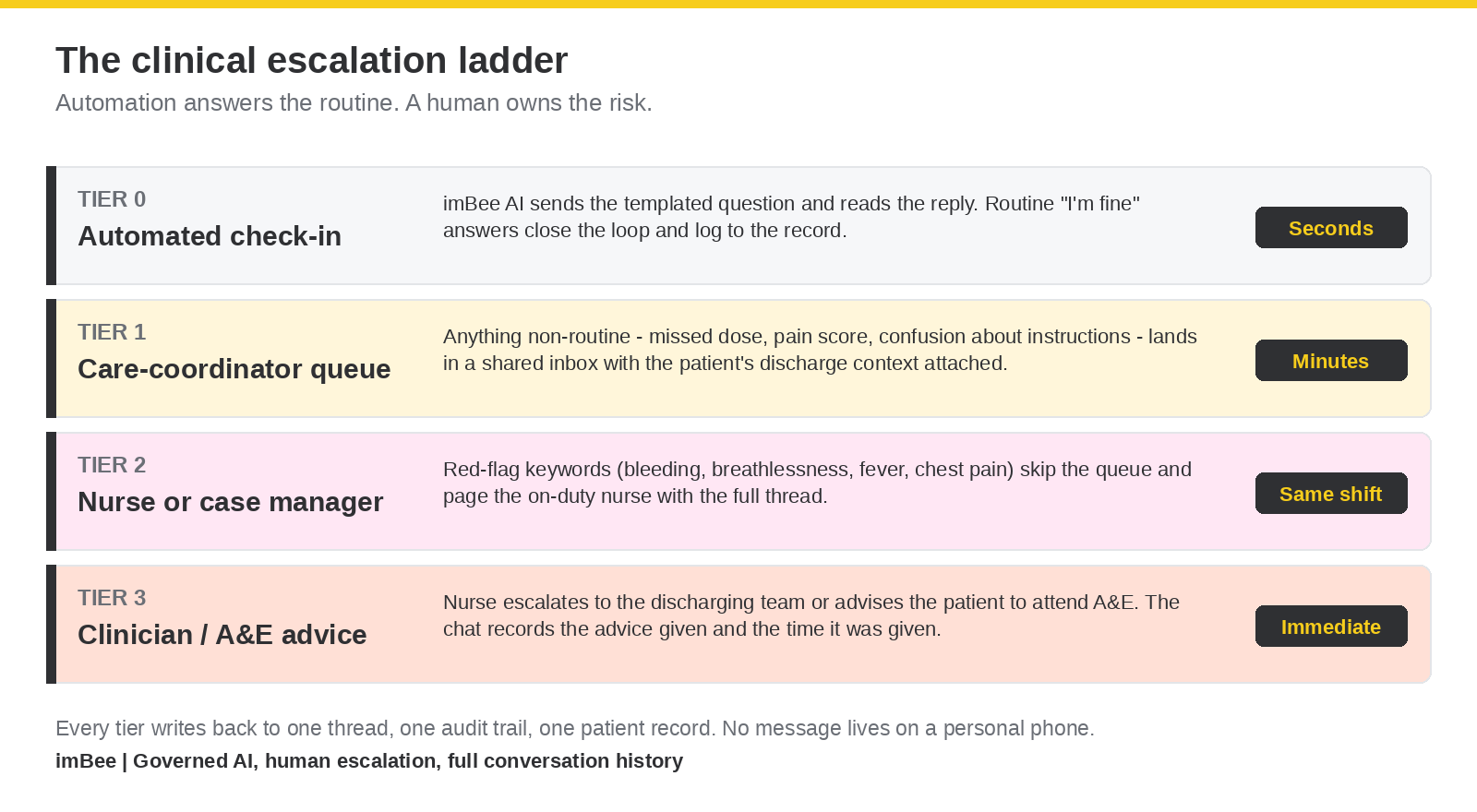
Tier 0 — automation handles the routine. imBee AI sends the templated check-in, reads the button response and closes the loop on the patients who are fine. That is the majority, and it is the whole point: it buys your coordinators the time to look at the minority who are not.
Tier 1 — the coordinator queue. Anything non-routine drops into a shared inbox with the patient's discharge context already attached — ward, discharging team, medication list, next appointment. No one hunts through a records system to work out who is asking.
Tier 2 — red flags jump the queue. A defined keyword and intent set (bleeding, breathlessness, chest pain, fever, fainting, confusion) bypasses the queue entirely and pages the on-duty nurse with the full thread. Define this list with your clinical governance committee, not your marketing team, and review it quarterly.
Tier 3 — clinician or A&E. The nurse escalates to the discharging team or advises attendance at A&E. Critically, the chat records the advice given and the time it was given — which is exactly the evidence you want if the case is ever reviewed.
Guardrails on the AI layer are non-negotiable. The assistant answers from an approved knowledge base of discharge instructions and clinic logistics; it does not improvise clinical advice; and any message it cannot confidently classify escalates rather than guesses. If you are weighing where automation belongs in a care pathway at all, our piece on where conversational automation earns its keep is a useful frame.
The channel is the same across the region. The obligations are not — and the WhatsApp policy's conditional clause means the local rule is the one that decides what you may send.
| Market | Law and regulator | What it means for discharge messaging |
|---|---|---|
| Hong Kong | Personal Data (Privacy) Ordinance (Cap. 486); Privacy Commissioner for Personal Data (PCPD). Public hospitals sit under the Hospital Authority. | Six Data Protection Principles govern collection, use, security and retention. Health data is not a separate statutory category, but DPP1 (purpose) and DPP4 (security) bite hard. The PCPD's eHRSS guidance is the closest thing to a health-sector benchmark. |
| Singapore | Personal Data Protection Act 2012 (PDPA); Personal Data Protection Commission (PDPC). MOH and the Agency for Integrated Care run transitional-care programmes such as Hospital-to-Home. | Consent, purpose limitation and reasonable security are the core obligations. Do Not Call rules bite on anything promotional — keep clinical logistics strictly separate from fundraising or service marketing. |
| Malaysia | Personal Data Protection Act 2010; Jabatan Perlindungan Data Peribadi (JPDP). | Health data is sensitive personal data, requiring explicit consent. Bilingual templates (Bahasa Malaysia and English) are an operational necessity, not a nicety. |
| Indonesia | Personal Data Protection Law (UU PDP, Law No. 27/2022). | Health data is expressly specific personal data with heightened consent and security duties. Treat WhatsApp as coordination-only and keep records in-country per your own counsel's advice. |
Hong Kong's framework rests on the Personal Data (Privacy) Ordinance (Cap. 486) and the six Data Protection Principles enforced by the PCPD. There is no bespoke health-privacy statute, but the Commissioner's points to note on the Electronic Health Record Sharing System set out how carefully the regulator expects patient data to be handled — a useful proxy when you are drafting an internal standard. In Singapore, the PDPA governs, and the public system already runs structured transitional care: the Hospital-to-Home programme, launched in 2017, pairs post-discharge support with an AI readmission-prediction model deployed across the public hospitals. A messaging layer is the natural front end for exactly that kind of programme. Teams building in Singapore should also read our WhatsApp Business API guide for Singapore.
One framing point, stated plainly: imBee has no relationship with any of these regulators and makes no claim to certify your compliance. What the platform does is give a hospital the controls — consent capture, role-based access, retention rules, full audit trail, ISO/IEC 27001-certified security programme — that a compliance officer needs in order to answer to them.
Here is the failure mode you should actually be worried about, and it has nothing to do with Meta's policy. It is the ward sister who, with the best intentions in the world, gives a discharged patient her personal WhatsApp number.
That single act creates a clinical conversation on an unmanaged device, with no audit trail, no retention policy, no supervision, no handover when she is off shift, and no way to produce the thread if the case is reviewed. It is happening in your hospital today. The question is not whether to allow WhatsApp — the patients and the staff have already decided that — but whether the traffic runs through a governed system or a personal handset.
A governed operating model has five parts:
imBee is an Official Meta Technology Partner serving 10,000+ enterprises across 60+ industries, with an omnichannel inbox that unifies WhatsApp, WeChat, Instagram, LINE, SMS and web chat, and an AI layer — imBee AI — that answers from your approved knowledge base and escalates to a human on anything it should not decide. For a broader view of why messaging is displacing SMS and outbound calls in patient communication, see healthcare patient messaging beyond SMS.
If you are running a discharge programme in Hong Kong, Singapore, Malaysia or Indonesia and want to see the governance controls before you see the demo, talk to our team.
Quick answers on what a hospital may send, how the follow-up ladder works, and where automation stops.
Can hospitals use WhatsApp for patients?
Yes, for coordination — appointment reminders, medication adherence nudges, discharge logistics and links to a secure portal. WhatsApp's Business Messaging Policy prohibits telemedicine and the sending of health information where local rules require heightened safeguards, so clinical content stays behind an authenticated login rather than in the message body.
Is WhatsApp allowed to carry patient health information?
Only conditionally. Meta's policy bars health-related information where applicable regulations prohibit its distribution to systems without heightened handling requirements. The safe design is to treat WhatsApp as a logistics channel: name the action, not the diagnosis, and link to a portal for anything sensitive.
What is a discharge follow-up sequence?
A structured series of messages sent after a patient leaves hospital — typically at discharge, day 1–2, day 7, day 14 and day 30 — that confirms instructions, prompts medication adherence, secures the follow-up appointment and captures the recovery outcome, escalating to a human whenever the patient signals a problem.
Does WhatsApp follow-up reduce readmissions?
Structured post-discharge follow-up is well established in the literature as a way to catch avoidable deterioration early; Hong Kong and Singapore both run formal transitional-care programmes for this reason. WhatsApp changes the economics and the reach of that follow-up rather than the clinical mechanism — the reminder gets read, so the intervention actually happens.
What is the 28-day readmission rate in Hong Kong?
The Hospital Authority reported an unplanned readmission rate within 28 days for general inpatients of 11.0% for the period March 2024 to February 2025, up 0.1 percentage points year on year, with cluster-level rates between 9.6% and 12.5%.
Do patients have to opt in before a hospital messages them?
Yes. Meta requires opt-in permission before a business initiates contact, and Hong Kong's PDPO, Singapore's PDPA, Malaysia's PDPA and Indonesia's UU PDP all impose consent obligations of their own. Capture opt-in on the ward at discharge, per message category, and make opting out effortless.
Can an AI assistant reply to patients without a nurse?
It can handle the routine — confirming a booking, restating a dosage the patient already has, answering a logistics question — but Meta's policy requires a clear, prompt escalation path to a human whenever automation replies. Clinically, red-flag symptoms should bypass the bot entirely and page a nurse.
What is imBee AI, and can it reply to patients safely?
imBee AI is imBee's AI assistant. It answers from your approved knowledge base, follows the guardrails your clinical governance team sets, and hands off to a human agent on anything outside its remit.
Start your 30-day free trial today. Supercharge your team's productivity by over 30% and take your business to new heights of success.