What is a loan repayment reminder, and why send it on WhatsApp?
When should you send loan repayment reminders?
What should a loan repayment reminder say? Templates you can adapt
How do you build a compliant escalation ladder?
Do WhatsApp reminders count as direct marketing under the PDPO?
How do you automate loan repayment reminders without losing control?
Frequently asked questions
For a Hong Kong licensed lender, the money you lose is rarely the loan that was always going to default. It is the borrower who simply forgot — who let an instalment slide because an email went unread, a letter arrived late, or a phone call felt like the start of a fight. A loan repayment reminder is the cheapest recovery tool you own: a short, scheduled message that tells a borrower an instalment is due, or overdue, and exactly how to settle it.
The channel you send it on decides whether it works. SMS is easy to ignore. A cold call feels like collections from the first ring, so borrowers dodge it. A posted notice reaches them after the due date has already passed. WhatsApp is different: it is where your borrowers already live, opt-in messages get read, and people will reply to a message when they would never pick up a call. That is why more Hong Kong lenders now run their pre-delinquency and early-arrears reminders on WhatsApp rather than the phone.
This guide is written for the person who owns the recovery number — a collections manager or COO at a licensed lender. It covers when to send reminders, what they should say, how to escalate without breaking the Money Lenders Ordinance (Cap. 163), where the Personal Data (Privacy) Ordinance (Cap. 486) draws its lines, and how to automate the whole thing while keeping a human on every hard conversation.
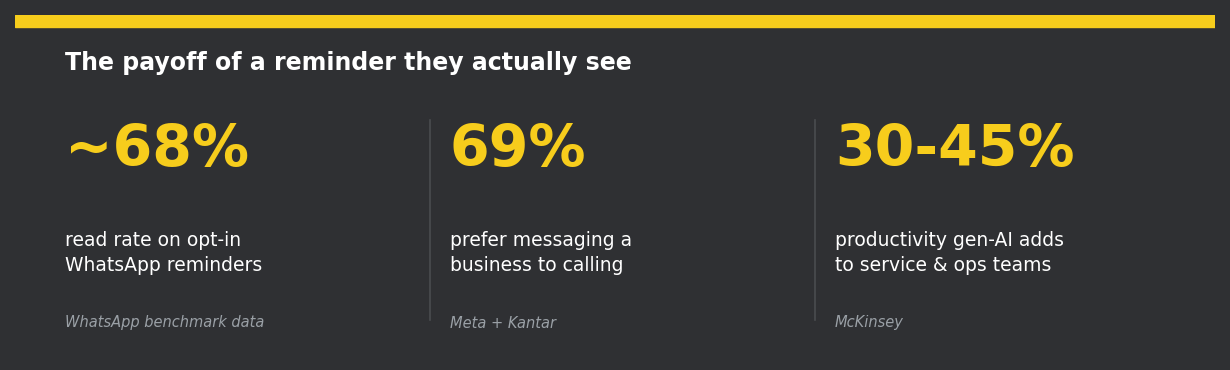
The payoff of a reminder they actually see
A reminder only recovers money if it is read. That single fact is why the channel matters more than the wording:
Key takeaways
Most lenders start reminding too late — a day or two after the due date, when the borrower is already anxious and the conversation is already adversarial. The reminders that recover the most money do their work before the instalment is due. A borrower who gets a friendly heads-up five days out has time to arrange funds; a borrower who first hears from you after they have missed a payment is already in a hole.
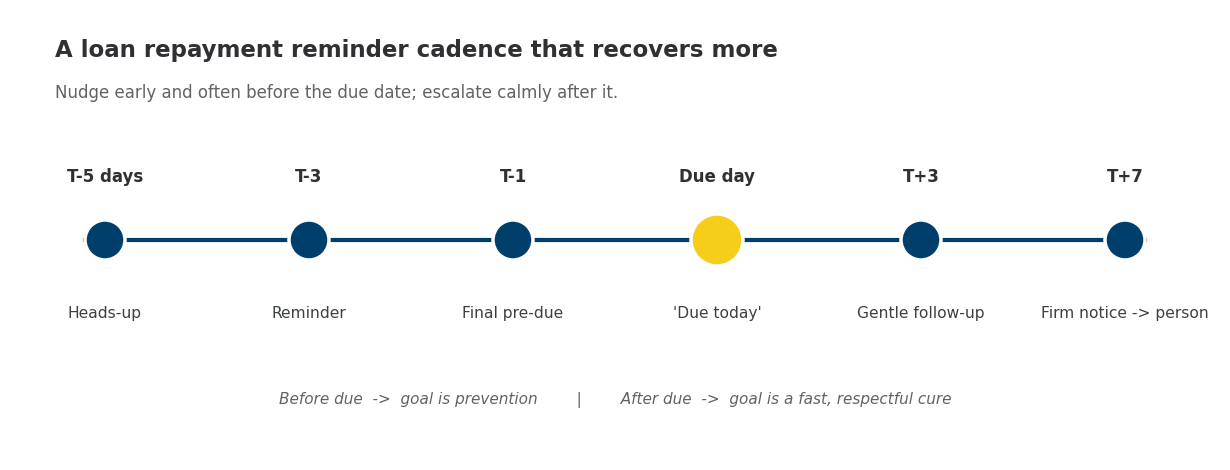
The cadence below is a sensible default for a monthly-instalment loan. Tighten or loosen it to fit your product, but keep the shape: several light touches before the date, a clear reminder on the day, then a small number of firmer, well-spaced follow-ups after it — never a barrage.
| Stage | Timing | Goal of the message | Tone |
|---|---|---|---|
| Heads-up | 5 days before due | Give the borrower time to arrange funds | Warm, informational |
| Reminder | 3 days before due | Confirm amount and payment method | Helpful |
| Final pre-due | 1 day before due | Last easy chance to pay on time | Clear, brief |
| Due today | On the due date | State the amount due today and how to pay | Direct, neutral |
| Gentle follow-up | 3 days after due | Flag the missed payment; offer help or a plan | Factual, supportive |
| Firm notice | 7 days after due | Formal overdue notice; hand to a person | Firm, respectful |
Two rules keep this cadence effective. First, stop the moment they pay — nothing damages trust faster than a reminder for money already settled, so reminders must be wired to your ledger, not sent blind. Second, respect quiet hours: schedule sends for reasonable daytime windows, not late at night. Both are easy when reminders are automated against your loan system rather than typed by hand.
On the WhatsApp Business Platform, a business-initiated message like a reminder is sent as a pre-approved template. Reminders about a borrower’s own account fall into the utility category; that keeps them distinct from marketing and, crucially, keeps their cost and their compliance profile predictable. (For how the 24-hour customer-service window and templates interact, see our guide on handling the WhatsApp 24-hour rule.)
Good reminder copy does three things: it names the amount and the due date, it shows exactly how to pay, and it gives the borrower an easy way to reply. Keep it factual. The moment you add an offer — ‘refinance today’, ‘top up your loan’ — the message stops being a utility reminder and becomes direct marketing, which changes both the template category and your consent obligations (covered in the PDPO section below).
| Scenario | Category | Sample message (adapt to your brand) |
|---|---|---|
| Upcoming instalment | Utility | Hi {{name}}, a friendly reminder that your instalment of HK${{amount}} is due on {{date}}. You can settle via {{method}}. Reply here if you have any questions. |
| Due today | Utility | Hi {{name}}, your instalment of HK${{amount}} is due today ({{date}}). Pay via {{method}} to keep your account in good standing. Reply if you need help. |
| Missed payment (day 3) | Utility | Hi {{name}}, we haven’t yet received your instalment of HK${{amount}} due on {{date}}. If you’ve already paid, thank you — please ignore this. If not, reply and we’ll help you sort it out. |
| Overdue notice (day 7) | Utility | Hi {{name}}, your instalment of HK${{amount}} is now 7 days overdue. Please settle via {{method}}, or reply to discuss a repayment arrangement. A member of our team can call you if that’s easier. |
| Payment plan offer | Utility | Hi {{name}}, we understand things come up. We can spread your outstanding HK${{amount}} over {{n}} smaller payments. Reply YES to talk it through with our team. |
| Payment received | Utility | Thank you, {{name}}. We’ve received your payment of HK${{amount}} on {{date}}. Your next instalment is due on {{next_date}}. |
A few practical notes. Use variables ({{name}}, {{amount}}, {{date}}) so every message is personal and accurate. Always send from a verified business number, not a personal phone — a borrower needs to trust the sender before they will act. And close the payment-received loop: a confirmation message costs nothing and prevents the most trust-destroying mistake of all, chasing money that is already in.
Escalation is where recovery efforts get lenders into trouble. The instinct under pressure is to message more often and more harshly. That is exactly what the law restrains. Under Licensing Condition 10 of a Hong Kong money lender’s licence, a lender and its debt collectors must not harass anyone or adopt unlawful or improper debt-collection practices, and must only pursue people who are in law indebted to them. Breaching a licensing condition is an offence under the Money Lenders Ordinance (Cap. 163), carrying a maximum penalty of a HK$100,000 fine and two years’ imprisonment, and the Companies Registry’s Money Lenders Section and the Police follow up complaints. For the full picture of what a licensed lender may and may not send, see our guide to the Money Lenders Ordinance and WhatsApp messaging.
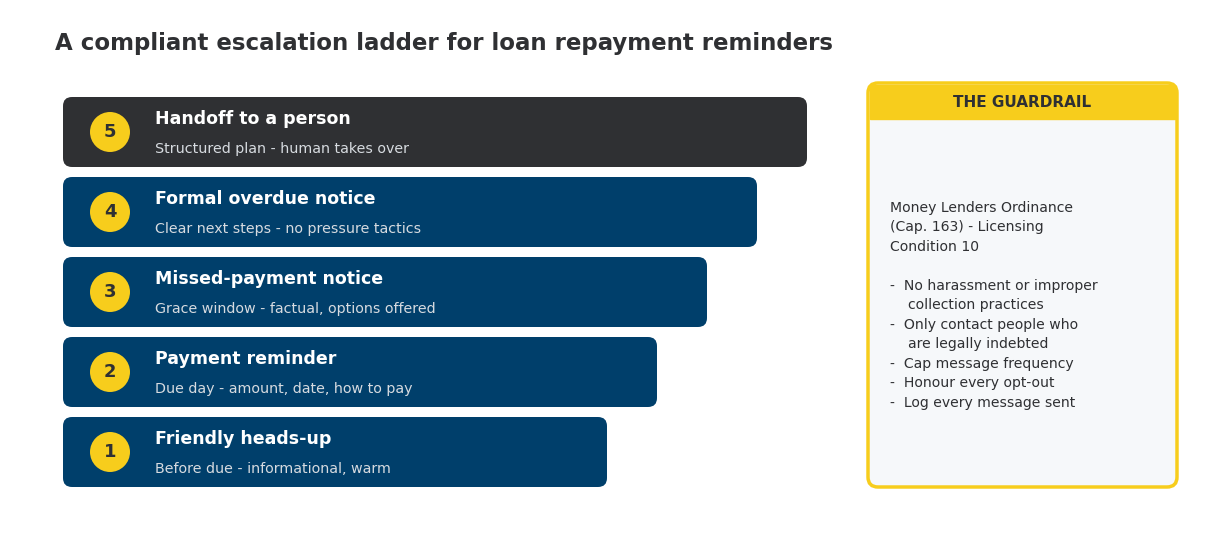
A fixed ladder solves the problem by removing improvisation. Everyone knows the next step, the tone rises predictably, and no agent decides in the heat of the moment to send a tenth message. The five rungs below map to the cadence in section 2:
Three guardrails make the ladder defensible. Cap the frequency — a fixed number of well-spaced messages, never a barrage. Honour every opt-out immediately and record it. And never contact third parties: the referee regime under Licensing Condition 13 is being tightened, and messaging a borrower’s friends or family is precisely the kind of improper practice the Ordinance targets. imBee is built for lenders answering to the Registrar of Money Lenders and the courts, so it supports these obligations — the discipline still has to be yours; a platform enables it, it does not absolve you of it.
This is the question that stops many lenders from using WhatsApp at all, usually out of an abundance of caution. The short answer: a reminder to an existing borrower about their own repayment obligation is a service (transactional) message, and is generally not ‘direct marketing’ under Part 6A of the Personal Data (Privacy) Ordinance. Direct marketing is about offering goods or services; a reminder that an instalment is due is not an offer.
The line is crossed the instant you attach a pitch. ‘Your payment is due’ is a reminder. ‘Your payment is due — and here’s a great rate to refinance’ is direct marketing, which requires the borrower’s consent and a working opt-out under the PDPO, enforced by the Privacy Commissioner for Personal Data (PCPD). Keep the two streams separate: reminders in one lane, offers in another with their own consent.
| Do | Don’t |
|---|---|
| Get clear opt-in to message the borrower on WhatsApp at account opening | Assume a phone number on file is consent to message on WhatsApp |
| Use borrower data only to service the loan you told them about (DPP3) | Slip a cross-sell or promotion into a repayment reminder |
| Offer an easy opt-out and honour it immediately | Keep messaging after someone asks you to stop |
| Keep data accurate and secure, and log every message (DPP4) | Store chat records loosely on personal staff phones |
Treat consent, purpose limitation and security as the foundation, not the fine print. Collect a specific opt-in to be contacted on WhatsApp, use the data only for the purpose you stated, keep it accurate and protected, and make opting out effortless. Done this way, WhatsApp reminders support your obligations under the PDPO rather than straining them — and you have a clean record to show if a borrower ever complains.
Manual reminders do not scale, and they break exactly when you are busiest. The fix is an operating model where the routine work is automated and the judgement calls stay human. Four building blocks turn a pile of due dates into a controlled, auditable reminder programme.

This is what imBee’s omnichannel inbox is built for: unifying WhatsApp with your other channels, automating utility reminders, and keeping a complete, exportable record of every conversation. As an Official Meta Technology Partner with an ISO/IEC 27001-certified security programme, serving 10,000+ enterprises across 60+ industries, imBee is designed for regulated APAC operators who cannot treat customer messaging as an afterthought. If you are weighing this up, our guides on WhatsApp for financial services in APAC, how financial-services teams use WhatsApp, the difference between the WhatsApp Business app, API and Platform, and WhatsApp Business API pricing in Hong Kong are the right next reads. When you want to see it on your own reminder flow, book a demo.
What is a loan repayment reminder?
A loan repayment reminder is a scheduled message that tells a borrower an instalment is due, or overdue, and how to pay it. It states the amount and date, gives a payment method, and invites a reply. Sent before the due date, it prevents late payments; sent after, it opens a path to a cure.
Are loan repayment reminders the same as debt collection or dunning messages?
They overlap but are not identical. ‘Dunning’ and ‘collection message’ usually describe post-due chasing. A repayment reminder starts earlier — often before the due date — and is deliberately lighter in tone. The best programmes treat reminders as one continuous ladder from friendly heads-up to formal overdue notice.
Can licensed money lenders in Hong Kong send repayment reminders on WhatsApp?
Yes. Nothing in the Money Lenders Ordinance (Cap. 163) prohibits messaging a borrower about their own account. You must, however, respect Licensing Condition 10 — no harassment, no improper practices, and only contacting people who are legally indebted — and the data-protection rules in the PDPO.
How often should I send loan repayment reminders?
Several light touches before the due date (about five, three and one day out, plus a due-day message), then a small number of well-spaced follow-ups after it. Cap the total, space them out, and stop the instant the borrower pays. Frequency without limits reads as harassment.
Do WhatsApp repayment reminders need to be opt-in approved templates?
Yes. Business-initiated reminders are sent as pre-approved WhatsApp utility templates, and you should have the borrower’s opt-in to be contacted on WhatsApp. Keep the copy factual; adding an offer turns a utility reminder into marketing, which needs separate consent.
Are repayment reminders direct marketing under the PDPO?
Generally no. A reminder about a borrower’s own repayment is a service message, not an offer of goods or services, so Part 6A of the PDPO does not usually apply. It becomes direct marketing — needing consent and an opt-out — the moment you attach a cross-sell such as refinancing.
What must I avoid so reminders don’t become harassment?
Avoid excessive frequency, threatening or shaming language, messaging at unreasonable hours, and contacting third parties such as referees, family or employers. Honour every opt-out, only pursue the actual debtor, and keep a full log — the record protects both the borrower and you.
How does imBee help lenders send compliant reminders?
imBee automates WhatsApp utility reminders against your loan system, routes every reply to a human inbox, and logs each message for audit. As an Official Meta Technology Partner with ISO/IEC 27001-certified security, it is built for regulated APAC lenders. Talk to our team to map it to your reminder flow.
Discuss your channels, team and conversation handover needs in a product demo.