Why Flag Day Operations Fall Apart Between 06:30 and 08:00
What Actually Has to Be Coordinated on Collection Day
Groups, Broadcast or One-to-One: Matching the Tool to the Job
What to Put in Place Before You Choose a Tool
Permits, Consent and Volunteer Data: The Compliance Layer
A Four-Week Countdown to Collection Day
What Better Messaging Will Not Fix
A programme manager stands outside a community centre in Sham Shui Po at 06:40 with a clipboard, a box of sealed collection bags and a phone that will not stop buzzing. Six hundred volunteers are due across eleven collection points. Forty have not confirmed. Two district captains cannot find their bag allocation. The Observatory has just hoisted an amber rainstorm warning, and everyone wants to know whether the day is still going ahead.
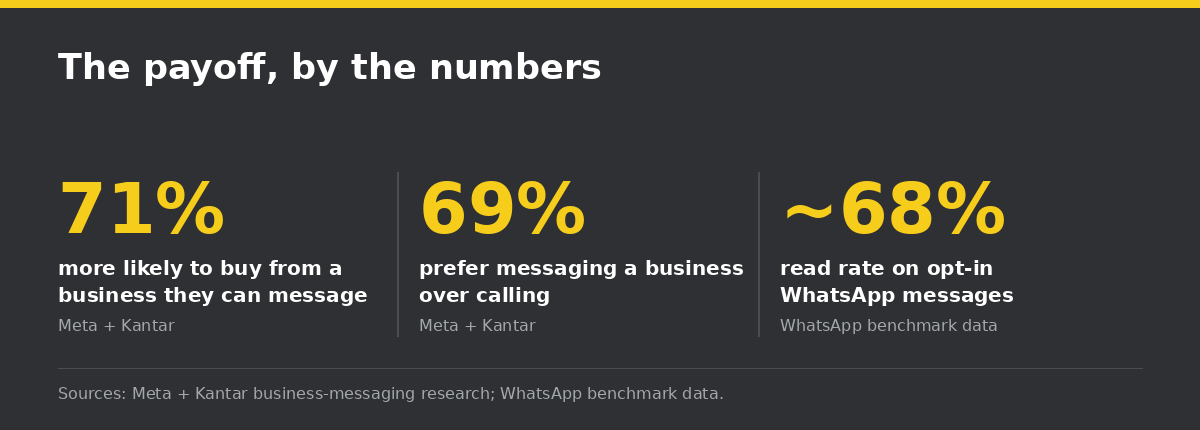
The payoff, by the numbers
Before the detail, here is why this is worth the team’s time:
Nothing in that scene is a fundraising problem. It is a logistics problem with a two-hour window and no room to reschedule. Flag day income depends almost entirely on volunteer hours actually delivered on the street, so a coordination failure at 07:00 converts directly into money the organisation will not raise, on a date the Social Welfare Department allocated months earlier and cannot simply move.
Most Hong Kong NGOs run this on WhatsApp already, because that is where volunteers are. The difference between a smooth morning and a chaotic one is rarely the app. It is whether the organisation is using the right WhatsApp tool for each job, whether one person is the single point of failure for every message, and whether volunteer contact details are held in a way the organisation can actually defend.
This guide is written for the operations side of a fundraising team: the people who own the volunteer roster, the district captains and the day-of communications, not the campaign creative.
Before choosing tools, be precise about what is being coordinated. A flag day is not one communication task. It is five, with different audiences, different urgency and different failure costs.
Confirmation. In the week before, every registered volunteer has to confirm they are coming, and the ones who go quiet have to be chased individually. This is a one-to-many send with a one-to-one follow-up tail.
Assignment. Each volunteer needs a collection point, a shift time, a captain's name and a phone number. This is personalised information, and sending it as a bulk message to a group means every volunteer sees everyone else's placement.
Live coordination. On the morning itself, captains need a fast channel to report bag shortages, no-shows and hot spots, and headquarters needs to answer within minutes.
Escalation. Weather warnings, a volunteer injury, an aggressive member of the public, a lost collection bag. These need a defined route to a named person, not a message dropped into a chat of three hundred.
Close-out. Bag returns, counting station timings, thank-you messages and, where a donor asked for one, a receipt. The Inland Revenue Department treats donations of HK$100 or more to approved charitable institutions as tax-deductible, so receipt requests are a real operational tail, not an afterthought.
WhatsApp offers three shapes of conversation, and the common failure is using one shape for all five flows above. Groups are visible to everyone in them. Broadcasts go out individually. One-to-one threads carry the personal detail. Match them deliberately.
| Flow | Right tool | Why | What goes wrong otherwise |
|---|---|---|---|
| Confirmation of attendance | Broadcast to opted-in volunteers | Each reply lands privately with the coordinator | A group of 300 fills with 'yes' messages |
| Shift and point assignment | One-to-one message | Placement is personal information | Everyone sees where everyone else is posted |
| Captain coordination | Small group per district | Fast, visible, few people | One giant group nobody can read |
| Weather and escalation | Broadcast plus captain group | Reaches everyone and gives captains a route back | Rumour spreads before the official call |
| Thanks and receipts | One-to-one follow-up | Requires the donor or volunteer record | Receipt requests lost in a group scroll |
Two limits matter when this runs at scale. A personal WhatsApp account is not built to send several hundred individual messages in a morning, and volunteers' numbers end up stored on a staff member's own handset. On the WhatsApp Business Platform the organisation holds one verified number, sends personalised messages from a system rather than a device, and keeps the volunteer list where the organisation can manage it. imBee is an Official Meta Technology Partner and supports both broadcast and group workflows on that platform, which our guide to the WhatsApp Groups API covers in detail.

Outbound messages to volunteers who have not written to you recently must use an approved template. In practice that is not a constraint — a flag day confirmation is exactly the sort of predictable, transactional message a Utility template is designed for, and templates can be prepared and approved weeks before collection day.
Coordination tooling amplifies whatever process already exists. If the roster lives in one volunteer coordinator's phone, better messaging simply makes that person busier. Work through these before the platform conversation.
One roster, one source of truth. Volunteer name, mobile number, district, shift, captain and consent status in a single list the whole team can see. Not three spreadsheets and a group chat.
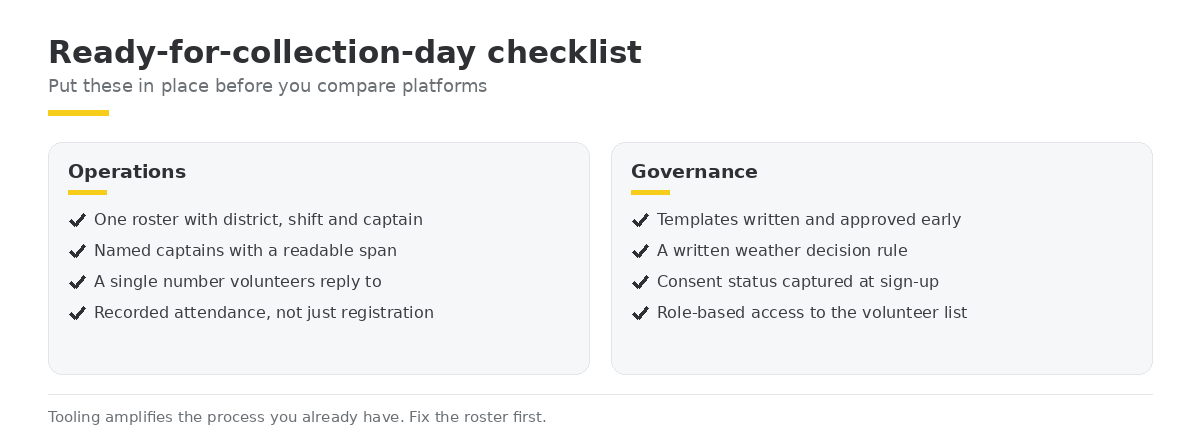
Named captains with a defined span. A captain should hold a group they can actually read — a district or a cluster of points, not the whole territory.
Templates written and approved in advance. Confirmation, assignment, weather-hold, cancellation and thank-you. Drafting a cancellation message during a rainstorm is how the wrong thing gets sent.
A decision rule for weather, written down. Who decides, at what warning level, by what time, and through which channel the call is announced. The Hong Kong Observatory issues the warning; your organisation still has to make and communicate the decision.
A single number volunteers can reply to. If the confirmation comes from the organisation's number and the assignment comes from a coordinator's mobile, volunteers reply to whichever they saw last.
An after-hours expectation. Volunteers message the night before at 23:00. Say when someone will answer and give an automated path for the two or three questions that always recur.
Two obligations sit behind a flag day. The first is the permit that allows the collection at all; in Hong Kong, charitable collections in public places are licensed, and the Social Welfare Department administers public subscription permits including flag days, with dates allocated in advance. The second is data protection, which applies to every volunteer and donor record the organisation touches, and it is the one operations teams under-plan.
The Personal Data (Privacy) Ordinance (Cap. 486) sets out six data protection principles covering collection, accuracy, retention, use, security and access. A volunteer who gave a mobile number to be rostered has not thereby agreed to receive donation appeals for the next three years. Using an operational list for fundraising promotion is direct marketing, and the Ordinance sets specific requirements for that, including an opt-out the volunteer can exercise at any time.
| Obligation | What it covers | What the team needs to be able to show |
|---|---|---|
| Collection permit | Charitable collection in a public place | The permit, its conditions and the allocated date |
| Purpose of collection | Why the volunteer's number was taken | A statement given at sign-up, kept on file |
| Direct marketing consent | Later appeals to the same number | A separate, timestamped opt-in with an opt-out route |
| Volunteers under 18 | Student and school-group volunteers | Consent handled through the school or guardian |
| Security of the list | Who can see volunteer contact details | Named accounts and role-based access, not a shared phone |
| Retention | How long the roster is kept after the event | A defined period, applied rather than assumed |
imBee provides role-based access, retention controls and audit logging so an organisation can support these obligations, and runs an ISO/IEC 27001-certified information-security programme. The charity remains the data user under the Ordinance and sets its own policies; no platform takes that responsibility on your behalf.
One practical consequence: stop running the roster from a personal handset. When a coordinator leaves, six hundred volunteer numbers leave with them, and the organisation has no way to show who had access to what.
The sequence below assumes the permit and date are already secured and the recruitment drive is running. It front-loads the two things that cause most day-of chaos: unconfirmed volunteers and undefined decision rights.
Four weeks out — build the roster properly. One list, one format, consent status recorded at sign-up. Split volunteers by district and assign captains. This is also the moment to draft and submit message templates so approval is not on the critical path.

Two weeks out — confirm, then chase. Send the confirmation to every volunteer individually and work the non-responders by hand. Assume a proportion will not reply at all; the point of doing this early is to have time to recruit replacements.
One week out — brief the captains. Small district groups, a written escalation route, bag counts and collection-point logistics. Captains should know who to call before they need to call anyone.
The day before — send assignments and the weather rule. Each volunteer gets their point, shift, captain and a single number to reply to, plus a plain statement of what happens if a warning is issued and by what time the call will be made.
Collection morning — one voice, one channel. Announcements go out from the organisation's number; captains report upward in their district groups; headquarters answers escalations. Nobody improvises a new group at 07:00.
Within 48 hours — close the loop. Thank every volunteer, publish the outcome, handle receipt requests, and record who actually turned up. That last field is the single most useful input to next year's roster.
It is worth being honest about the boundary, because fundraising teams under pressure sometimes buy tooling to solve a problem that sits elsewhere.
It will not fix under-recruitment. If eleven collection points need six hundred volunteers and four hundred registered, no message improves the total. Recruitment channels, school partnerships and corporate volunteering agreements do.
It will not fix a roster nobody maintains. Messaging pulls from the list it is given. A list with duplicate entries, missing districts and dead numbers produces confident, well-formatted chaos.
It will not make the weather decision for you. A platform can send a cancellation to six hundred people in minutes, which is genuinely valuable. Deciding to send it, at what warning level and by when, remains a human judgement your organisation has to define in advance.
It will not convert a volunteer into a donor by itself. The post-event follow-up matters, but it needs consent captured at sign-up and a genuine reason to be in touch. Our guide to donor communications on WhatsApp covers that path in more detail.
| Symptom on the day | Likely cause | Where the fix sits |
|---|---|---|
| Volunteers arrive at the wrong point | Assignments sent to a group, not individually | One-to-one assignment messages |
| Captains cannot reach headquarters | No defined escalation route | Escalation rule, agreed in the briefing |
| Conflicting weather messages circulate | More than one person announcing | Single announcing channel |
| Large gap between registered and attending | Confirmation happened too late to replace | Confirm at two weeks, chase at one |
| Volunteer numbers sit on a staff phone | No organisation-owned messaging number | Business number with role-based access |
Flag day is one of the few fundraising formats where operational quality is directly visible in the result. Get the coordination layer right and the same volunteer base raises more, simply because more of them are standing in the right place at the right time with a bag in hand.
How do Hong Kong NGOs coordinate flag day volunteers on WhatsApp?
Most use a mix: a broadcast to confirm attendance with every volunteer, one-to-one messages carrying each person's collection point and shift, and small district groups so captains can report problems quickly. Running all three from one organisation-owned business number keeps replies in a single place and off staff members' personal handsets.
Do we need a permit for a flag day in Hong Kong?
Charitable collections in public places in Hong Kong are licensed activities, and flag day dates are allocated in advance. The Social Welfare Department administers public subscription permits and publishes the application process and conditions. Confirm current requirements and timelines directly with the department before planning a collection date.
Should volunteer assignments be sent in a group chat?
No. A collection point and shift are personal information, and posting them to a group means every volunteer can see everyone else's placement. Send assignments one-to-one. Keep groups for district captains, where the number of people is small enough that messages are actually read.
What does the PDPO require for volunteer contact details?
The Personal Data (Privacy) Ordinance (Cap. 486) requires you to collect only what you need, state the purpose, keep the data secure, hold it no longer than necessary and give access on request. A number collected to roster a volunteer does not automatically permit later fundraising appeals, which are treated as direct marketing.
How should we handle a weather cancellation?
Decide the rule before the day: who makes the call, at which warning level, by what time, and through which channel it is announced. Have the cancellation template pre-approved. Then send it from one number to every volunteer at once, and let captains handle questions in their district groups.
Can we message volunteers who have not written to us recently?
Yes, using an approved template on the WhatsApp Business Platform. Confirmation, assignment and cancellation messages are transactional in nature and fit the Utility template category. Prepare and submit templates weeks in advance so approval never sits on the critical path in the final week.
Can we use the volunteer list for donation appeals afterwards?
Only with consent captured for that purpose. Rostering consent and marketing consent are different things under the Ordinance, and appeals require a clear opt-in with an opt-out route the volunteer can use at any time. The practical fix is to ask at sign-up, when the volunteer is already engaged.
What about volunteers under 18?
Student volunteers are common on flag days and their contact details deserve extra care. Handle consent through the school or guardian rather than directly, keep the data set minimal, and delete it on the retention schedule you set for the event rather than carrying it into a general supporter database.

Kelly S.
Content Team Lead, imBee
Kelly S. owns content strategy, product positioning, and customer education at imBee. Previously, Kelly led B2B SaaS content programs and supported go-to-market initiatives for customer engagement products. On the imBee blog, Kelly covers conversational commerce, omnichannel messaging, WhatsApp Business, customer experience, and strategies for scaling business communications.
Questions about anything in this article? Talk to our team.
Discuss your channels, team and conversation handover needs in a product demo.