What is the difference between WhatsApp Business App, API, and Platform?
Who is the WhatsApp Business App still right for in 2026?
What is the WhatsApp Business API (WABA / WhatsApp Cloud API)?
WhatsApp Business App vs API vs Platform: 12-point comparison table
Security, compliance, and APAC regulator expectations across the three options
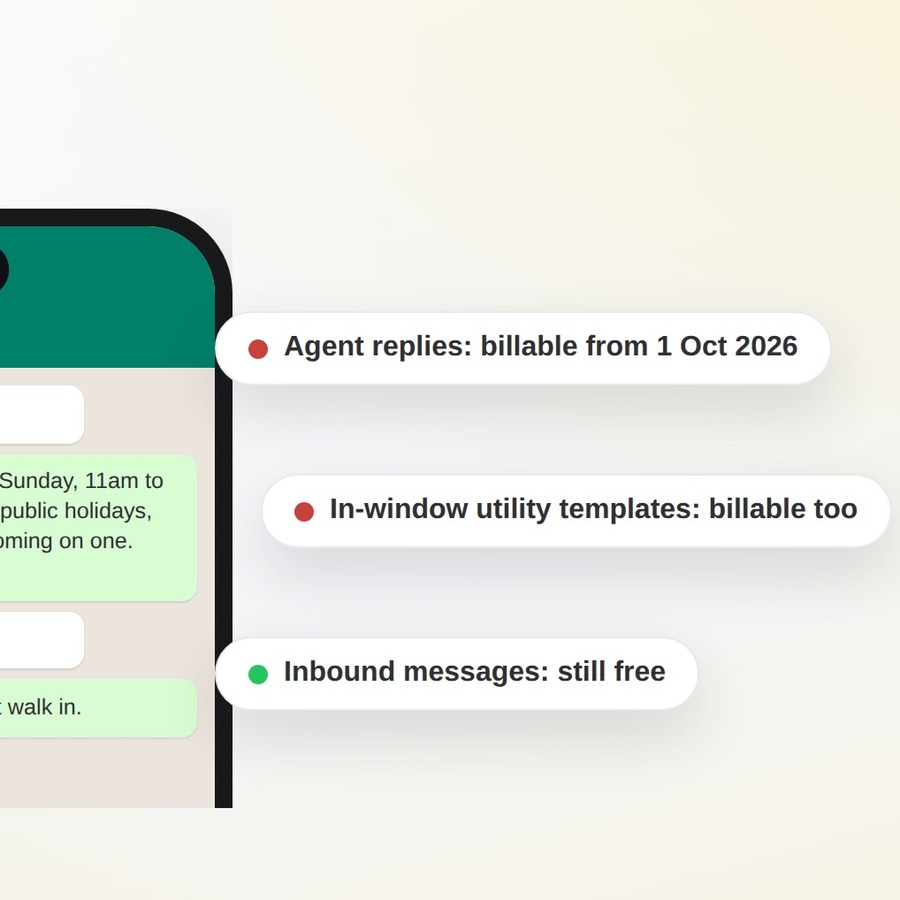
How conversation-based pricing actually works in 2026
Vertical playbooks: how Hong Kong money lenders, healthcare clinics, NGOs, and brokerages choose
If you are reading this article, you are probably trying to answer one of these questions before you commit to a deployment in Hong Kong, Singapore, Malaysia, or Indonesia. Here is what we’ll cover, in order:
One quick vocabulary clean-up before we begin. Meta has rebranded the "WhatsApp Business API" into a wider product called the Meta WhatsApp developer docs-documented WhatsApp Business Platform. The Platform encompasses the API itself, conversation-based pricing, message templates documentation (formerly called HSMs, or Highly Structured Messages), Click-to-WhatsApp Ads, and WhatsApp Flows. When industry analysts and BSPs say "WABA" or "WhatsApp Cloud API," they are talking about the same family of products. We’ll use the terms interchangeably.
The WhatsApp Business App is the free, downloadable mobile application Meta launched in 2018 for solo operators and microbusinesses. It runs on a single phone number tied to a single device (with up to four linked devices via Multi-Device beta). Outside of those linked devices, there is no central inbox, no role-based access, no API connector to your CRM, and no audit log.
It is still the right choice for a narrow profile of businesses. We see it work well for:
It stops being the right answer the moment more than two agents need access, you need to log conversations for a regulator, you want to broadcast beyond 256 contacts, you need to integrate with Salesforce, HubSpot, or Zoho, or you want to run a Click-to-WhatsApp ad campaign. Most APAC enterprises hit that wall between 50 and 100 chats per day.
One additional limitation: the Business App does not support message templates documentation. That means you cannot proactively message a customer outside the 24-hour window unless they message you first. For a clinic sending appointment reminders or a money lender sending instalment reminders, that is a hard ceiling.
The WhatsApp Business API — also called the WhatsApp Business Platform, WABA, or, when hosted by Meta, the WhatsApp Cloud API — is the programmatic interface enterprises use to send and receive messages, manage templates, run campaigns, and integrate with downstream systems. Three structural facts separate it from the Business App.
First, you do not access the API directly. You access it through a provider like imBee, an Official Meta Technology Partner, who layers an omnichannel inbox, automation engine, role-based access, and reporting on top. The provider’s platform is what your agents actually see and use.
Second, your account on the Platform must clear Meta Business Verification and is associated with a Verified Business Account. Verified accounts get the green tick badge, higher quality scores, and access to messaging limits that scale with engagement.
Third, all outbound messages outside the 24-hour customer-initiated conversation window must go through pre-approved message templates. As of 2026, Meta classifies templates into four categories: Marketing, Utility, Authentication, and Service. Each is priced and rate-limited differently. We go into this in section six.
Practically, this means an APAC enterprise running the API can: route messages to dozens or hundreds of agents from a single number; log every customer interaction into a ISO/IEC 27001-compliant audit trail; broadcast to opted-in lists of any size subject to messaging and rate limits; trigger workflows from CRM events; deflect inquiries with AI agents; and report on first-response time, CSAT, conversion, and recovered revenue at a tenant-wide level.
| Dimension | WhatsApp Business App | WhatsApp Business API (raw) | WhatsApp Business Platform (via BSP) |
|---|---|---|---|
| Best for | Sole traders, microbusinesses | Developers, dev teams | Regulated APAC enterprises |
| Cost | Free | Per-conversation, Meta-billed | Per-conversation + platform subscription |
| Number of agents | 1 phone + 4 linked devices | Unlimited via integration | Unlimited, role-based access |
| Central inbox | No | No (you build it) | Yes (BSP-provided) |
| CRM integration | No | Yes (via API) | Yes, pre-built connectors |
| Message templates (HSM) | No | Yes | Yes, with template-builder UI |
| Broadcast limit | 256 contacts/list | Subject to messaging tier limits | Subject to messaging tier limits |
| Click-to-WhatsApp Ads | Limited | Supported | Supported, with campaign analytics |
| WhatsApp Flows | No | Yes | Yes, with low-code builder |
| Verified Business Account | No | Eligible | Eligible & managed by BSP |
| ISO/IEC 27001 audit trail | No | Build-your-own | Yes, out of the box |
| Regulator-friendly logging (HKMA, MAS, SFC) | No | Build-your-own | Yes |
The headline reading: the App is functionally a consumer-grade tool wearing a business label, the raw API is a developer building block, and the Platform-via-BSP is the only configuration that an enterprise compliance officer in Hong Kong, Singapore, Kuala Lumpur, or Jakarta will sign off on without a fight.
Every WhatsApp message between a business and a customer is end-to-end encrypted by Meta’s Signal-based protocol — necessary but not sufficient. Regulators want to know what happens after the message lands in your environment: who can see it, how long it’s retained, who exported it, and whether you can produce it on demand. The Business App fails those tests because the data lives on individual agent phones.
The Office of the Privacy Commissioner for Personal Data (PCPD) enforces the Personal Data (Privacy) Ordinance, Cap. 486. Part VIA of the PDPO sets out the rules on using personal data in direct marketing — a regime that catches almost every broadcast WhatsApp message a business sends. To stay defensible, an enterprise needs documented consent for the channel, a clear opt-out path, and an auditable record of who was messaged when. That record cannot live on a single agent’s phone.
For banks, the Hong Kong Monetary Authority (HKMA)’s supervisory guidance on technology risk management (TM-G-1) expects logging, role-based access, and a documented information-security framework that maps neatly onto ISO/IEC 27001. For securities firms, the Securities and Futures Commission (SFC) sets analogous expectations under the Securities and Futures Ordinance, Cap. 571 and the Code of Conduct paragraph 12.5 on record-keeping. Licensed money lenders fall under the Money Lenders Ordinance, Cap. 163 and the Licensing Court’s requirement to maintain proper books and records for at least seven years.
The PDPC Singapore enforces the Personal Data Protection Act (PDPA), including the Do Not Call provisions that apply to marketing messages on WhatsApp. For Singapore-licensed banks and capital-markets firms, the MAS Technology Risk Management Guidelines require comprehensive logging, access controls, and outsourcing controls that the Business App cannot satisfy on its own.
Malaysia’s PDPA 2010 and Bank Negara Malaysia’s RMiT guidelines set similar expectations. Indonesia’s UU PDP (Indonesia Law No. 27/2022) came into force in 2024 with significant fines for breaches; OJK supervises consumer finance and fintech messaging.
Across all four jurisdictions, the practical implication is the same: defensible WhatsApp logging needs the Business Platform routed through a BSP that holds ISO/IEC 27001 certification, supports region-specific data residency where required, and produces audit-ready exports.
Under Meta conversation-based pricing, a “conversation” is a 24-hour messaging window between a business and a single customer. The window opens the first time a message is delivered after the previous window closes. There are four categories, and you pay once per conversation regardless of how many messages flow in either direction during that window.
| Conversation category | What triggers it | Typical use case | Pricing tier (relative) |
|---|---|---|---|
| Marketing | Outbound marketing or promotional template | Sale announcement, abandoned-cart, upsell | Highest |
| Utility | Outbound transactional template tied to an event | Order confirmation, delivery update, loan reminder | Mid |
| Authentication | One-time password (OTP) delivery | Login, onboarding step, password reset | Lower |
| Service | Customer-initiated conversation reply | Inbound support enquiry replies | Free in many markets (subject to entry-point rules) |
Pricing varies by country. In Hong Kong, Singapore, Malaysia, and Indonesia the four categories are all separately priced, and the spread between Marketing and Authentication can be three-to-one or more. You can find the live rates on Meta’s pricing page above. Three things APAC buyers consistently miss:
HK licensed money lenders sit under the Money Lenders Ordinance, Cap. 163, with seven-year record-keeping, anti-collusion, and direct-marketing restrictions under the Personal Data (Privacy) Ordinance, Cap. 486. The Business App fails the record-keeping test the moment a manager’s phone walks out the door. The Platform plus a BSP with templated loan-stage messaging (pre-approval, instalment due, late-payment, collections handover) and ISO/IEC 27001 controls is the standard configuration. Conversation mix is dominated by Utility and Authentication templates, with seasonal Marketing pushes during festive cash-need periods. See our Hong Kong WhatsApp Web business guide for a full HK setup walkthrough.
Patient data triggers the highest-sensitivity tier of Personal Data (Privacy) Ordinance, Cap. 486, PDPA, and PDP-equivalent statutes. The Business App will not satisfy a hospital’s privacy impact assessment. Most clinics standardise on Utility templates for appointment reminders (24-hour and 2-hour pre-visit), Authentication templates for portal logins, and Service conversations for inbound questions routed to a nurse triage queue. The Platform handles all three, with role-based access so reception staff cannot see clinical notes.
Donor stewardship is a high-volume Service and Utility play; Marketing templates are used sparingly for annual appeals and emergency response. The Platform is the default for any NGO above roughly 5,000 donors — the App cannot broadcast at scale and the audit trail matters when grant funders ask for stewardship logs.
The Securities and Futures Commission (SFC) expects every client communication that influences a trading decision to be logged and retrievable for seven years. Onboarding notifications, margin call alerts, and trade confirmations sit on the WhatsApp channel for many APAC brokerages. The Platform with role-based access, full audit logs, and ISO/IEC 27001-aligned controls is the minimum bar.
Start with three questions:
If you cleared those three and you’re heading for the Platform, your next choice is the BSP. The criteria that matter most for APAC enterprises:
imBee’s positioning sits squarely on those six criteria. We hold ISO/IEC 27001 certification, run more than 300 native integrations, support every major APAC channel out of the box, and ship the imBee AI generative-AI assistant trained on your company knowledge base.
the WhatsApp Web QR setup walkthrough walks through the technical end of the same migration for Hong Kong businesses.
What is the difference between WhatsApp Business API, WABA, and WhatsApp Cloud API?
They refer to the same underlying product. “WhatsApp Business API” was the original name. “WABA” (WhatsApp Business Account) is the account abstraction Meta uses internally. “WhatsApp Cloud API” is the Meta-hosted variant of the API, launched in 2022, that removed the need for self-hosted on-premises infrastructure. Most APAC BSPs now use the Cloud API by default.
What are the most important WhatsApp Business features for an APAC enterprise in 2026?
The eight that matter most are: Verified Business Account status, message templates across all four categories, conversation-based pricing visibility, Click-to-WhatsApp Ads, WhatsApp Flows for interactive forms, broadcast lists with audit trails, role-based agent access, and CRM and data-warehouse integrations. Without those eight you cannot run a defensible APAC operation.
Can I use the free WhatsApp Business App if I am a small business in Hong Kong?
Yes — but only if you handle under roughly 30 chats per day, have one or two agents, do not process sensitive personal data, do not need outbound proactive messaging, and have no plan to integrate with a CRM. The moment any of those change, the App becomes a productivity and compliance liability.
How much does the WhatsApp Business Platform cost per month for a Hong Kong enterprise?
Total cost has two parts: Meta’s per-conversation fees (which vary by country and conversation category) and the BSP’s platform subscription plus per-conversation markup. For a typical mid-market Hong Kong enterprise sending 10,000 conversations a month with a balanced mix of Utility and Service, expect to budget several thousand HKD per month for Meta plus a comparable BSP platform fee.
Do I need to be ISO/IEC 27001 certified to use the WhatsApp Business Platform?
You do not, but your BSP should be. ISO/IEC 27001 is the international standard for information security management. For Hong Kong financial-services, healthcare, and any business handling sensitive customer data, working with an ISO 27001-certified BSP is the path of least regulatory friction.
What is a WhatsApp Business Solution Provider (BSP)?
A BSP is an authorised Meta partner that resells the WhatsApp Business Platform and layers operational software on top: an omnichannel inbox, template builder, automation engine, analytics, and integrations. imBee is an Official Meta Technology Partner, one of more than a hundred providers operating in APAC; these providers differ on industry depth, channel coverage, AI capability, and certifications.
Can I run WhatsApp Marketing campaigns from the Business App?
Not at scale. The Business App has a broadcast list limit of 256 contacts and no template support, so you cannot proactively message customers outside the 24-hour window. For genuine marketing campaigns to opted-in audiences of any size, you need the Platform.
Does the WhatsApp Business Platform support the languages our APAC customers use?
Yes — templates can be approved in Traditional Chinese (zh-Hant), Simplified Chinese (zh-Hans), English, Bahasa Indonesia, Bahasa Malaysia, Tagalog, Vietnamese, Thai, Japanese, Korean, and more. The BSP’s inbox should also localise the agent interface; imBee’s inbox renders in English, Traditional Chinese, and Bahasa Indonesia.
If your team is weighing the Business App, the raw API, or the Platform-via-BSP route, the imBee team builds defensible APAC WhatsApp deployments end to end — ISO 27001-certified, with native WhatsApp, WeChat, Instagram, Messenger, SMS, and LINE coverage and the imBee AI AI assistant. Book a demo to see your vertical’s template library and pricing scenario, or try imBee for free.
Last updated 21 May 2026.

Start your 30-day free trial today. Supercharge your team's productivity by over 30% and take your business to new heights of success.