Why Result Delivery Is the Slowest Part of an Otherwise Fast Diagnostic Service
What Delivering a Lab Result on WhatsApp Should Actually Mean
Portal, Email, SMS or Messaging: How the Delivery Models Actually Compare
What to Look For in a Result-Notification Workflow
Consent, Sensitivity and Retention Under the PDPO and PDPA
How to Roll Out Result Notifications Without Creating a Clinical Risk
What Messaging Cannot Do, and Where Providers Waste Money
A diagnostic centre in Kowloon Bay clears most routine panels within a working day. Yet its front desk fields the same call every morning: are my results ready. The samples were processed on time; what took three extra days was the loop of a nurse phoning a patient who was in a meeting, a callback that reached a full voicemail box, and finally a printed report collected in person on Saturday.
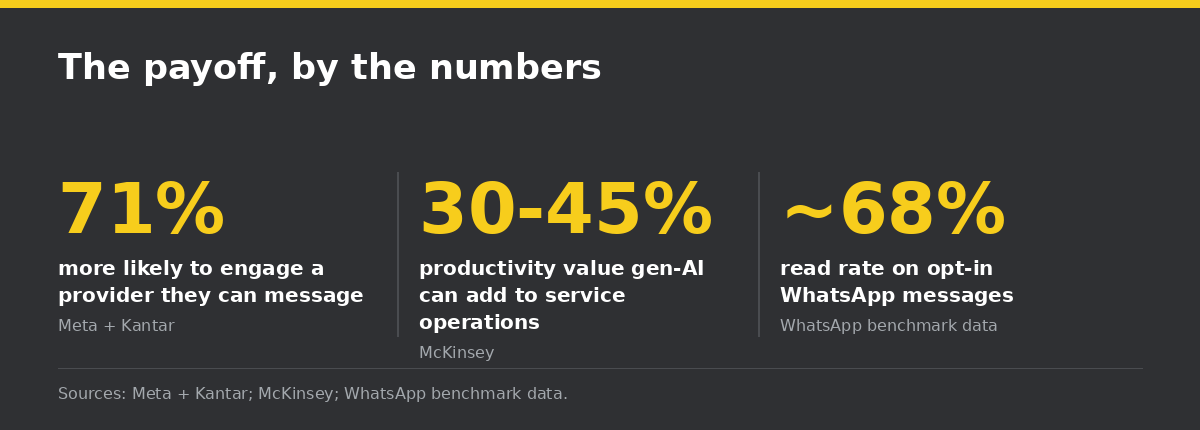
The payoff, by the numbers
Before the detail, here is why this is worth the team’s time:
The clinical work is fast and the delivery is slow, and the delivery is where the cost sits. Every unanswered call is staff time. Every patient who comes back to collect paper occupies a counter. Every delayed result delays the follow-up consultation that the result was ordered to inform.
Messaging is the obvious fix, and it is also where providers most often get it wrong. The instinct is to photograph the report and send it. That single decision converts an efficiency project into a data-protection incident waiting to be reported, because a laboratory report is health data attached to a named person, sitting in a consumer chat backup on a handset the clinic does not control.
There is a workflow that gets the speed without the exposure. It treats the message as a doorbell, not a delivery. This guide sets out how that works, how the realistic delivery models compare, and what patient messaging beyond SMS has to satisfy before a Hong Kong or Singapore provider turns it on.
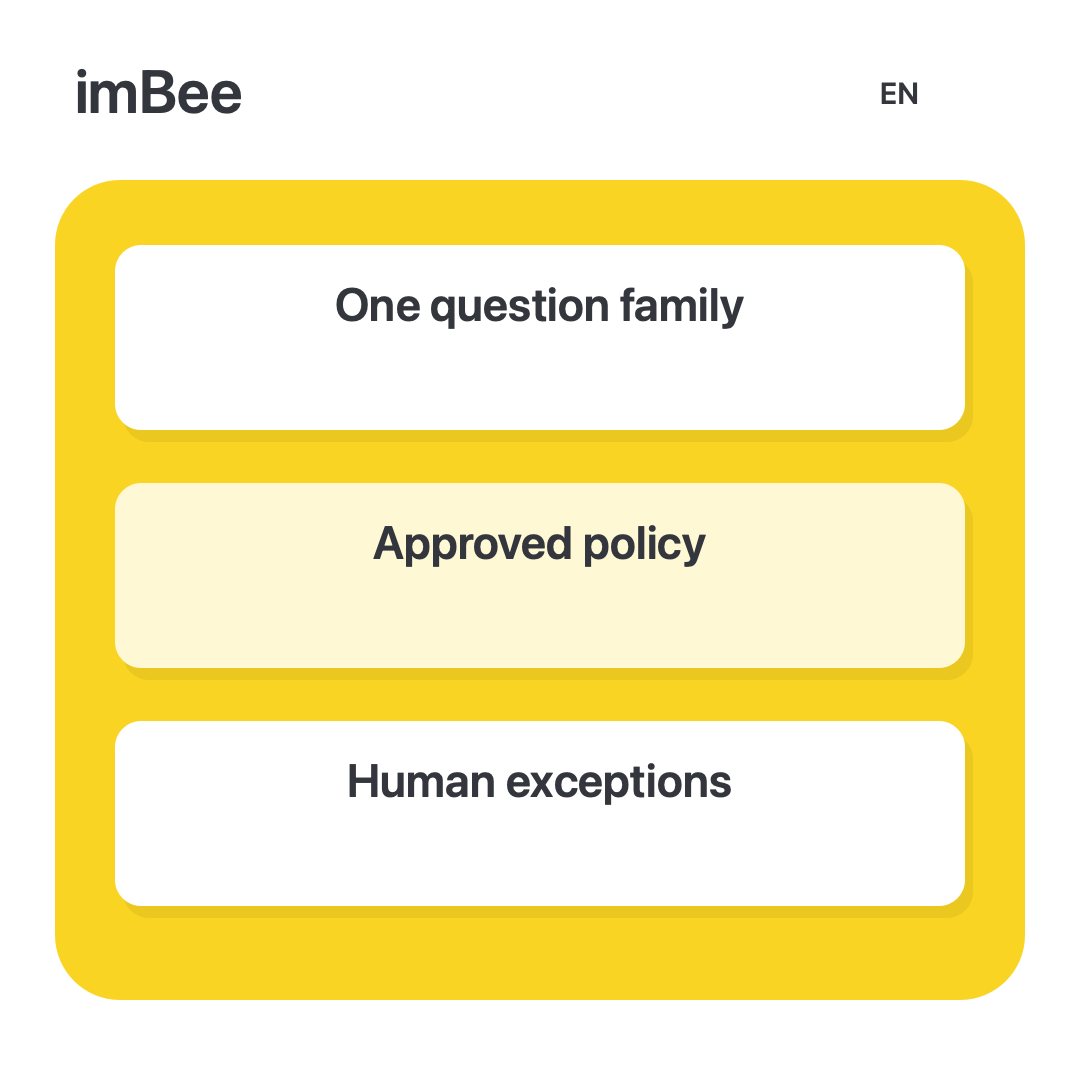
Providers who run this well do not send the result in the chat. They send a notification that a report exists, prove they are talking to the right person, and then release the content somewhere the provider still controls.
Notify, do not disclose. The outbound message says a report from a named service is ready and how to retrieve it. It does not carry the test name, the values, or anything that reveals a diagnosis to whoever is holding the phone. A message preview on a lock screen is visible to anyone in the room.

Verify the person, not the number. Phone numbers are recycled, shared inside families, and left logged in on a spouse's tablet. A one-time passcode or an in-clinic identifier check is what turns a phone number into an identified patient. On the WhatsApp Business Platform this is what the Authentication template category exists for.
Release through a controlled surface. The report itself is retrieved from a patient portal, a secure link with an expiry, or a document sent only after the patient has authenticated in the same session. The provider keeps the ability to revoke access; a photograph in a chat backup cannot be recalled.
Keep the clinician in the loop for anything abnormal. Automation is appropriate for normal, expected, routine results. A finding that changes management, or that a patient should not read alone without context, belongs to a person who calls. Deciding that boundary in advance is a clinical governance decision, not a software setting.
Encryption is often invoked here and it is worth being precise. Messages are encrypted in transit, but a business platform by design stores and processes conversations at the business end. Encryption protects the wire. It does not mean nobody at your clinic, or your provider, can read the thread, and it does not remove your obligations as the party holding the data.
The comparison that matters is not which channel is most modern. It is which combination gets a result read quickly, proves who read it, and leaves the least residue on a device you do not manage.
| Model | How the patient gets the result | Strengths | Where it fails |
|---|---|---|---|
| Patient portal only | Logs in to retrieve the report | Strong access control, full audit trail, revocable | Low uptake; patients forget the login and call reception anyway |
| Email with attachment | Report arrives as a file | Familiar, handles long documents | Mailbox may be shared or work-owned; attachments get forwarded; delivery is unverified |
| SMS with the result in the text | Reads it in the message | Reaches any handset | Discloses health data to whoever holds the phone; no identity check; no recall |
| Messaging notification plus authenticated retrieval | Prompted in chat, authenticates, then retrieves | High read rate on opt-in, identity verified, content stays controlled | Requires opt-in and approved templates; needs a monitored reply loop |
The fourth row is the pattern that combines the reach of a consumer channel with the control of a portal. The notification arrives where the patient already reads messages, and the clinical content never leaves a surface the provider governs.

One category detail decides whether your templates get approved. A message telling a patient that a report they paid for is ready relates to an existing transaction, so it is written as a Utility template. A message inviting the same patient to book an unrelated wellness screening is Marketing, with different consent expectations. Providers who blur the two are the ones whose templates get rejected, and the rejection usually arrives in the middle of a rollout.
Cost behaves differently across these models too. Portal delivery is close to free per message and expensive in support calls. Messaging carries a per-conversation charge and cuts the support calls. If you are budgeting, the honest comparison is total cost including front-desk time, not the line item on the messaging invoice — the Hong Kong pricing breakdown sets out how conversations are charged.
Evaluate against your own release policy rather than a vendor feature grid. These are the questions that decide whether a workflow survives its first audit.
Can you prove who received the notification? Delivery to a number is not receipt by a patient. Look for a verification step that is recorded, with a timestamp you can produce later.
Can you hold results back by type? Some panels should never auto-release. The system needs a rule that routes defined result types to a clinician queue instead of the patient, without depending on someone remembering.
Does the message contain no clinical content by construction? If the template can be edited by any user to include values, it will be. Lock the template so the safe behaviour is the default behaviour.
Is there a monitored reply path? Patients reply to result notifications with questions. An unanswered clinical question is a bigger risk than a slow result. Route replies to a named team with a stated response window.
Are access and retention controlled per user? Named accounts, role-based permissions, and a retention period applied automatically — not a shared login and an inbox that grows forever.
Does it work in the languages your patients use? In Hong Kong that generally means Traditional Chinese and English handled in the same workflow, with both template versions approved before launch, not after a complaint.
A result notification reveals that a named individual is a patient of a named service. That is sensitive on its own, before any values are disclosed. Both Hong Kong and Singapore treat it accordingly.
In Hong Kong, the Personal Data (Privacy) Ordinance (Cap. 486) sets six data protection principles covering collection, accuracy and retention, use, security, transparency and access. Telling a patient that the test they requested is ready is a use directly related to the purpose of collection. Using the same contact list to promote a health package is direct marketing, and the Ordinance imposes specific notification and consent requirements before personal data may be used that way, with an opt-out that must be honoured.
In Singapore, the Personal Data Protection Act requires consent, limits use to notified purposes, and imposes protection and retention-limitation obligations. Marketing messages to Singapore telephone numbers attract further checks under the Do Not Call provisions, while a transactional notice about a test the patient ordered sits in a different category. Where consent has been given clearly and is evidenced in an accessible form, the position is considerably simpler — which is an argument for capturing consent properly at the point of booking rather than reconstructing it later.
| What an auditor asks | What you need to be able to produce |
|---|---|
| Did the patient agree to this channel? | A timestamped consent record naming the channel and the purpose |
| Was health data disclosed in the message body? | A locked template showing the notification carries no clinical content |
| How was identity verified before release? | The authentication step and its log for that release event |
| Who inside the organisation could see the thread? | Named user accounts with role-based permissions and access logs |
| How long is the conversation kept? | A documented retention period applied automatically, not manually |
| Can a patient obtain or correct their data? | A defined access and correction process with an owner |
imBee's platform provides named-user access control, role-based permissions, retention settings and audit logging, and operates an information-security programme certified to ISO/IEC 27001. The provider remains the data user under the Ordinance and sets its own release policy; no platform discharges that duty on your behalf. imBee is an Official Meta Technology Partner, which governs how messages are sent, not who is accountable for them.
Start narrow and make the clinical decisions before the technical ones. The order below front-loads the two things that stall rollouts: which results may auto-release, and who answers when a patient asks what the number means.
Agree the release policy first. With clinical leadership, list which result types may be notified automatically and which must route to a clinician. Write it down and configure the system to match. This is the step that cannot be delegated to whoever configures the templates.
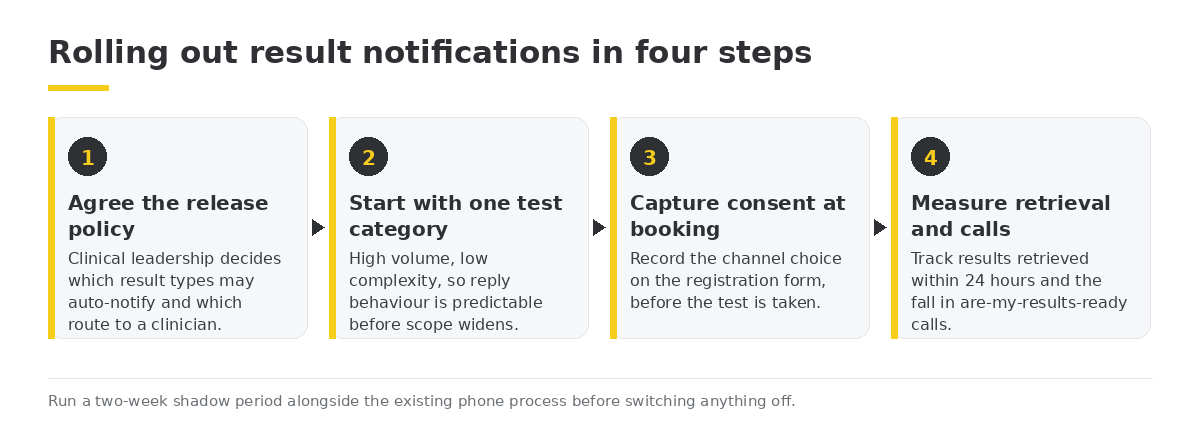
Pick one test category to start. A high-volume, low-complexity routine panel gives you a clean read on reply volume and patient behaviour before the scope widens.
Capture consent at booking, not at result time. Add the channel choice to the booking or registration form so consent is recorded before the test happens. Retro-fitting consent to a legacy contact list is slow and rarely complete.
Staff the reply loop and publish the window. Say in the notification when a human replies. A patient who reads a result notification at 22:00 will ask a question; a stated response time is reassuring, silence is not.
Run a two-week shadow period. Send notifications while keeping the existing phone process running. Compare how many patients retrieved the report unaided against how many still called. That number tells you whether the workflow is ready to replace the calls or merely to supplement them.
Measure retrieval, not delivery. The metric is the proportion of results retrieved by the patient within 24 hours and the drop in inbound calls asking whether results are ready. Messages delivered tells you nothing about whether the loop closed.
Result notification is a strong fix for a specific bottleneck. It is regularly bought to solve problems that sit somewhere else entirely, and those projects disappoint at the first review.
It does not shorten laboratory turnaround. If the analyser, the courier or the reporting clinician is the constraint, faster notification simply tells patients sooner that they are still waiting. Measure where the days actually go before buying anything.
It does not substitute for a conversation about an abnormal finding. A result that changes management needs a clinician, a call and time. Automating that boundary badly is the one failure mode in this workflow with genuine clinical consequences.
It does not fix a records system that cannot say which report belongs to which visit. If the laboratory information system and the patient record do not reconcile cleanly, automated notification will surface that mismatch at scale, in front of patients.
It does not create consent you never captured. A large legacy contact list collected for phone calls is not a messaging list. The cheapest route to reach is better consent capture at registration, not a broader send.
It is not an emergency channel. Say so explicitly in the template and in the clinic's patient information. A patient who feels unwell should not be waiting on a chat reply, and the message should tell them where to go instead.
| Symptom | Likely cause | Where the fix sits |
|---|---|---|
| Patients still call to ask if results are ready | Notification sent but retrieval step too hard | Authentication and retrieval UX |
| Templates rejected during rollout | Marketing content inside a Utility template | Template category and wording |
| Staff pasting values into the chat | Template not locked, no release policy | Governance and configuration |
| Results notified to the wrong person | Number verified, identity never verified | Add an authentication step |
| Reply backlog after go-live | Reply owner never assigned | Staffing, not software |
| No improvement in turnaround | Constraint is in the laboratory, not delivery | Process, not messaging |
Setting these limits out in advance keeps the business case defensible. The measurable win is the front-desk time recovered and the follow-up consultations that happen sooner because the patient knew, on the day, that a report was waiting.
Can you send lab results on WhatsApp?
You can use WhatsApp to tell a patient that a report is ready, but the safe and defensible pattern is not to put the clinical content in the chat. Send an approved Utility template as a notification, verify the patient's identity, then release the report through a portal or an expiring secure link the provider still controls.
Is sending a lab report by WhatsApp legal in Hong Kong?
Nothing in the Personal Data (Privacy) Ordinance (Cap. 486) bans a channel outright. What the Ordinance requires is that the use matches the purpose the data was collected for, that the data is protected against unauthorised access, and that retention is limited. Putting health values into a consumer chat backup you cannot recall is very hard to defend against those principles.
What template category applies to a result notification?
A message telling a patient that a test they ordered is ready relates to an existing transaction, so it is submitted as a Utility template. One-time passcodes used to verify identity fall under the Authentication category. An invitation to book an unrelated screening is Marketing, with different consent expectations and different pricing.
How do you verify that the right patient is reading the result?
Treat the phone number as a routing address, not an identity. Add a verification step before release: a one-time passcode sent as an Authentication template, or a check against an identifier the patient supplied in clinic. Log the verification event so you can show later who authenticated and when.
Should abnormal results ever be sent automatically?
No. Decide with clinical leadership which result types may auto-notify and which must route to a clinician queue, then configure the system so that routing happens without anyone having to remember. A finding that changes management needs a conversation, and automating that boundary badly is the one failure mode with genuine clinical consequences.
What does the PDPA require for patient result notifications in Singapore?
The Personal Data Protection Act requires consent, limits use to the purposes notified to the patient, and imposes protection and retention-limitation obligations. A notice about a test the patient ordered is transactional. Promotional messages to Singapore telephone numbers attract further checks under the Do Not Call provisions, so keep the two message types clearly separate.
How long should result notification conversations be retained?
There is no single answer, because it depends on your own retention policy and any professional record-keeping expectations that apply to your service. What both jurisdictions expect is a defined period that is documented and applied automatically, rather than conversations accumulating in an inbox indefinitely because nobody set a rule.
Does encryption make WhatsApp safe for health data?
Encryption protects the message in transit. It does not change the fact that a business platform stores and processes the conversation at the business end, that a chat backup sits on a handset you do not manage, or that anyone holding the phone can read a preview. Encryption is a control, not a compliance answer.

Kelly S.
Content Team Lead, imBee
Kelly S. owns content strategy, product positioning, and customer education at imBee. Previously, Kelly led B2B SaaS content programs and supported go-to-market initiatives for customer engagement products. On the imBee blog, Kelly covers conversational commerce, omnichannel messaging, WhatsApp Business, customer experience, and strategies for scaling business communications.
Questions about anything in this article? Talk to our team.
Discuss your channels, team and conversation handover needs in a product demo.