Why Client Messaging Became a Supervision Problem, Not an IT Problem
What Compliant WhatsApp Messaging Actually Means for a Licensed Firm
Personal WhatsApp, the Business App, or the Business Platform?
What to Look For When Choosing a Platform for a Licensed Firm
Records, Consent and Supervision: The Hong Kong Obligations Behind the Decision
Migrating a Client Book Without Damaging the Relationship
What a Messaging Platform Cannot Fix
A client messages her advisor at 21:40: markets look ugly, should she move the bond allocation? He answers from his own handset, in a thread that also holds his football group and a photo of his daughter. The advice is given, the client is reassured, and no part of that exchange exists anywhere the firm can see.
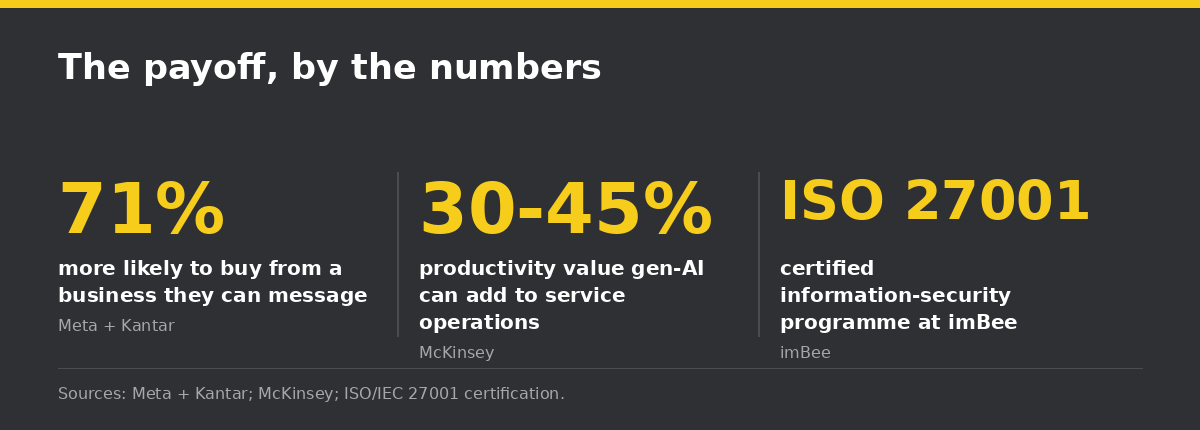
The payoff, by the numbers
Before the detail, here is why this is worth the team’s time:
Multiply it across a floor of advisors in Central and the exposure becomes structural rather than personal. Three things are happening at once. The firm cannot supervise advice it cannot read. The firm cannot produce a record it never held. And the client relationship sits inside a private phone book, so when the advisor resigns, the book walks out with the handset.
The pressure is not coming from compliance alone. Clients in Hong Kong and Singapore have decided how they want to be reached, and it is not a switchboard. A private-banking client will not sit through an IVR menu to ask whether a subscription cut-off has passed. She will send a message, and she expects an answer in the same thread.
So the realistic question for a licensed firm is not whether advisors use WhatsApp. They already do. It is whether those conversations run through a number the firm owns, on a platform that logs, supervises and retains them, or through fifty personal handsets nobody can see. This guide sets out the difference, the obligations that sit behind it in Hong Kong, and a migration sequence that does not damage the client relationship on the way.
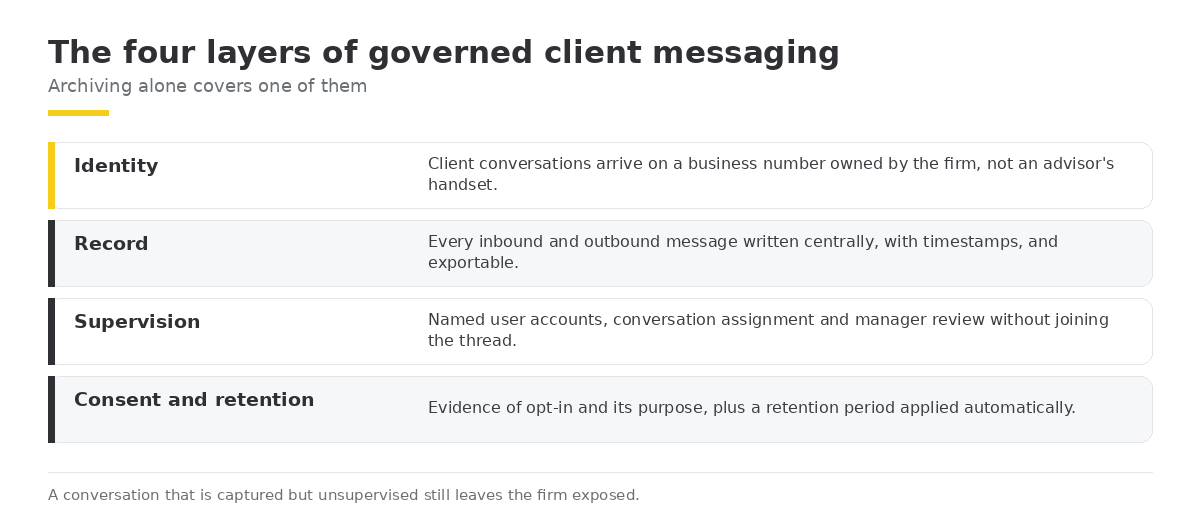
Compliance teams often frame this as a single control: archive the messages. Archiving on its own solves the evidence problem and none of the others. A conversation that is captured but unsupervised, or supervised but attached to a personal number, still leaves the firm exposed on continuity and on data protection.
Four layers have to hold together. Identity means client conversations arrive on a business number registered to the firm, not to an individual. Record means every inbound and outbound message is written to a system of record the firm controls, in a form that can be exported. Supervision means named user accounts, assignment of conversations to advisors, and the ability for a manager to review. Consent and retention means the firm can show why it holds a client's number, on what basis it messages them, and how long the thread is kept.
Only the WhatsApp Business Platform makes all four possible at the same time. It is the interface Meta provides for businesses that need a single verified number served by a team, with messages flowing through a system rather than a device. imBee is an Official Meta Technology Partner and provisions that platform for enterprise clients across Hong Kong and Singapore.
| Layer | What good looks like | Common shortcut that fails |
|---|---|---|
| Identity | One verified business number owned by the firm | Advisors use personal numbers with a business signature |
| Record | Every message written centrally and exportable | Screenshots kept in a folder by the advisor |
| Supervision | Named accounts, assignment, manager review | A shared login used by the whole desk |
| Consent | Timestamped opt-in with the purpose recorded | A tick box on a form nobody can produce later |
| Retention | A defined period applied automatically | Threads kept forever because nobody set a rule |
Read the table as a diagnostic rather than a shopping list. If your firm can answer the middle column for all five rows today, messaging is already governed. If two or more rows sit in the right-hand column, the gap is not a tooling gap — it is a policy gap that tooling can then enforce.
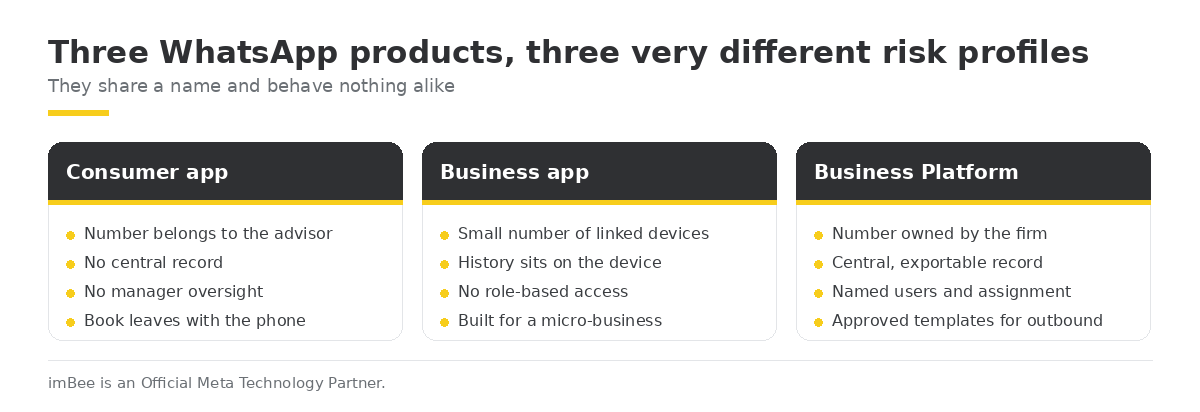
Most firms discover the distinction late, usually when someone asks for a message history that cannot be produced. The consumer app and the WhatsApp Business app are built for individuals and very small businesses. The WhatsApp Business Platform is the only one designed for a supervised team.
| Consumer WhatsApp | WhatsApp Business app | WhatsApp Business Platform | |
|---|---|---|---|
| Who the number belongs to | The individual | Usually the individual | The firm |
| Team access | One person | A small number of linked devices | Unlimited named users with roles |
| Central message record | None | On the device | In the firm's system, exportable |
| Manager oversight | Not possible | Not practical | Assignment and review built in |
| Outbound to a cold thread | Free-form | Free-form | Approved template required |
| Continuity when staff leave | Book leaves on the phone | Book leaves on the phone | Conversations stay with the firm |
The last row is the one that changes procurement conversations. Every other difference is a control question; that one is a commercial question, and it is usually what moves the decision from compliance to the management committee.
On the Business Platform, outbound messages to a client who has not written to you recently must use an approved template, and templates are categorised — Utility for messages tied to an existing transaction, Marketing for anything promotional, Authentication for codes. Once a client replies, a 24-hour customer service window opens in which the advisor can respond in free form. Meta has also changed how these messages are priced, most recently with adjustments effective 1 October 2026, so check the current rate card before you model cost. Firms serving banks and brokerages will find the same structure discussed in our guides to WhatsApp for banks in APAC and SFC record-keeping for brokerages.
Run every shortlisted product through the same set of questions, in the same order, and record the answers. The order matters: an excellent inbox that cannot export a thread is a worse purchase than a plain one that can.
Can you export a complete conversation, with timestamps, on demand? Ask for a live demonstration rather than a data-sheet line. Export should include attachments and the identity of the sending user, not just message text.
Is access controlled per named user, with roles? Shared logins make it impossible to say who read a client's information, which is the first question asked in any access review.
Can a manager see and review conversations without joining them? Supervision that requires the manager to insert themselves into the thread is not supervision; it is interruption.
Does it record consent as evidence rather than a setting? You need to show when the client agreed to be messaged and through which route, especially where direct marketing is involved.
Can retention be set and applied automatically? A period nobody enforces is a policy on paper. It should apply itself and be documented.
Does it hold a recognised information-security certification? Ask for the ISO/IEC 27001 certificate and, more importantly, the scope statement — certification that excludes the messaging product tells you nothing. imBee runs an ISO/IEC 27001-certified information-security programme; our certification checklist for customer messaging sets out what to ask for.
Does it work in the languages your clients use? In Hong Kong that means Traditional Chinese and English handled in the same workflow, by the same team, without a separate tool.
A message from an advisor to a client can be two things simultaneously: a record of a regulated activity, and personal data. The obligations come from different places and neither substitutes for the other.
On the regulated-activity side, licensed corporations answering to the Securities and Futures Commission are expected to keep records of client instructions and of the advice given, and to be able to produce them. The medium does not change that expectation — an instruction received by message is still an instruction. Firms whose staff are registered institutions also sit inside the Hong Kong Monetary Authority's supervisory expectations, and insurance intermediaries answer to the Insurance Authority. imBee holds no relationship with any of these bodies; the point is that the platform must let a firm meet obligations it already carries.
On the data-protection side, the Personal Data (Privacy) Ordinance (Cap. 486) sets out six data protection principles covering collection, accuracy, retention, use, security and access. Using a client's number to service an account they hold is a use directly related to the purpose of collection. Using the same list to promote an unrelated product is direct marketing, and the Ordinance imposes specific requirements there, including the client's ability to opt out at any time.
| Question you will be asked | What the firm needs to be able to show |
|---|---|
| Where is the instruction behind this trade? | The message thread, exported with timestamps |
| Who gave this advice, and when? | A named user account attached to every outbound message |
| Was the client's consent obtained? | A timestamped record of opt-in and the route it came through |
| Was this message service or marketing? | Template category and content tied to the client relationship |
| Who inside the firm could read this? | Role-based permissions and an access log |
| How long is it kept? | A documented retention period, applied automatically |
The pattern across both rule sets is the same: the firm is not asked to be perfect, it is asked to be able to explain itself with evidence. That is a systems property, not a training issue. No amount of advisor briefing produces an exportable record from a personal handset.
The failure mode is predictable. A firm announces that advisors must stop using their own numbers, gives a deadline, and provides no path for the client. Clients keep messaging the old number, advisors keep answering, and the policy quietly dies. The sequence below moves the client rather than instructing the advisor.
Start with one desk, not the whole floor. Pick a team with a manageable client count and a manager willing to sponsor it. You need a clean read on message volume per advisor before you size the rollout.
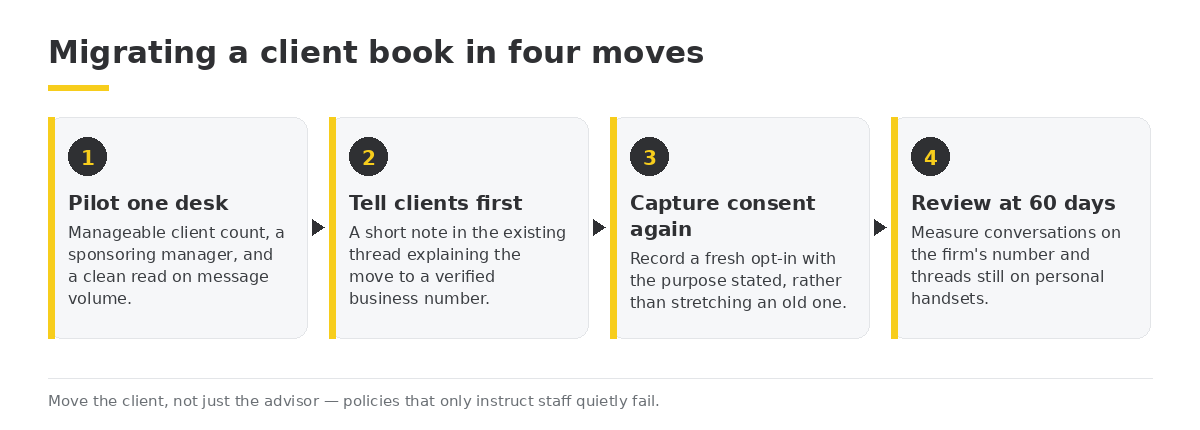
Tell clients before you switch. A short note from the advisor, in the existing thread, explaining that the firm is moving to a verified business number and why, converts a disruption into a service improvement. Clients understand record-keeping; they resent silence.
Capture consent as you migrate. Existing numbers were often collected for calls or statements, not messaging. Treat the migration as the moment to record a clear opt-in, with the purpose stated, rather than assuming the old consent stretches.
Set the advice boundary explicitly. Decide what may be said in a message and what must move to a call or a documented meeting. Write it down before launch, because advisors will otherwise decide individually, at speed, under client pressure.
Agree the out-of-hours expectation. Clients message at 22:00. If the desk answers from 09:00, say so in the automated response and give an alternative route for anything urgent. Silence reads as indifference.
Measure the right thing at review. Not messages sent. The metrics that matter are the proportion of client conversations now on the firm's number, response time within business hours, and how many threads still run through personal handsets after 60 days.
A governed messaging platform solves visibility, continuity and evidence. It does not solve the reasons those gaps opened, and it is worth being blunt about the limits before a procurement cycle starts.
It does not decide what advice may be given by message. That is a policy the firm writes. The platform can enforce templates and record what was sent, but it cannot tell you whether a suitability discussion belongs in a chat thread.
It does not stop an advisor using a second phone. Technology narrows the incentive; it does not remove the option. The firms that succeed make the business number obviously easier — faster client responses, shared history, no personal number exposed — so the workaround stops being attractive.
It does not create consent you never captured. If a client's number was collected for statements, a marketing broadcast to that number is a problem no platform setting fixes. Consent has to be gathered, at a point where the client understands what they are agreeing to.
It does not replace supervision by a human. Logging every message is not the same as anyone reading them. Firms that treat the archive as the control end up with a searchable record of a problem nobody noticed at the time.
| Symptom after go-live | Likely cause | Where the fix sits |
|---|---|---|
| Clients still message the old number | No migration notice was sent to clients | Client communication, not tooling |
| Advisors avoid the platform | It is slower than their handset | Workflow design and templates |
| Archive full, nobody reviews it | Supervision was never assigned | Management routine |
| Marketing broadcasts draw complaints | Consent captured for service, used for promotion | Consent capture at onboarding |
| Export requested, takes days | No self-serve export in the platform | Vendor selection criteria |
Set these limits out honestly in the business case. A messaging platform is a strong answer to a specific and expensive problem: client conversations the firm cannot see, cannot produce, and does not own. It is not a substitute for a supervision routine, and it will not write your advice policy for you.
Can financial advisors in Hong Kong use WhatsApp with clients?
Yes. Nothing prohibits messaging clients on WhatsApp, but a licensed firm needs the conversation to be recorded, supervised and retained. That is only practical on the WhatsApp Business Platform, where the number belongs to the firm and every message is written to a system the firm controls, rather than to an advisor's personal handset.
What is the difference between the WhatsApp Business app and the Business Platform?
The Business app is built for a very small business: one number, a handful of linked devices, and history stored on the device. The Business Platform gives the firm a verified number served by unlimited named users, with roles, conversation assignment, a central exportable record and approved templates for outbound messages.
Do we need to archive WhatsApp messages for SFC purposes?
Licensed corporations are expected to keep records of client instructions and advice and to produce them on request, regardless of the medium used. An instruction received by message is still an instruction. Firms should confirm the exact record and retention requirements that apply to their licence with their own compliance advisers.
Does the PDPO allow us to message clients on WhatsApp?
The Personal Data (Privacy) Ordinance (Cap. 486) governs how you may use a client's contact details, not which app you choose. Servicing an account the client holds is normally a use directly related to the purpose of collection. Promotional content is direct marketing and carries additional requirements, including a clear route to opt out.
What happens to client conversations when an advisor resigns?
On a personal handset, the history and often the relationship leave with the phone. On the Business Platform the conversations sit in the firm's system, so the incoming advisor picks up the thread with full context and the client experiences a handover rather than a restart. This continuity argument usually carries more weight internally than the compliance one.
What is a WhatsApp template and when do we need one?
A template is a pre-approved message used to open a conversation with someone who has not messaged you recently. Templates are categorised as Utility, Marketing or Authentication. Once the client replies, a 24-hour customer service window opens in which the advisor can answer in free form without a template.
Can a compliance manager review advisor conversations?
On a properly configured platform, yes — a manager can read and search conversations under a named account without joining the thread or being visible to the client. That is a core reason to move off personal numbers, where review is impossible without asking the advisor to hand over a device.
How long should client message threads be retained?
There is no universal answer; it depends on the firm's licence conditions, its own record-keeping policy and any obligations attached to the products it sells. What matters is that a period is defined, documented and applied automatically, rather than threads accumulating indefinitely because nobody set a rule.

Kelly S.
Content Team Lead, imBee
Kelly S. owns content strategy, product positioning, and customer education at imBee. Previously, Kelly led B2B SaaS content programs and supported go-to-market initiatives for customer engagement products. On the imBee blog, Kelly covers conversational commerce, omnichannel messaging, WhatsApp Business, customer experience, and strategies for scaling business communications.
Questions about anything in this article? Talk to our team.

Start your 30-day free trial today. Supercharge your team's productivity by over 30% and take your business to new heights of success.