The Account Opening Pack That Lives on a Relationship Manager's Phone
What Client Document Collection on WhatsApp Actually Involves
Three Ways Brokerages Collect Client Documents by Chat
What a Supervisable Collection Channel Needs
The Regulatory Environment: Record-Keeping, AML and Privacy
Migrating Onboarding to a Firm-Operated Channel
What Chat-Based Collection Cannot Do
A Sheung Wan brokerage onboards perhaps forty new clients a month. The account opening pack is well designed and the compliance checklist is thorough. But the documents rarely arrive the way the process assumes. They arrive as photographs, sent at night, to whichever relationship manager the client happens to have a number for.
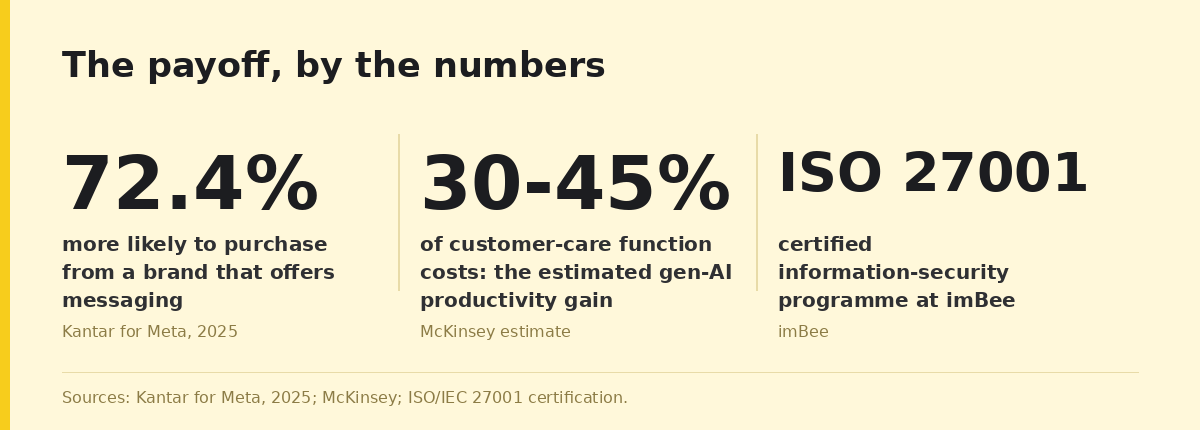
The payoff, by the numbers
Before the detail, here is why this is worth the team’s time:
What follows is the part nobody writes down. The RM downloads the images, emails them to himself, uploads them to the shared drive, and deletes the originals — or does not. The identity document now exists on a personal handset, in a personal mailbox, and in the firm's file. The firm can account for one of those three.
This is the practical problem behind client document collection on WhatsApp. Clients will not stop using messaging, and telling relationship managers not to accept documents there has never worked in any market. The question is whether the channel is one the firm operates, supervises and can produce records from, or one that happens on private devices outside the firm's control.
For a licensed corporation, that distinction is not a preference. It is the difference between a supervisable communication channel and an unrecorded one.
Account opening for a Hong Kong brokerage typically requires proof of identity, proof of residential address, bank account evidence, tax residency declarations, and a completed risk profile or suitability questionnaire. Some of that is a document; some of it is structured data the client must supply.
A messaging channel that genuinely supports this has to do five things, and only the first is about sending messages.
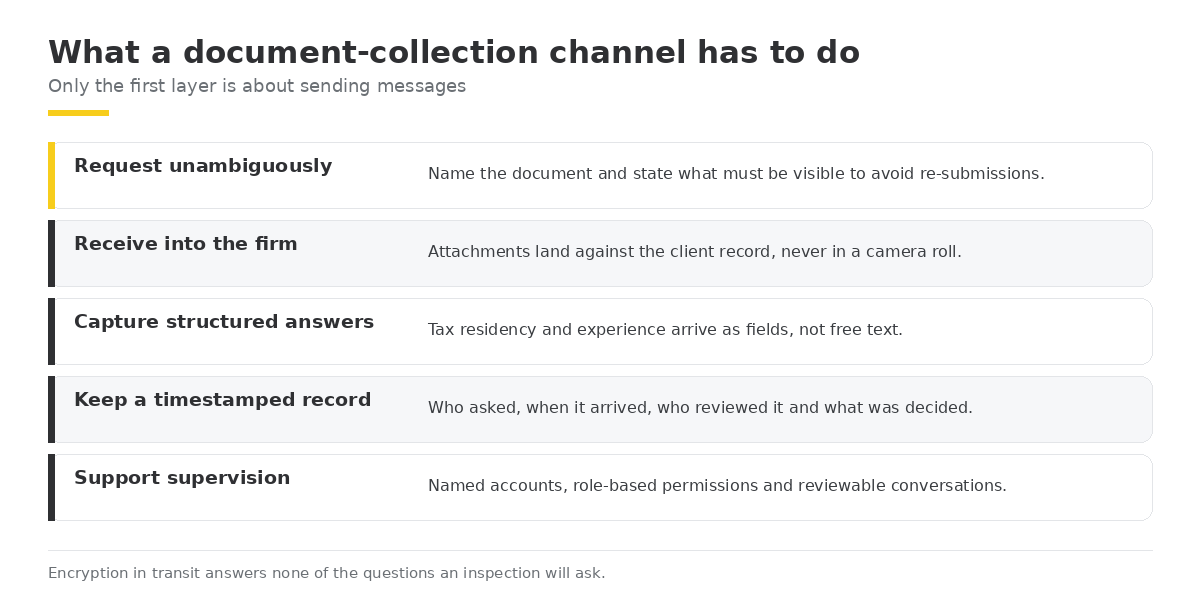
Request the right item, unambiguously. Most re-submissions happen because the client sent the wrong thing — a photo of a card instead of a statement, or an image cropped so the address is missing. A structured request that names the document and states what must be visible removes most of that loop.
Receive the file into the firm, not the device. The attachment must land in a system the firm controls, tied to the client record, without passing through anyone's camera roll.
Capture structured answers as data. Tax residency, employment status and investment experience are form fields, not free text. WhatsApp Flows and interactive messages let those be answered inside the chat and arrive as structured values rather than sentences a junior has to interpret.
Keep a complete, timestamped record. Who asked for what, when it arrived, who reviewed it, and what was decided. A screenshot pasted into a folder is not that.
Support supervision. Named user accounts, permissions by role, and the ability to review conversations — because a channel nobody can review is a channel the firm cannot supervise.
Worth stating plainly: WhatsApp messages are encrypted in transit, but once a message reaches the business, how it is stored and who can read it is entirely determined by the firm's own systems. Encryption in transit answers none of the questions a regulator or an auditor will actually ask.
Almost every firm is running one of these, often without having chosen it.
| Pattern | How it works | Record-keeping position | Client friction |
|---|---|---|---|
| RM's personal handset | Client messages an individual's own number | Records sit outside the firm; no supervision | Lowest — and that is why it persists |
| Secure link-out | Chat sends a link to an onboarding portal | Strong: documents land in the firm's system | Higher; drop-off at the hand-off |
| In-chat structured collection | Documents and form answers submitted inside a firm-operated chat | Strong, provided the platform retains and exports | Low; nothing leaves the thread |
| Hybrid | Chat for routine items, portal for signed instruments | Strong if both are firm-operated | Moderate and predictable |
The first row is the status quo at a surprising number of firms, and it is the one that fails an inspection. It is not fixed by a policy telling staff not to do it, because the client behaviour that causes it does not change. It is fixed by giving the client a firm-operated number that works exactly as conveniently.
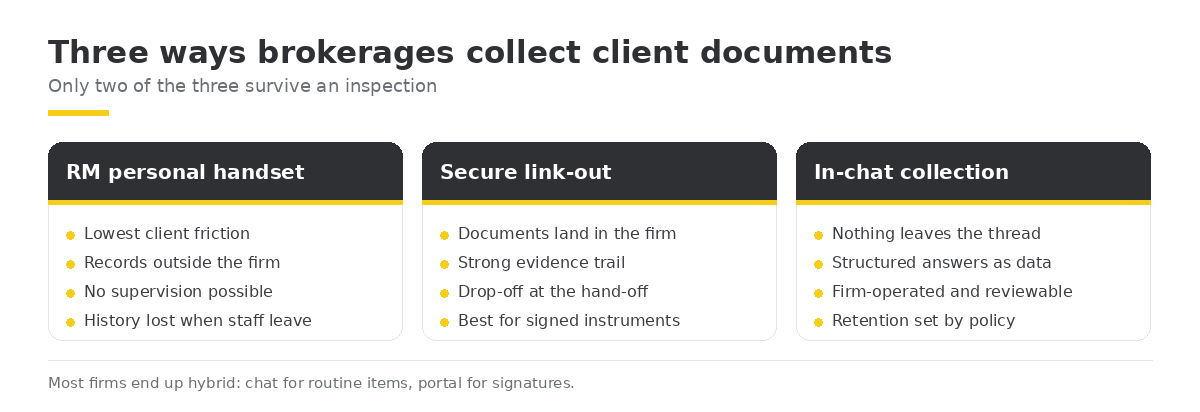
Between the two defensible options, the deciding factor is usually the instrument. Anything requiring a signature or a formal declaration generally belongs in a portal or an e-signature flow. Identity documents, address proofs and structured questionnaire answers are well suited to in-chat collection, where completion rates are materially better because the client never leaves the conversation.
For the record-keeping angle in more depth, see our guide to SFC record-keeping and WhatsApp for brokerages.
Use this as the evaluation list, and ask for each item to be demonstrated in a live environment rather than described in a deck.
Named user accounts. Every action attributable to an individual, with no shared logins and no personal devices holding client documents.
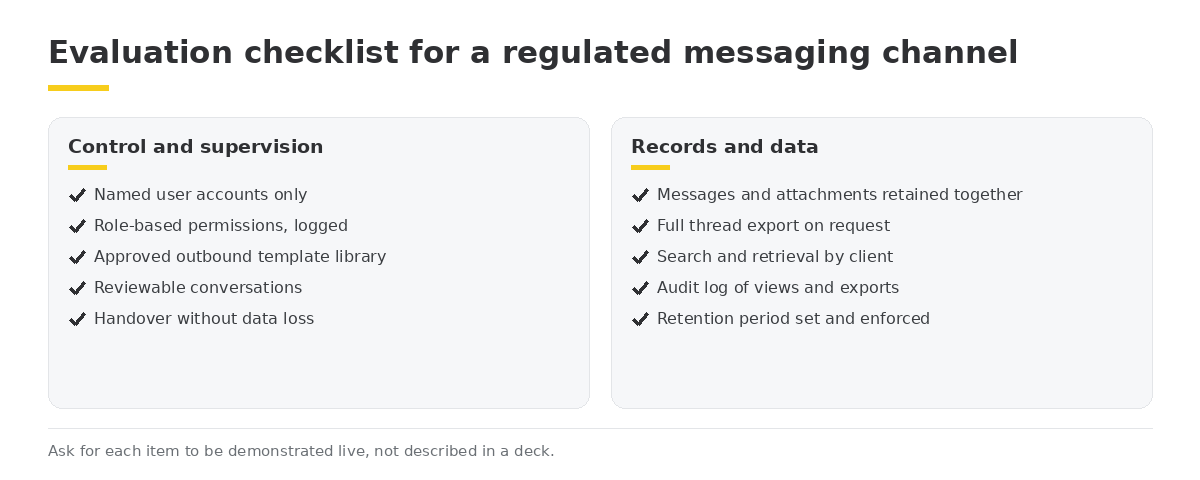
Role-based permissions. A dealing team member and a compliance reviewer should not have identical visibility, and access changes should be logged.
Complete conversation retention. Message content and attachments retained together for the period the firm's policy requires, with the ability to export a full thread on request.
Attachment handling inside the platform. Documents attached to the client record rather than downloaded to a laptop as an interim step.
Search and retrieval by client. If producing one client's complete communication history takes a week of manual work, the channel is not usable under time pressure.
Template control. Outbound request messages drawn from an approved library, so what is sent to clients is reviewable in advance.
Handover without loss. When an RM leaves, the conversation history and the client relationship stay with the firm.
Structured data capture. Questionnaire answers arriving as fields, not as sentences someone retypes.
Audit logging. Who viewed, exported or deleted what, and when.
Defined retention and deletion. A period set once and applied automatically, in both directions — nothing deleted early, nothing kept forever by accident.
A Hong Kong brokerage collecting onboarding documents by chat is operating inside three overlapping sets of duties, and a platform choice can support or undermine each of them.
The first is conduct and record-keeping. Licensed corporations answer to the Securities and Futures Commission under the Code of Conduct, and the expectation that client communications and instructions are properly recorded does not change because the medium is a messaging app. Where records sit with an external provider, they still need to remain readily accessible to the firm — check the SFC's current guidance on external electronic data storage before signing anything.
The second is anti-money laundering. The Anti-Money Laundering and Counter-Terrorist Financing Ordinance (Cap. 615) sets customer due diligence and record-keeping requirements, including minimum retention periods for CDD records. Confirm the current period in the Ordinance and set your platform's retention to match rather than to a vendor default.
The third is privacy. Identity documents are personal data under the Personal Data (Privacy) Ordinance (Cap. 486), and an HKID copy is about as sensitive as a routine commercial record gets. Collection must be necessary and proportionate, security adequate, and retention limited.
| Obligation area | What the channel must support |
|---|---|
| Conduct and supervision (SFC Code of Conduct) | Reviewable conversations, named accounts, approved templates |
| Record-keeping | Full thread and attachment retention, exportable on request |
| Customer due diligence (Cap. 615) | Documents tied to the client record, retained for the required period |
| Non-face-to-face onboarding | Evidence of how identity was verified, kept with the file |
| Personal data (Cap. 486) | Proportionate collection, access control, defined retention |
| Cross-border considerations | Knowing where data is stored and who can access it |
imBee is an Official Meta Technology Partner and runs an ISO/IEC 27001 certified information-security programme, with named-user access, role-based permissions, retention controls and audit logging built for firms answering to the SFC and to the HKMA. The licensed corporation remains responsible for its own compliance; a platform supports your obligations, it does not assume them.
Firms that succeed at this treat it as a change to how client relationships are held, not as a software rollout.
Start with new accounts only. Do not attempt to migrate live relationships in week one. New clients arriving on the firm number establishes the pattern without disturbing anyone.
Publish one number and put it everywhere. Website, account opening pack, email signatures, business cards. Fragmented entry points are the reason personal numbers persist.
Give RMs a better tool, not a restriction. Adoption follows convenience. If the firm channel has templates, client history and faster document handling, the personal handset loses on merit.
Define the escalation boundary. Written rules on what may be discussed in chat and what must move to a recorded call or a formal instruction. Order instructions in particular need an explicit position.
Test retrieval before you rely on it. Ask for one client's complete history as if a regulator had requested it. Do this in month one, not the first time it is asked for.
Review declined and re-requested documents. A high re-submission rate is a template problem, not a client problem. Fix the request wording and it falls quickly.
See also how financial services teams in Hong Kong and Singapore use WhatsApp. To map this against your own onboarding process, talk to the imBee team.
A firm-operated messaging channel improves collection, supervision and record-keeping. It does not remove judgement, and there are four things it cannot do.
It does not verify identity by itself. A clear photograph of a document is a document, not a verified identity. Verification remains a defined procedure using appropriate checks; the channel only determines how the material arrives.
It does not replace a signature where one is required. Formal instruments belong in an e-signature flow or a portal with the appropriate evidence trail.
It does not make an unsuitable client suitable. Faster onboarding produces faster arrival at the suitability assessment, which still has to be done properly.
It does not fix a poorly defined onboarding process. If the document list is ambiguous or the review steps are undocumented, digitising the collection produces ambiguity at higher speed.
| Symptom | Likely cause | Where the fix sits |
|---|---|---|
| Documents keep being re-requested | Request message does not state what must be visible | Template wording |
| Client history spread across devices | Relationships held on personal numbers | Firm-operated channel and one published number |
| Slow response to a records request | No search by client across the archive | Platform retrieval capability |
| Onboarding stalls at the questionnaire | Free-text answers reinterpreted by staff | Structured in-chat forms |
| Compliance cannot review conversations | No supervision view or named accounts | Access model, not messaging |
Read that way, chat-based document collection is a strong answer to a real and common failure: documents arriving through channels the firm does not control. It is not an identity verification product, and it should never be presented internally as one.
Can Hong Kong brokerages collect onboarding documents over WhatsApp?
Yes, provided the channel is operated by the firm rather than by an individual, and the documents, messages and attachments are retained in a system the firm can search and export. The medium is not the issue; supervision and record-keeping are. Documents arriving on a relationship manager's personal handset are the problem, not chat itself.
What is wrong with clients messaging an RM's personal number?
The firm cannot supervise, retain or produce those records, and the client documents sit on a personal device outside its control. When the relationship manager leaves, so does the history. A policy telling staff not to accept documents there rarely works, because it does not change what clients do.
Does WhatsApp encryption satisfy our data security obligations?
No. Messages are encrypted in transit, but once a message reaches the business, storage, access control and retention are determined entirely by the firm's own systems. Regulators and auditors ask who could read the document, where it was stored, how long it was kept and whether the access was logged.
What record-keeping rules apply to brokerage client communications?
Licensed corporations answer to the Securities and Futures Commission under the Code of Conduct, and the expectation that client communications are properly recorded applies regardless of medium. Where records sit with an external provider they must remain readily accessible to the firm — check the SFC's current guidance on external electronic data storage.
How long must customer due diligence records be kept in Hong Kong?
The Anti-Money Laundering and Counter-Terrorist Financing Ordinance (Cap. 615) sets minimum retention periods for customer due diligence and transaction records. Confirm the current period directly in the Ordinance and configure your platform's retention to match it, rather than accepting a vendor default that may be shorter.
Can a chat flow verify a client's identity?
No. A clear photograph of an identity document is a document, not a verified identity. Verification remains a defined procedure using appropriate checks and, where relevant, the approaches the SFC has set out for non-face-to-face account opening. The channel determines how the material arrives, not whether it is accepted.
Should signed documents be collected in chat?
Generally not. Instruments requiring a signature or a formal declaration belong in an e-signature flow or a portal that produces the appropriate evidence trail. Identity documents, address proofs and structured questionnaire answers are well suited to in-chat collection, where completion rates are higher because the client never leaves the conversation.
How do we move existing clients off personal numbers?
Start with new accounts only, publish one firm number across every touchpoint, and make the firm channel genuinely better to use — templates, client history and faster document handling. Adoption follows convenience. Attempting to migrate live relationships in the first week is how these projects stall.

Kelly S.
Content Team Lead, imBee
Kelly S. owns content strategy, product positioning, and customer education at imBee. Previously, Kelly led B2B SaaS content programs and supported go-to-market initiatives for customer engagement products. On the imBee blog, Kelly covers conversational commerce, omnichannel messaging, WhatsApp Business, customer experience, and strategies for scaling business communications.
Questions about anything in this article? Talk to our team.

Start your 30-day free trial today. Supercharge your team's productivity by over 30% and take your business to new heights of success.