

Why do appointment no-shows cost Hong Kong clinics so much?
Why is WhatsApp the best reminder channel for Hong Kong patients?
What does an effective WhatsApp appointment reminder workflow look like?
How do you write reminder templates that Meta approves and patients answer?
How do you keep patient reminders PDPO-compliant?
How much revenue can a Hong Kong clinic recover?
FAQ: WhatsApp appointment reminders in Hong Kong
A missed appointment looks like a fifteen-minute gap in the diary. It is actually a paid doctor, a paid nurse, a rented consultation room and a patient who may now deteriorate before anyone sees them. Across outpatient settings, published baselines put no-show rates at 15-30% of booked visits: a study in The American Journal of Medicine recorded a 23.1% no-show rate among patients who received no reminder at all, and rates above 30% are common in high-volume public systems.
Key takeaways from this guide:
Hong Kong sharpens the problem. Specialist out-patient queues at Hospital Authority clinics push patients toward private practice, where competition is dense and margins depend on a full diary. Every unfilled slot is an unbilled consultation - typically HK$300-800 in general practice and far more in specialist and dental clinics - plus the reception time spent chasing the patient afterwards.
The instinctive fix, more phone calls, is the most expensive one: each call consumes minutes of staff time, lands during working hours when patients cannot answer, and leaves no written record. The better fix is moving reminders to the channel Hong Kong patients already live in.
WhatsApp is not just popular in Hong Kong - it is the default. Statista's platform-usage data puts WhatsApp at roughly 75% usage among Hong Kong's online population, the highest of any messaging app, and country-level comparisons consistently rank it the territory's dominant messenger. Patients from teenagers to retirees check it daily; clinic reception desks already field booking requests on it informally.
For business-initiated messages that patients have opted into, WhatsApp benchmark data shows read rates around 68% - and unlike SMS, reading is measurable, replies are one tap away, and your clinic's name appears as a verified sender rather than an anonymous shortcode. Messages render natively in Traditional Chinese, carry maps and preparation instructions, and support quick-reply buttons that turn a passive reminder into a confirmed booking.
| Channel | Engagement | Two-way? | Cantonese-friendly | Staff time per reminder |
|---|---|---|---|---|
| WhatsApp utility message | ~68% read rate on opt-in messages (WhatsApp benchmark data) | One-tap Confirm / Reschedule buttons | Full Traditional Chinese support | None - automated |
| SMS | Delivery is high but reads are unverifiable; increasingly filtered as spam | Replies rare and clunky | Supported, with legacy encoding quirks | None - automated |
| Phone call | Depends on pickup; many patients screen unknown numbers | Yes, but one call at a time | Yes | 2-4 minutes per patient |
| Routinely buried or unopened for routine notices | Slow, low reply rates | Yes | None - automated |
The two-way property is what moves the revenue needle. A reminder a patient can act on converts intent into either a kept appointment or an early cancellation you can backfill. And because a patient's button tap opens a 24-hour customer-service window, your team can answer follow-up questions free of template charges - see how imBee handles this in smart session handling.
Effective reminder programmes are cadences, not single messages. The pattern that performs across clinics is three timed touches before the visit, an escalation path for silence, and a backfill loop for freed slots. A randomized study in The Permanente Journal found that adding reminder touches for high-risk bookings measurably reduced missed visits - the marginal message is cheap, the marginal empty slot is not.
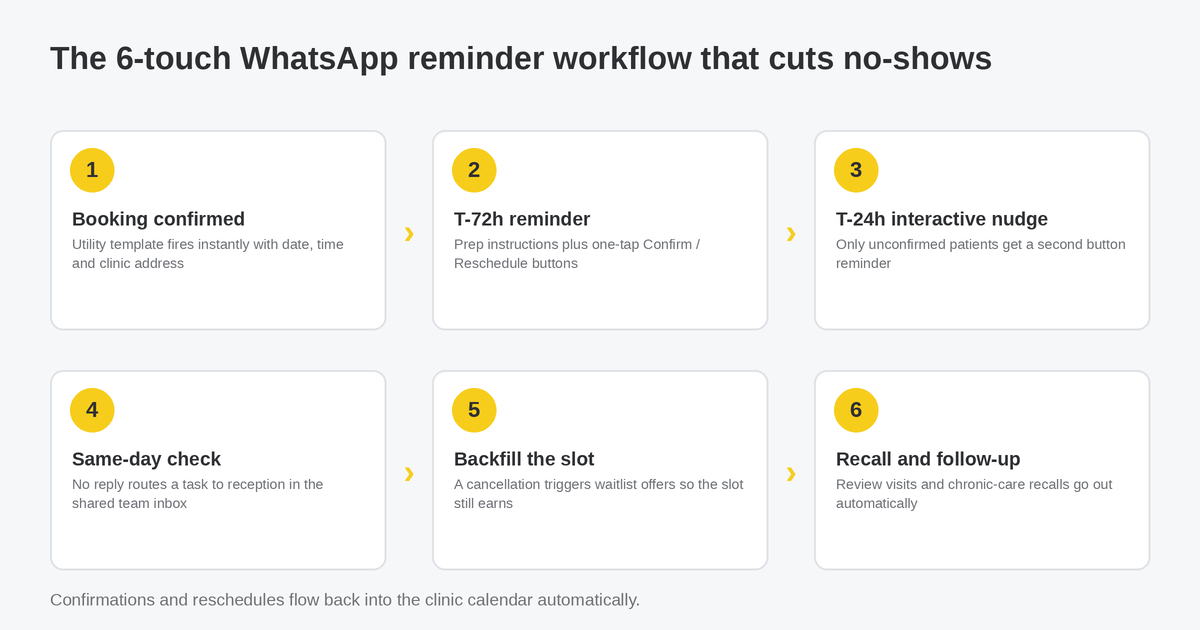
The escalation path matters as much as the reminders themselves. A patient who has not tapped Confirm by the morning of the appointment is a flight risk: route them into a task queue in your shared team inbox so reception calls a short list of five, not a blind list of sixty. A patient who taps Reschedule frees the slot immediately - your workflow can offer it to a waitlist automatically, which is how mature programmes turn even cancellations into billed visits.
Recalls extend the same machinery beyond the booked visit: chronic-disease reviews, vaccination schedules, dental cleanings and post-operative checks can all fire from simple date rules, keeping the diary full without reception lifting a finger. Campaign-level performance - delivery, reads, confirmations by template - is visible in broadcast analytics, so you can see which wording fills slots.
None of this requires staff to send anything manually. Booking events from your practice-management or EMR system trigger templates at the right offsets through an API, confirmations write back to the calendar, and only exceptions - the silent, the rescheduling, the anxious - ever reach a human.
Any message your clinic initiates outside an open service window must be a template that Meta has pre-approved - this is a platform rule, not a vendor choice. Templates are submitted per language under Meta's message-template system in one of three categories, and appointment reminders belong in UTILITY: they relate to an existing, agreed transaction. That classification matters commercially too, because under WhatsApp's per-message pricing, utility templates are billed at some of the platform's lowest rates - and patient replies inside the 24-hour service window are free to answer.
A working reminder template has four parts: a header that names your clinic, a body with variables for patient name, date and time, an optional footer for opt-out wording, and quick-reply buttons. Submit English and Cantonese versions separately - for example:
| Scenario | English template | Cantonese template |
|---|---|---|
| Booking confirmation | Hello {{1}}, your appointment at {{2}} is confirmed for {{3}} at {{4}}. Address: {{5}}. Reply STOP any time to opt out of reminders. | {{1}}您好!您已成功預約{{2}}的診期:{{3}}({{4}})。地址:{{5}}。如不欲再收取提示訊息,可隨時回覆「停止」。 |
| 24-hour reminder | Hi {{1}}, a reminder of your appointment at {{2}} tomorrow, {{3}} at {{4}}. Please arrive 10 minutes early with your ID card. Tap below to confirm or reschedule. | {{1}}您好!溫馨提示:您明天({{3}}){{4}}在{{2}}有預約。請提前10分鐘到達並攜帶身份證。請按下方按鈕確認或改期。 |
| Missed-visit rebooking | Hello {{1}}, we missed you at {{2}} today. Tap below to rebook - we still have slots this week. | {{1}}您好,您今天未能出席{{2}}的預約。本星期尚有時段,如欲重新預約,請按下方按鈕。 |
Pair each with quick-reply buttons - Confirm 確認 and Reschedule 改期 - so the patient's answer is a tap, not a typed sentence your team has to parse.
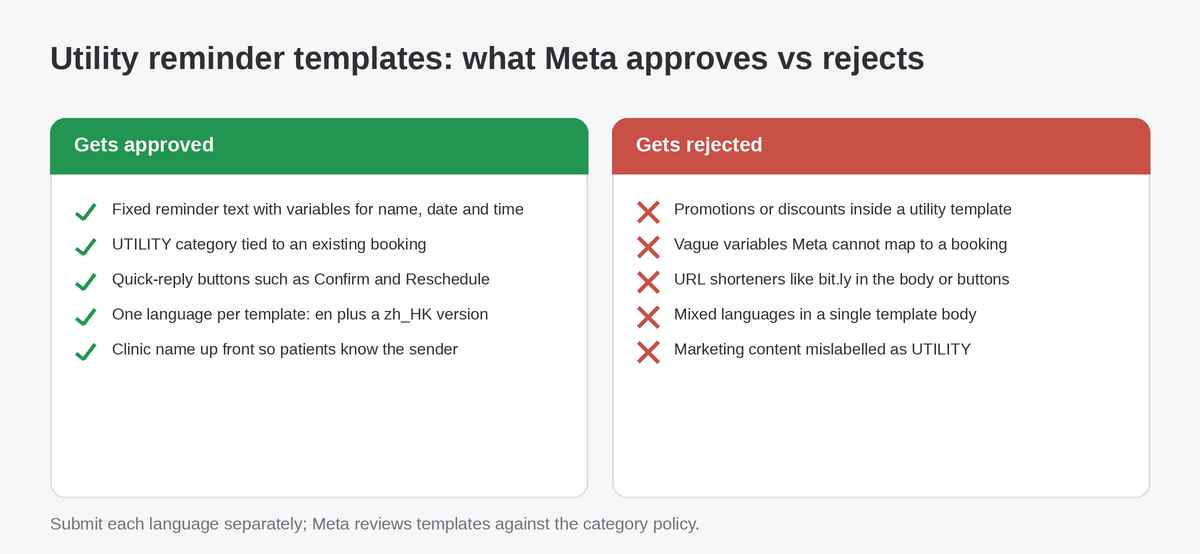
Approval is fast when templates stay transactional. The common rejection triggers are promotional wording inside a UTILITY submission, vague variables Meta cannot map to a booking, URL shorteners, and mixed languages in one body. Keep marketing in its own MARKETING-category templates, and review the WhatsApp Business Messaging Policy before submitting healthcare content.
Patient names, phone numbers and appointment details are personal data under the Personal Data (Privacy) Ordinance (Cap. 486), so your reminder programme has to satisfy the same rules as the rest of your practice. The good news: reminders fit naturally. Data Protection Principle 1 requires collecting data for a lawful purpose directly related to your function - delivering care - and DPP3 limits use to that purpose unless the patient consents to something new. Reminding a patient about the appointment they booked is squarely within the care purpose.
The line to respect is Part 6A of the Ordinance, the direct-marketing regime enforced by the Privacy Commissioner for Personal Data (PCPD). A reminder about an existing booking is a service message. An invitation to book a body check, a flu-jab promotion or a teeth-whitening offer is direct marketing - it needs the patient's separate, informed consent before the first message, and every subsequent message must honour an opt-out. Run the two flows on separate templates and separate consent records so one unsubscribe never silences the other.
Practical compliance for a clinic comes down to a short checklist: capture WhatsApp opt-in at registration with wording that names the reminder purpose; record consent per channel; honour a STOP keyword automatically; restrict who on the team can see patient conversations; keep an audit trail of every message; and set retention limits rather than hoarding chat history. Platforms built for institutions answering to the PCPD make this operational - imBee adds role-based access controls, audit logs and data-governance tooling on infrastructure certified to ISO/IEC 27001, the international information-security standard (see imBee's ISO/IEC 27001 certification).
One more habit worth keeping: send reminders from your verified business identity, never from staff members' personal WhatsApp accounts. Personal phones leak patient data outside your controls and outside your audit trail - the exact exposure the Ordinance exists to prevent.
Reminder economics are unusually easy to defend because both sides of the ledger are measurable. On the recovery side, the published range is consistent: the Cochrane review of mobile-phone reminders found text reminders significantly increase attendance, and reminder systems in clinic studies deliver 25-40% relative reductions in no-shows, with live confirmation channels at the top of the range. Take a deliberately ordinary example:
| Line | Illustrative value |
|---|---|
| Booked visits per month | 600 |
| Baseline no-show rate | 20% = 120 missed visits |
| Relative reduction from three-touch WhatsApp cadence | 35% = 42 visits recovered |
| Average consultation fee | HK$450 |
| Recovered revenue | HK$18,900 per month / ~HK$226,800 per year |
| Messaging cost (~1,800 utility messages) | A few hundred Hong Kong dollars |

The cost side barely registers: utility templates are billed per message at Meta's lowest commercial rates, replies inside the service window are free, and the platform subscription is a fraction of one recovered day of consultations. Swap in your own volumes - the arithmetic survives even pessimistic assumptions about your baseline.
imBee runs this whole loop for Hong Kong healthcare teams: an Omnichannel Inbox your reception staff share, Chatbot and Workflow automation that fires reminders from booking data, broadcast tooling with per-template analytics, and Cantonese-plus-English template management - as an Official Meta Technology Partner serving 10,000+ enterprises across 60+ industries. If you are choosing your setup, start with the app-vs-API-vs-platform comparison and the features that matter for business accounts, then book a demo to see a reminder workflow built on your own clinic's booking flow.
Clinics connect a dedicated phone number to the WhatsApp Business API through a platform such as imBee, submit utility message templates for Meta approval, and trigger them from booking data. Patients then receive confirmations, 72-hour reminders and same-day nudges with Confirm and Reschedule buttons, while staff handle replies in a shared inbox.
The free app suits a solo practitioner: one user, manual sends, no automation. Scheduled reminders, multiple receptionists, approved templates and clinic-system integration require the WhatsApp Business API - also called the WhatsApp Business Platform - accessed through a provider, since Meta offers no end-user interface for it.
No. A reminder about an existing booking is a service message, not an offer, so the Part 6A direct-marketing regime does not apply to it. Promoting health checks, vaccines or packages through the same channel is direct marketing, which requires separate consent and a working opt-out under the Ordinance.
Meta bills utility templates per message at some of its lowest rates, and replies inside the 24-hour customer-service window are free. A clinic sending three reminder touches across 600 monthly appointments typically spends a few hundred Hong Kong dollars - small against a single recovered consultation fee.
Yes. Templates are submitted per language - for example en and zh_HK - and approved independently. Your booking system stores each patient's language preference and triggers the matching version automatically, so an elderly Cantonese-speaking patient and an expatriate patient each read the reminder comfortably in their own language.
Published studies report 25-40% relative reductions from reminder systems, with live and interactive confirmation channels at the top of the range. Results depend on your baseline: a clinic missing 20% of bookings has far more to recover than one missing 8%, and two-way reminders outperform one-way blasts.
Yes. Platforms such as imBee expose APIs and workflow automation that read bookings from practice-management or EMR systems and fire templates at the right offsets. Confirmations and reschedules write back to the calendar, and unanswered reminders create follow-up tasks for reception staff to action.
Treat silence as risk. Route unconfirmed appointments into a same-day task queue so reception calls a short list rather than everyone. Many clinics also release unconfirmed slots to a WhatsApp waitlist a few hours ahead of time, so even a genuine no-show ends up costing nothing.


Start your 30-day free trial today. Supercharge your team's productivity by over 30% and take your business to new heights of success.