The Twenty Minutes After an Offer Lands Decide Everything
What a Pre-Approved Offer Flow Actually Is
Marketing or Utility? The Classification That Decides Cost and Reach
Consent, Caps and Disclosure: The Hong Kong Obligations Behind the Send
What to Look For in a Platform Before You Send a Single Offer
How to Launch the Flow Without Creating a Compliance Problem
What a Pre-Approved Flow Cannot Fix
A licensed money lender operating out of Tsim Sha Tsui runs a familiar cycle. The credit team identifies a segment of existing borrowers who would qualify for a further advance. A list goes to the call centre. Agents dial through it. Roughly a third of numbers go unanswered, a portion of those answered are cut off within seconds, and the customers who were genuinely interested get a callback two days later, by which time they have taken a competitor's offer.
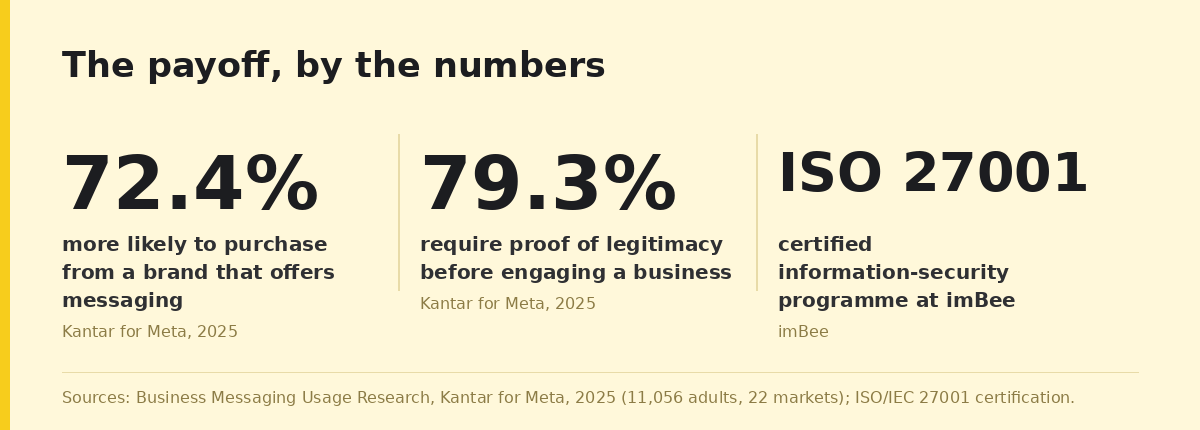
The payoff, by the numbers
Before the detail, here is why this is worth the team’s time:
The offer was fine. The channel was the problem. A phone call from an unknown Hong Kong number in 2026 reads as a nuisance call before a word is spoken, and the borrower who would have said yes never gets far enough to hear the terms.
This is why pre-approved offer flows on WhatsApp have become a serious topic for Hong Kong lenders rather than a marketing experiment. A message the borrower can read at their own pace, respond to in the same thread, and act on without a phone call closes the gap between the offer and the reply from days to minutes.
It also concentrates a set of obligations into one message. A pre-approved offer is a promotional communication about a regulated credit product, sent to a person whose personal data you hold, on a channel that Meta classifies and prices by intent. Get any of those three classifications wrong and the flow either gets blocked, gets expensive, or creates a compliance record you would rather not produce.
The phrase covers a wide range of implementations, from a single broadcast to a fully conversational journey. The version that works for a licensed lender in Hong Kong has five distinct stages with a deliberate handover point in the middle.
| Stage | What happens | Automated or human |
|---|---|---|
| Eligibility | Credit team defines the segment and the conditional terms, outside the messaging tool | Neither — this is a credit decision |
| Offer message | An approved template goes to consented recipients with the indicative terms and required warnings | Automated |
| Response capture | The borrower expresses interest, asks a question, or opts out, in the same thread | Automated |
| Verification | Identity, income and affordability checks under the lender's own policy | Human, with system support |
| Drawdown | Documentation, disclosure of final terms, signature and disbursement | Human |
The most common design mistake is treating stage four as an extension of stage three. An automated flow can carry a borrower to the point of saying yes. It should not carry them past it. The moment the conversation moves from an indicative offer to a binding one, a named person with the authority to make that commitment needs to be in the thread.
The second mistake is the opposite: making stage two and three human. If an agent has to type the offer to each borrower individually, the flow is a call list with extra steps, and it will not scale past a few hundred recipients a month.
Drawing the line clearly at the end of stage three is what makes the rest of the design tractable — template classification, consent, disclosure and record-keeping all follow from where the automation stops.
On the WhatsApp Business Platform, every message sent outside a 24-hour customer service window is a template, and every template carries a category. For a lender, the distinction that matters is between Marketing and Utility, and the honest answer is usually less convenient than teams hope.
| Message | Category | Why |
|---|---|---|
| Unsolicited offer of a further advance | Marketing | Promotes a product the borrower did not ask about |
| Outcome of an application the borrower submitted | Utility | Relates to a specific transaction already in motion |
| Repayment reminder on an active loan | Utility | Services an existing agreement |
| Rate promotion to a lapsed borrower | Marketing | Promotional, regardless of the prior relationship |
| One-time passcode for account access | Authentication | Verifies identity for a login or transaction |
A pre-approved offer sent to a borrower who has not applied is Marketing. Describing it as a service message because the borrower is an existing customer does not change the classification, and template rejections at review are the usual result of trying.

Three consequences follow. Marketing templates are priced above Utility templates on Meta's rate card, which changes periodically and should be checked before any volume model is signed off. Meta applies per-user limits on how many marketing template messages a person receives, so sending more does not linearly buy more reach. And marketing content requires an opt-in that covers promotional messaging specifically, not merely an agreement to be contacted about an existing account.
The design implication is worth stating plainly: the highest-converting version of this flow is usually the one that turns a Marketing moment into a Utility one. An eligibility check the borrower initiates — a keyword, a link from a statement, a button on your site — produces an inbound application, and the approval outcome is then a Utility message inside an open conversation window.
A pre-approved offer message sits at the intersection of money lending regulation, data privacy law and platform policy. Each has its own requirements, and satisfying one does not satisfy the others.
Money lending. Lending as a business in Hong Kong requires a licence under the Money Lenders Ordinance (Cap. 163), administered through the Licensing Court with the Registrar of Money Lenders at the Companies Registry. The Ordinance caps the effective interest rate a licensed lender may charge and sets a lower threshold above which a transaction may be reopened by a court as extortionate. Licensing conditions also require money lender advertisements to carry a risk warning about borrowing and about paying intermediaries. A promotional message on WhatsApp is an advertisement for this purpose, and the warning belongs in the message rather than behind a link.
Data privacy. The Personal Data (Privacy) Ordinance (Cap. 486) governs the borrower's contact details. Its direct marketing provisions require a data user to notify the individual and obtain consent before using their personal data in direct marketing, to tell them they may opt out without charge, and to stop when asked. The consequences for getting this wrong are among the more serious in the Ordinance, and a borrower list assembled for servicing an existing loan does not automatically carry marketing consent.
Platform policy. Meta's Business Messaging Policy sets out what may be promoted and what opt-in evidence is expected. Financial services content is reviewed carefully at template approval, and a rejected template usually means the copy promised an outcome it could not guarantee.
| Requirement | Where it comes from | What you must be able to show |
|---|---|---|
| Valid licence | Money Lenders Ordinance (Cap. 163) | Current licence details on your material |
| Interest within the statutory cap | Money Lenders Ordinance (Cap. 163) | The effective rate calculation for the offer |
| Risk warning in advertisements | Money lender licensing conditions | The warning in the message body itself |
| Marketing consent | PDPO (Cap. 486), direct marketing provisions | Timestamped opt-in and the wording shown |
| Working opt-out | PDPO (Cap. 486) | An opt-out honoured across every channel, not just WhatsApp |
| Approved template | Meta Business Messaging Policy | The approved template version sent on that date |
imBee provides role-based access, retention controls and audit logging so a lender can support these obligations, and imBee is an Official Meta Technology Partner for the WhatsApp Business Platform. Your firm remains the accountable party for its licence conditions and its data handling; no platform assumes that responsibility for you.
Assess every shortlisted platform against the record you will have to produce later, not against the demo you are shown now.
Consent as a record, not a flag. You need to show when marketing consent was captured, through which route, and what wording the borrower saw — and to suppress anyone who has withdrawn it, immediately and across channels.

Template version history. When a regulator or an internal auditor asks what a borrower received on a given date, the answer has to be the exact approved template in force then, not the current one.
Segment control at send time. The list that goes out must be the list credit approved. A platform that allows a marketing user to broaden a segment after approval is a governance problem in waiting.
A real reply loop with assignment. Offers generate questions. Those questions have to reach a named person, with the whole thread, before the borrower's interest cools.
Handover to a licensed human at a defined point. The system should make it easy to stop the automation at the end of the indicative stage and hard to run past it.
Retention and access control. Financial conversations should age out under a policy you set, and access should be per named user with roles, so you can say who saw a borrower's information.
Two further checks are worth the time: whether the platform supports Traditional Chinese and English in the same workflow without a separate build, and whether opt-outs captured in WhatsApp propagate to your SMS and call lists. A borrower who opts out once expects to have opted out everywhere.
The sequence below is ordered by what stops launches, not by what is easiest to demonstrate. Most delays come from discovering at week six that the list you planned to message never carried marketing consent.
Audit the consent you actually hold. Separate borrowers who consented to marketing from those who only agreed to be contacted about an existing loan. The second group cannot receive a pre-approved offer until they opt in.

Agree the disclosure wording with compliance before design. The risk warning, the indicative nature of the terms, and the fact that a formal application and checks follow all belong in the first message. Writing this last forces a template rebuild.
Build the inbound path first. A keyword, a link on the statement or a button on the site that lets a borrower start an eligibility check turns your best segment into inbound applicants and moves the reply into a service window.
Pilot on one segment. A single well-understood cohort, a few hundred recipients, and a fixed two-week window gives you a clean read on reply rate, question types and opt-out rate.
Staff the reply loop before you send. Decide who answers, in what hours, and what an out-of-hours reply says. An unanswered question on a credit offer is worse than no offer.
Measure qualified applications, not deliveries. The only metric that matters is applications that pass verification. Read rate flatters the flow; conversion after verification tells you whether the segment was right.
If you want the pilot reviewed against your current consent position, the imBee team can walk through it at imbee.io/contact-us.
Lenders who expect the channel to solve problems that sit in credit policy or in the product are usually disappointed at the first quarterly review. Four limits are worth setting out before procurement.
It does not improve a segment that was wrong. If the pre-approval criteria select borrowers who will not pass verification, a faster channel simply produces failed applications faster, and each one costs goodwill with a customer who was told they were pre-approved.
It does not make an uncompetitive offer competitive. Borrowers compare terms. A well-designed flow removes friction from the yes; it does not manufacture one.
It does not substitute for affordability assessment. Speed to offer and speed to drawdown are different problems, and compressing the second is where conduct risk sits. The automation should end where the assessment begins.
It does not repair consent you never had. The fastest route to reach in most lender books is better opt-in capture at origination and at every servicing touchpoint, not a larger send.
| Symptom | Likely cause | Where the fix sits |
|---|---|---|
| Template rejected at review | Promotional copy promising a guaranteed outcome | Rewrite to indicative terms with the required warning |
| High reads, almost no replies | No clear next action in the message | One explicit action, not three |
| Replies arrive, nobody answers | Reply loop unstaffed outside office hours | Assignment rules and a stated response window |
| Applications fail verification | Pre-approval criteria looser than credit policy | Credit segmentation, not messaging |
| Opt-out complaints | Consent captured for servicing, used for marketing | Re-permission the list before the next send |
Set out honestly, the case is still strong. A pre-approved offer flow on WhatsApp turns a two-day callback cycle into a same-hour conversation, keeps the disclosure record in one place, and gives compliance a cleaner audit trail than a call list ever did. It is a distribution improvement, not a credit strategy, and the business case should say so.
Can Hong Kong money lenders send pre-approved loan offers on WhatsApp?
Yes, provided the lender is licensed under the Money Lenders Ordinance (Cap. 163), holds marketing consent under the Personal Data (Privacy) Ordinance for each recipient, sends through an approved template on the WhatsApp Business Platform, and includes the risk warning that money lender advertising conditions require. The offer must be indicative, with formal checks before any commitment.
Is a pre-approved offer a Marketing or a Utility template?
An unsolicited offer of further credit is Marketing, because it promotes something the borrower did not ask about. The outcome of an application the borrower submitted is Utility, because it relates to a transaction already in motion. Existing-customer status does not change the classification, and mis-labelling is a common reason templates are rejected at review.
What consent do we need before sending a loan offer by message?
You need consent that covers direct marketing specifically. Under the PDPO the lender must notify the individual, obtain consent before using their data for marketing, tell them they can opt out at no cost, and stop on request. Consent captured to service an existing loan does not extend to promotional offers.
Does the risk warning have to appear in the WhatsApp message?
Treat a promotional message as an advertisement and include the warning in the message body. Placing it behind a link relies on the borrower clicking, which many will not do, and it makes the record harder to evidence later. Agreeing the exact wording with compliance before template design avoids a costly rebuild.
How do we avoid Meta's marketing message limits?
You cannot buy past them, so design around them. Convert outbound promotion into inbound interest with a keyword, a statement link or a website button that lets the borrower start an eligibility check. The reply then arrives inside a customer service window, where the conversation is not constrained in the same way.
Should the whole loan journey be automated?
No. Automate the offer and the response capture; keep verification and drawdown human. The moment the conversation moves from indicative terms to a binding commitment, a person with the authority to make that commitment needs to be in the thread. Compressing the assessment stage is where conduct risk concentrates.
What should we measure to know the flow is working?
Count applications that pass verification, not messages delivered or read. Read rate flatters a messaging channel and tells you nothing about whether the pre-approval criteria matched credit policy. Track opt-out rate alongside it, because a rising opt-out rate is the earliest signal that the segment or the frequency is wrong.
How long does it take to launch a compliant flow?
Configuration is rarely the constraint. The consent audit, the disclosure wording sign-off and template approval usually set the timeline, and template review for financial services content can take several attempts if the copy promises a guaranteed outcome. Plan for a pilot on one segment rather than a full-book launch.

Kelly S.
Content Team Lead, imBee
Kelly S. owns content strategy, product positioning, and customer education at imBee. Previously, Kelly led B2B SaaS content programs and supported go-to-market initiatives for customer engagement products. On the imBee blog, Kelly covers conversational commerce, omnichannel messaging, WhatsApp Business, customer experience, and strategies for scaling business communications.
Questions about anything in this article? Talk to our team.
Discuss your channels, team and conversation handover needs in a product demo.