A Margin Call Is a Delivery Problem Before It Is a Credit Problem
What a Time-Critical Client Notification Workflow Has to Do
Email, Phone, SMS or Messaging: What Actually Reaches a Client Before the Cut-Off
Corporate Actions: The Deadline Problem Nobody Budgets For
Record-Keeping and Supervision: Building for the Firms You Answer To
How to Roll This Out Without Creating a Supervision Gap
What a Notification Channel Cannot Fix
The market gaps down at the open. By 09:20 the risk system at a brokerage in Central has flagged forty accounts below maintenance margin, with a house cut-off at 14:00 before positions are liquidated. The credit decision is already made. What remains is contacting forty people, in the next four hours, and getting a response from each.
The payoff, by the numbers
Before the detail, here is why this is worth the team’s time:

That is where the money is lost. Email sits unread in a work inbox the client will not open until the evening. The registered mobile number rings out because the client is in a meeting, or has three unanswered calls that morning from numbers they do not recognise. The dealing desk works down a list, and the accounts that were never reached get liquidated at whatever the market offers at 14:00 — a forced sale the client will dispute, and often a relationship the firm does not keep.
Corporate actions produce the same shape of problem with a longer fuse. A rights issue, an open offer or a scrip dividend gives the client an election with a deadline, and the broker's internal cut-off falls earlier than the issuer's. Clients who do not respond get the default action, which is frequently the worst economic outcome available to them, and the complaint lands months later when the value of the lapsed entitlement is visible.
Both problems are notification problems. The firm knows what it needs to say and to whom. What it lacks is a channel the client actually reads on a weekday morning, with a reply path that does not compromise the firm's supervision and record-keeping obligations. That constraint is what makes this harder than it looks, and it is where record-keeping for licensed brokerages and client communication meet.
A broker's notification workflow is not a marketing tool with a compliance wrapper. It has to do four jobs, and only the first is about the message.
Reach the client on a channel they read within the window. The window for a margin call is hours, not days. A channel with a high read rate on opt-in messages changes the odds materially compared with an email that competes with sixty others.
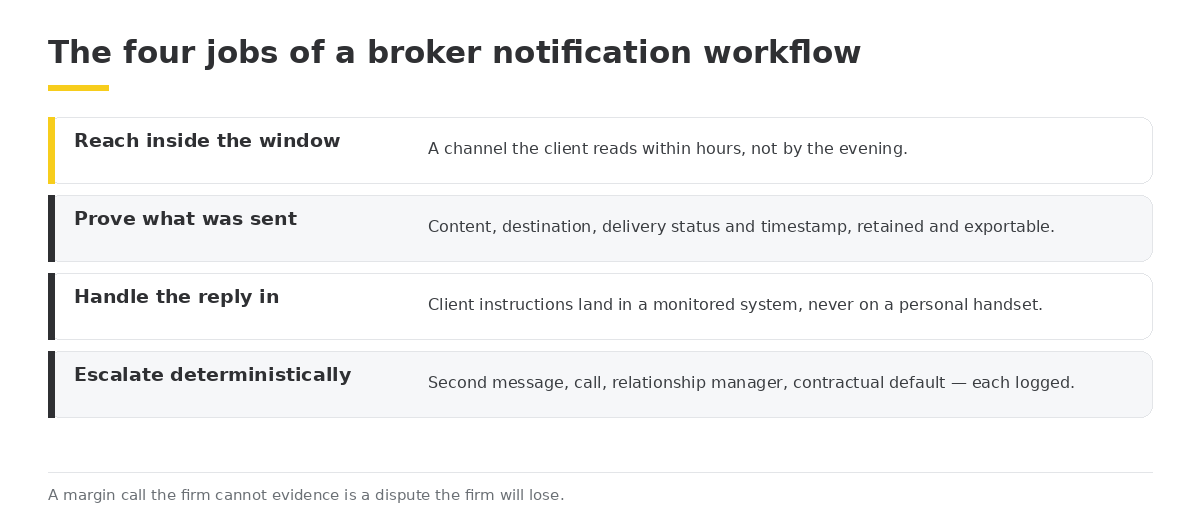
Prove what was sent, to whom, and when. When a client says they were never told, the firm needs a record showing the message content, the destination, the delivery status and the timestamp. A screenshot from a dealer's personal phone is not that record.
Handle the reply inside supervision. Clients reply. Some will reply with an instruction — sell the position, transfer funds, take up the rights. The moment that instruction arrives on an unsupervised channel, the firm has an order record it cannot produce and a supervision gap it cannot explain.
Escalate deterministically when nobody answers. Silence is the expected case for a proportion of clients. The workflow needs a defined escalation — second message, call, relationship manager, then the contractual default — with each step logged so the firm can show it followed its own procedure.
The category detail matters for approvals. A margin call, a corporate-action notice and a settlement reminder all relate to an existing account and an existing position, so on the WhatsApp Business Platform they are written as Utility templates. One-time passcodes used to verify a caller belong to the Authentication category. Nothing in this workflow is Marketing, and submitting it as such is a common cause of rejection during onboarding.
Judge each channel on three things: whether the client reads it inside the window, whether the firm can evidence delivery, and whether a reply lands somewhere the firm supervises.
| Channel | Read inside a four-hour window | Evidence of delivery | Where a reply lands |
|---|---|---|---|
| Unreliable during market hours | Sent and sometimes opened; rarely conclusive | Mailbox — supervisable if it is the firm's system | |
| Outbound call | Strong when answered, poor when not | Call log; recorded line if the desk records | The recorded line, if the client called back on it |
| SMS | High reach, no app dependency | Delivery receipt only | Usually nowhere — replies are rarely monitored |
| Personal messaging app on a staff handset | Very high | None the firm controls | A private device outside supervision |
| WhatsApp Business Platform | High on opt-in messages | Message, template, status and timestamp retained | A supervised shared inbox with named users |
The fourth row is the one worth staring at. It is also, in practice, the channel many client-facing staff already use, because it works. That is precisely the risk: the behaviour that gets the client reached is the behaviour that removes the record. Regulators in several markets have penalised firms for business conducted on unmonitored personal messaging applications, and the finding in those cases is rarely about the content of the messages — it is about the firm's inability to produce them.
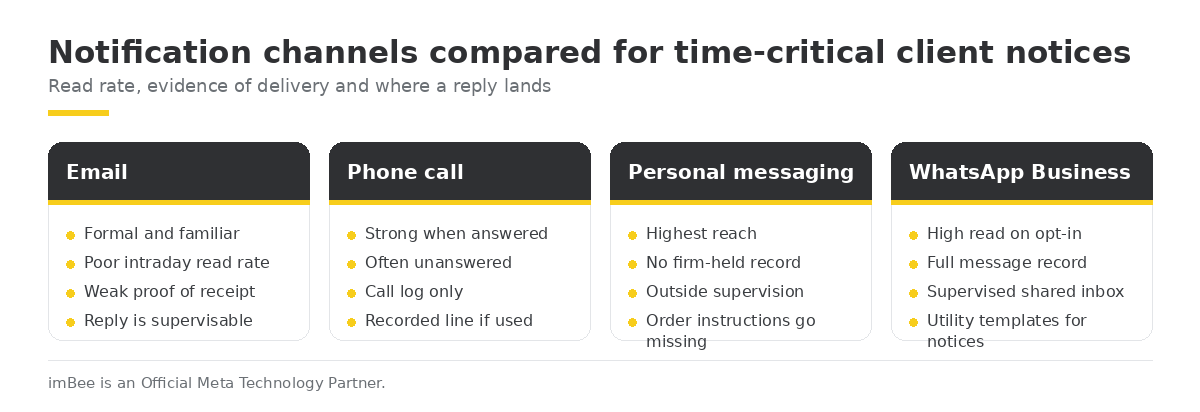
The workable answer is not to ban the channel the clients use. It is to move it onto the firm's platform, where the same convenience exists but every message is retained, supervised and exportable. That is the same argument that has been made for regulated financial institutions across APAC, and it applies with more force at a brokerage, where a single message can constitute an order instruction.
One practical note on the reply window. Once a client replies, the platform allows the desk to converse freely for a defined period without sending another template, which is exactly what a margin-call conversation needs. Outside that window, further outbound contact returns to approved templates. Design the escalation timings around that behaviour rather than fighting it.
Corporate-action notification is higher volume, lower drama and, cumulatively, the source of more client complaints. The mechanics create the difficulty: the issuer sets a deadline, the clearing system sets an earlier one, and the broker sets an earlier one still so that elections can be aggregated and submitted. The client sees none of that and hears only the final date reported in the press.
| Event type | What the client must decide | What happens on silence | Notification difficulty |
|---|---|---|---|
| Rights issue or open offer | Take up, sell the nil-paid rights, or let them lapse | Entitlement usually lapses, sometimes with a residual payment | High — economics are time-sensitive and misunderstood |
| Scrip dividend election | Cash or shares | Falls to the stated default, often cash | Medium — low urgency, high volume |
| Tender or buy-back offer | Tender at the offer price or hold | No tender submitted | High — a hard deadline with no second chance |
| Share consolidation or split | Usually nothing | Automatic | Low — informational only |
| Voluntary conversion or exchange | Convert or hold | Holds, and the option may expire worthless | High — narrow windows |
The operational fix is not a better letter. It is a notification that arrives on a channel the client reads, states the broker's cut-off rather than the issuer's, states the default explicitly, and offers a single unambiguous way to respond. Clients do not fail to elect because they disagree with the economics. They fail because the notice arrived in a format they skimmed and the deadline they remembered was the wrong one.
Two content rules make a measurable difference. First, lead with what happens if the client does nothing, because for most recipients that is the decision they are actually making. Second, quote your own cut-off date and time, with the timezone, and never the issuer's — the gap between the two is where the disputes live.
Client communications at a brokerage are records. Firms answering to the Securities and Futures Commission in Hong Kong, and to the Monetary Authority of Singapore, are expected to keep records of their dealings with clients and to be able to produce them on request. Where an order instruction is involved, the expectation is stricter still, because the record establishes what the client asked for.
That has a direct design consequence. If a client can send an instruction through a channel, that channel is inside your record-keeping perimeter, whether or not you intended it to be. There are only two defensible positions: bring the channel inside supervision, or make it structurally impossible to instruct through it and say so in the message itself.
| Control | What it means in practice | Why it matters when questioned |
|---|---|---|
| Named user accounts | Every staff member has an individual login; no shared credentials | Establishes who saw and who sent |
| Full message retention | Inbound and outbound messages retained under a documented policy | Lets the firm reconstruct an exchange years later |
| Supervisory access | Compliance can search and export conversations without asking a dealer | Removes dependence on a personal device |
| Order-instruction handling rule | A documented rule for what happens when a client instructs by message | Closes the gap between a chat and an order record |
| Template control | Client notices sent from approved, locked templates | Ensures consistent, reviewable wording |
| Consent and channel record | Evidence of the client agreeing to the channel, tied to the account | Supports the personal-data obligations that also apply |
Personal-data obligations run alongside. In Hong Kong the Personal Data (Privacy) Ordinance (Cap. 486) governs collection, use, security and retention of the client's personal data, and marketing use is separately regulated. In Singapore the Personal Data Protection Act applies, with additional checks on marketing messages to Singapore telephone numbers. Account notices are not marketing, and keeping the two streams separate in your templates is what preserves that distinction.
imBee provides named-user access, role-based permissions, retention controls, supervisory search and export, and runs an information-security programme certified to ISO/IEC 27001. imBee is an Official Meta Technology Partner. The licensed firm remains responsible for its own record-keeping and supervision policies; a platform supports those obligations and does not assume them.
Most failed rollouts in this space fail the same way: the notification goes live, clients start replying with instructions, and nobody decided in advance what happens next. Settle that first.
Write the order-instruction rule before anything else. Decide, with compliance, whether an instruction received by message is acceptable and under what conditions. If it is not, the template must say where instructions must go, and staff must be trained to redirect rather than to act.
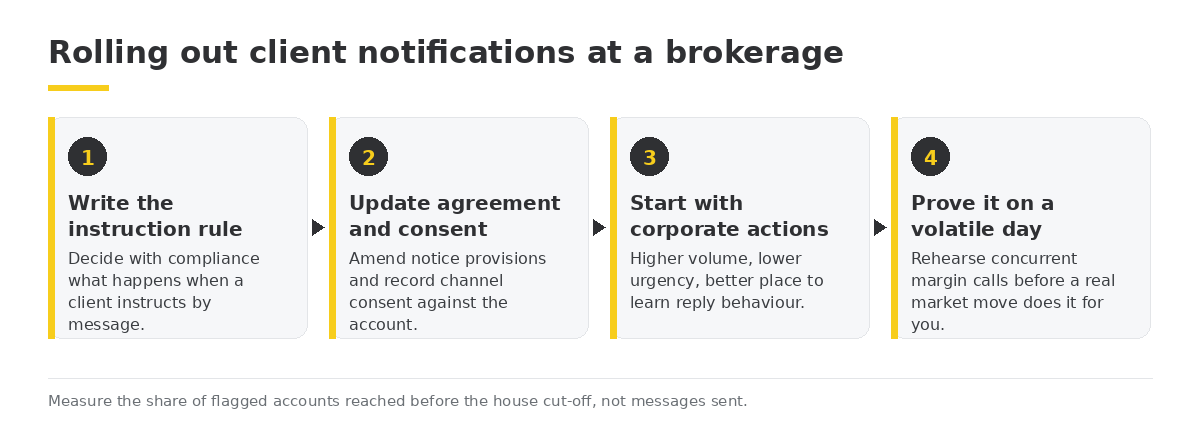
Update the client agreement and the channel consent. Adding a notification channel usually touches the client agreement's notice provisions. Capture the client's agreement to the channel against the account record, with a date, so it can be produced later.
Start with corporate actions, not margin calls. Corporate actions are higher volume and lower urgency, which makes them the better place to learn how clients respond. Move margin calls onto the channel once reply handling is proven.
Define the escalation ladder and log every rung. Message, second message, call, relationship manager, contractual default — each with a timestamp. The ladder is what demonstrates the firm followed its procedure when a client disputes a liquidation.
Rehearse a volatile morning. Forty simultaneous margin calls is a different operational problem from four. Test the desk's capacity to handle concurrent replies before a real market move does it for you.
Measure contact rate before cut-off. The metric is the proportion of flagged accounts that responded before the house deadline, and the resulting fall in forced liquidations of clients who simply never saw the notice. Messages sent is not a measure of anything.
Notification work is often sold internally as a risk-reduction project. It reduces one specific risk — the client who was never reached — and leaves the others exactly where they were.
It does not make an underfunded client solvent. Reaching every client faster surfaces the shortfall sooner. It does not create the funds, and it may simply produce an earlier, better-documented liquidation.
It does not fix a margin policy set too loosely. If house requirements let concentrated positions build, the notification arrives when the damage is already structural. That is a credit and risk-appetite question, not a communications one.
It does not substitute for the contractual notice provisions. Whatever the client agreement says about how formal notice is given still governs. A message is an operational reach mechanism alongside that, unless the agreement is amended to say otherwise.
It does not turn a chat into a system of record. The order management system remains the record of orders. The messaging platform is a record of communications. Firms that let the two blur end up unable to answer basic reconstruction questions.
It does not remove the need for a person. A client facing a forced sale wants a conversation. The channel gets the client's attention; the relationship manager keeps the account.
| Symptom | Likely cause | Where the fix sits |
|---|---|---|
| Clients still missing margin deadlines | Notice arriving on a channel they do not read intraday | Channel selection and opt-in coverage |
| Disputes over whether notice was given | No retained, exportable record of the send | Platform retention and supervisory export |
| Instructions arriving by chat | No documented order-instruction rule | Compliance policy and staff training |
| Lapsed corporate-action entitlements | Notice quotes the issuer deadline, not the broker cut-off | Template wording |
| Desk overwhelmed on volatile mornings | No concurrency planning for reply handling | Staffing and escalation design |
| Templates rejected at onboarding | Account notices submitted under the wrong category | Use Utility for transaction-related notices |
Framed that way, the business case is narrow and defensible: fewer clients liquidated because they never saw the call, fewer lapsed entitlements, and a communications record the firm can produce without asking anyone to unlock a personal phone.
How do brokers notify clients of a margin call?
Most firms use a layered approach: an immediate notice on a channel the client reads intraday, a follow-up call, then escalation to the relationship manager before the house cut-off. On the WhatsApp Business Platform the notice is sent as an approved Utility template because it relates to an existing account, and both the send and the reply are retained as records.
Is it compliant to send margin calls over WhatsApp in Hong Kong?
The channel is not the issue; supervision and record-keeping are. A firm answering to the Securities and Futures Commission needs to retain client communications, produce them on request, and supervise instructions. Using the WhatsApp Business Platform through a business system that retains and exports messages supports those obligations; a dealer using a personal handset does not.
What is the difference between a Utility and a Marketing template here?
A Utility template relates to an existing transaction or account — a margin call, a corporate-action election, a settlement reminder. A Marketing template promotes something the client did not ask about, such as a new product. They carry different consent expectations and different pricing, and account notices submitted as Marketing are a common cause of template rejection.
What happens if a client sends a trading instruction by message?
Decide the answer before you launch. Either the instruction is captured into the order record with the same controls as any other channel, or the firm does not accept instructions that way and the template says so explicitly. The unacceptable outcome is staff acting on chat instructions that never reach a supervised record.
How early should a corporate-action notice go out?
Work back from your own cut-off, not the issuer's. Clients need enough time to decide, ask a question and act, and your internal deadline is usually earlier than the date reported publicly. Notices that quote the issuer deadline instead of the broker cut-off are the single most common source of lapsed-entitlement complaints.
Do clients need to opt in before a broker can message them?
Yes, and the opt-in should be recorded against the account with a date so it can be produced later. In Hong Kong the Personal Data (Privacy) Ordinance (Cap. 486) governs how client contact data may be used, and marketing use has its own requirements. In Singapore the Personal Data Protection Act applies, with additional checks for marketing messages to Singapore numbers.
Can a messaging platform replace the firm's formal notice provisions?
Not by default. Whatever the client agreement specifies about how formal notice is given continues to govern until the agreement is amended. Treat the messaging channel as an operational way to make sure the client actually knows, running alongside the contractual notice rather than replacing it.
What should a firm measure after go-live?
The share of flagged accounts that responded before the house cut-off, the fall in forced liquidations of clients who never saw the notice, and the fall in lapsed corporate-action entitlements. Delivery counts and message volumes tell you the system is running, not that it is working.

Kelly S.
Content Team Lead, imBee
Kelly S. owns content strategy, product positioning, and customer education at imBee. Previously, Kelly led B2B SaaS content programs and supported go-to-market initiatives for customer engagement products. On the imBee blog, Kelly covers conversational commerce, omnichannel messaging, WhatsApp Business, customer experience, and strategies for scaling business communications.
Questions about anything in this article? Talk to our team.
Discuss your channels, team and conversation handover needs in a product demo.