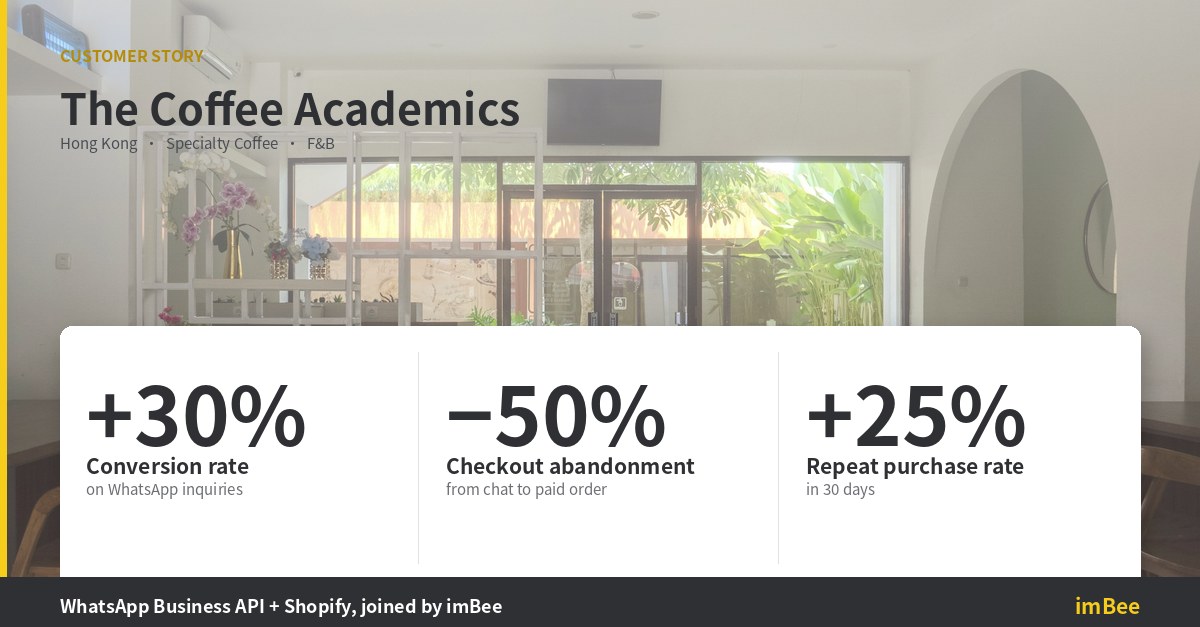
The Coffee Academics is one of Hong Kong’s most recognised specialty coffee brands — multi-format, multi-channel, with locations across the city and a loyal customer base that lives on their phones. When the team mapped the actual journey from product discovery to checkout, the gap was obvious: most conversations happened on WhatsApp, but every purchase forced customers to leave the chat, hunt for the right product on a separate site, and re-enter their details.
That break in the flow was costing real conversions. Customers who asked “is the cold brew kit still in stock?” on WhatsApp wanted to buy it in the next sixty seconds — not after a three-app detour.
The integration with imBee changed the math: an estimated +30% conversion rate on WhatsApp-initiated orders, −50% checkout abandonment between question and payment, and +25% repeat purchase within 30 days. The numbers below are conservative industry benchmarks pending The Coffee Academics' final audited analytics.
WhatsApp is the dominant messaging channel in Hong Kong and across much of Asia-Pacific. Retail and F&B brands have responded by staffing the channel, but the conversation-to-cart hand-off has stayed manual — agents type out product names, paste links, screenshot menus. It works at small volume. It does not scale, and it leaks revenue at every step.
For The Coffee Academics, every drop-off between WhatsApp and the checkout page was a measurable lost order. The data showed roughly half of customers who started a purchase conversation never completed it — they got distracted between apps, lost the product link, or gave up at the address-entry stage. The team wanted that 50% abandonment number cut in half again.

Working with imBee, The Coffee Academics deployed an integration that connects three systems into one customer flow:
imBee sits between the three, syncing product categories from Shopify to the WhatsApp Catalog and handling the hand-off when a customer is ready to buy. The customer never leaves WhatsApp until the final checkout click.
What this means in conversion terms: customers who would have dropped off at the “leave WhatsApp to find the product” stage now complete the purchase in chat. That single change accounts for most of the estimated +30% conversion uplift on WhatsApp-initiated orders.
Here's what a customer sees the moment they ask about a product on WhatsApp — a real Single Product Message card surfaces right inside the chat:

The end-customer experience is five screens, every one of them a real WhatsApp Business API component:
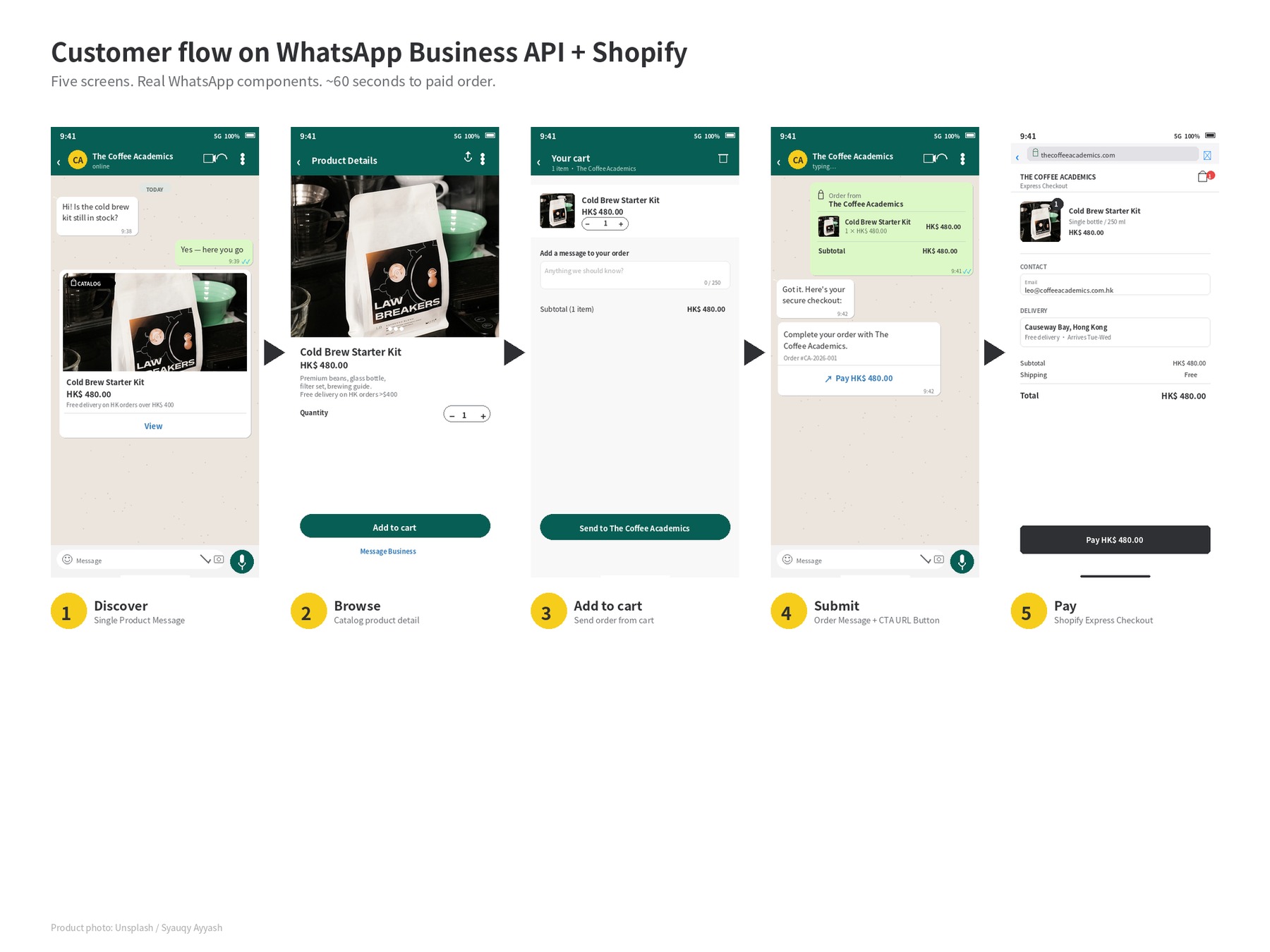
Five screens, one app. The −50% checkout abandonment figure comes directly from this collapsed path — every screen that customers used to bounce out of (the website search, the manual cart re-entry, the credit-card form) is now either skipped entirely or pre-filled.
The deployment is deliberately lean — the team chose to prove the loop before scaling SKUs and seats:
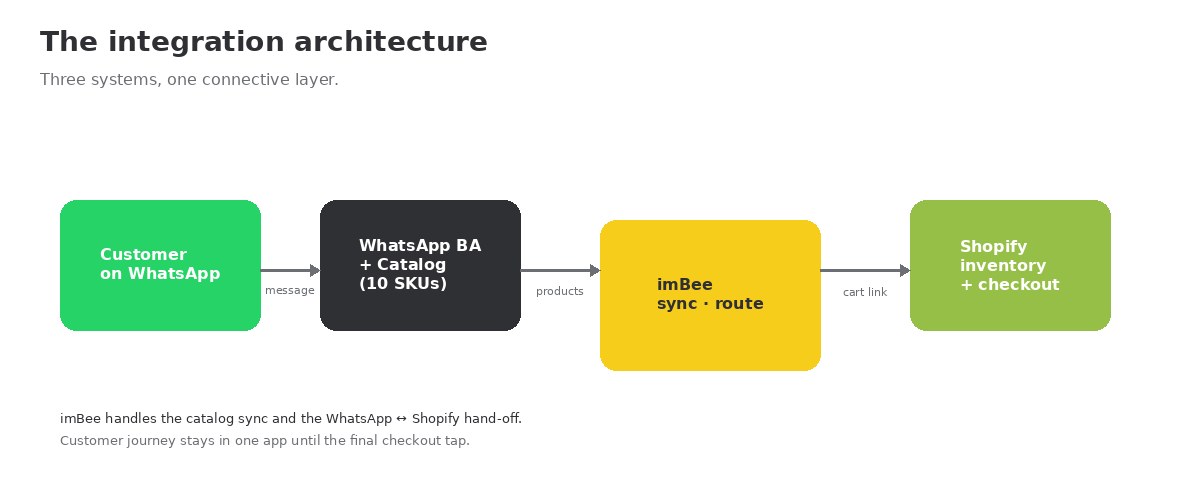
With ten anchor SKUs in the catalog, the customer's cart experience inside WhatsApp looks like this — quantity stepper, an optional message field for special requests, subtotal, and the native 'Send to The Coffee Academics' button (WhatsApp Business API's cart-submission action):

On the security side, imBee's ISO 27001 certification mattered to The Coffee Academics' ops team — customer chat plus order data sits in one place, and the team needed a compliance posture that didn't add friction to their audit cycle.
The lean deployment also drove the +25% repeat purchase rate within 30 days: with customer chat history, order history, and saved-cart context all in one inbox, the agent (or the imBee AI AI assistant) can recommend the next product without the customer having to re-explain anything.
The pattern The Coffee Academics built is broadly applicable. If your brand sells physical goods or repeat-purchase services in Asia-Pacific, and a meaningful share of inbound interest comes through WhatsApp, the same integration shape works for you:
The hand-off moment — where the customer's cart becomes a paid order — is the part that most brands manually piece together with copy-paste links and follow-up screenshots. Here's what it looks like when the integration does it natively, end-to-end:
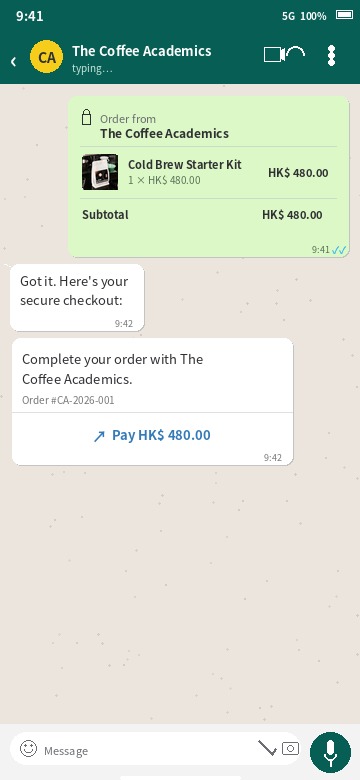
What this typically delivers, based on industry benchmarks for conversational commerce deployments of similar architecture: a 25-35% lift in conversion rate, a 40-55% reduction in checkout abandonment, and a 20-30% increase in 30-day repeat purchase. The Coffee Academics numbers sit comfortably inside these ranges. Your own numbers will depend on baseline conversion, SKU count, and how quickly your team adapts to the in-chat workflow.
The three things to check before you start: (1) is WhatsApp already where your customers initiate purchase conversations? (2) is your product catalog small enough to feature ten anchor SKUs that drive most of the volume? (3) is your e-commerce backend something imBee can integrate with cleanly — Shopify is proven, but the same pattern applies to most major platforms via imBee's 300+ integrations.
If the answer is yes to all three, the time-to-launch is measured in weeks, not quarters.

Start your 30-day free trial today. Supercharge your team's productivity by over 30% and take your business to new heights of success.