WhatsApp Broadcast vs WhatsApp Campaign: Why the Difference Decides Your 2026 Reach
What Is a WhatsApp Broadcast, and Why Does It Stop at 256 Contacts?
What Is a WhatsApp Campaign on the WhatsApp Business Platform (API)?
WhatsApp Broadcast vs Campaign: The Side-by-Side Comparison Hong Kong Teams Need
Which WhatsApp Message Template Category Does Your Campaign Need?
Is WhatsApp Mass Messaging Legal in Hong Kong? What the PDPO Requires Before You Send
How Much Does a WhatsApp Campaign Cost — and Why Are Broadcasts “Free”?
The terms get used interchangeably, but on WhatsApp they describe two completely different delivery mechanisms with different limits, different compliance exposure, and very different results. Getting this wrong wastes budget and — in Hong Kong — can put you on the wrong side of the Personal Data (Privacy) Ordinance (PDPO) Cap. 486.
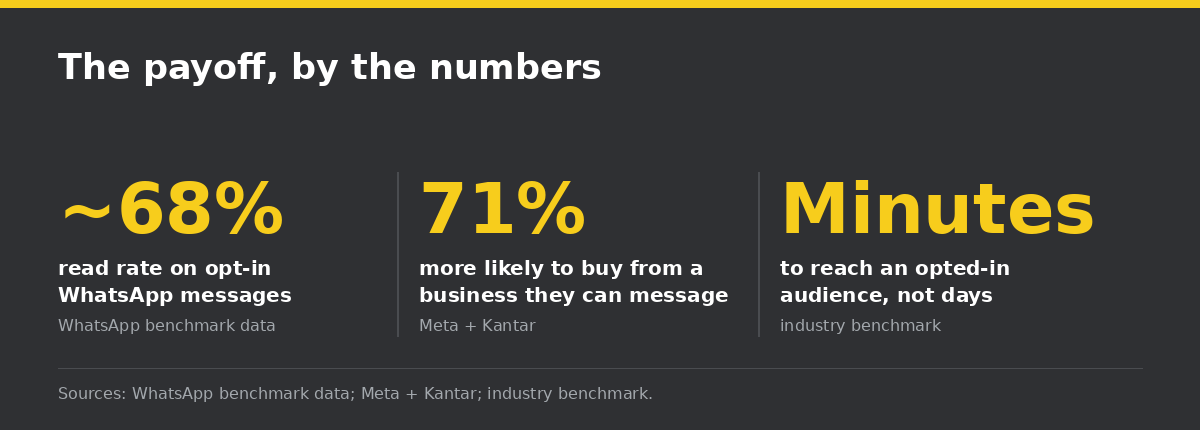
The payoff, by the numbers
Before the how-to, here is why this is worth your team’s time. These are the benchmarks business-messaging programmes are measured against:
Here is what this guide covers, so you can jump to what you need:
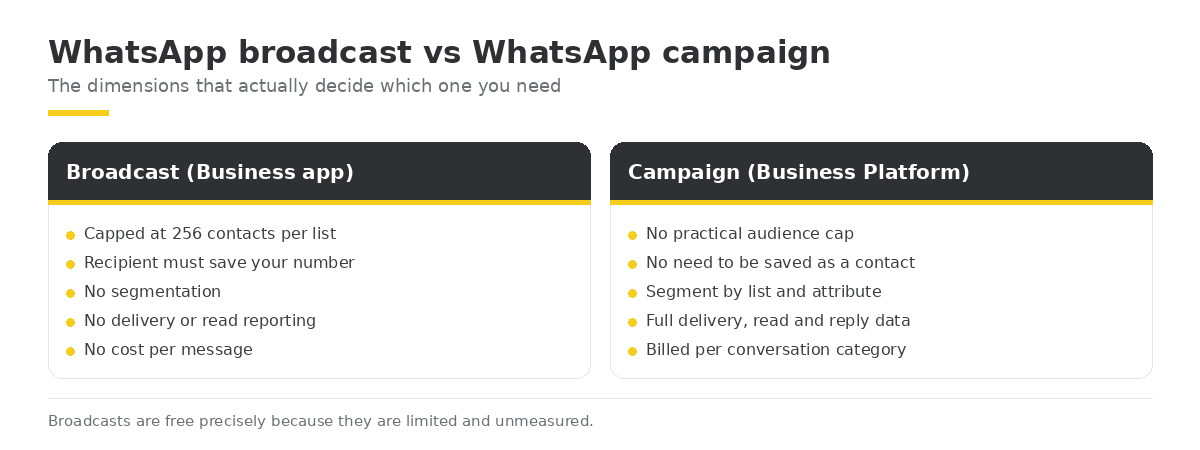
Two limits matter for any Hong Kong business. First, a single broadcast list holds a maximum of 256 contacts. To reach 4,000 customers you would build and manage roughly 16 separate lists by hand. Second — and this is the one that quietly kills reach — a broadcast only delivers to recipients who have saved your business number in their phone’s contacts. If a customer messaged you once but never saved you, your broadcast never lands. In practice this means a large share of your list silently misses every send.
Broadcasts also give you no analytics. You cannot see open rates, click rates, or delivery failures in any structured way, you cannot segment by behaviour, and you cannot run A/B tests. For a one-person shop messaging a few dozen regulars, that is fine. For a marketing team that needs to prove ROI, it is a dead end. The WhatsApp Business app is the right tool for conversational, low-volume customer service — not for measurable marketing at scale. For the fuller breakdown of the three WhatsApp products, see our guide on WhatsApp Business: App vs API vs Platform.
Unlike a broadcast, a campaign has no 256-contact ceiling and does not require the recipient to have saved your number. Instead it relies on two things Meta built specifically for business messaging at scale: message templates and opt-in.
A message template (historically called a Highly Structured Message, or HSM) is pre-written content you submit to Meta for review. Once approved, you can send it to any contact who has opted in to receive messages from you. Templates are how you legitimately initiate a conversation outside the 24-hour customer service window. Because the WhatsApp Business Platform exposes full delivery, read, and click data, a campaign tells you exactly what happened: how many messages were delivered, read, and acted on — the metrics imBee surfaces in its Marketing Campaign & Broadcast module.
Enterprises in regulated verticals add another reason to use the Platform: governance. The WhatsApp Business Platform supports the audit trails, role-based access, and data-handling controls that an ISO/IEC 27001-certified vendor can wrap around your messaging — something the consumer Business app cannot offer a Hong Kong bank or healthcare provider.
| Dimension | WhatsApp Broadcast (Business app) | WhatsApp Campaign (Business Platform / API) |
|---|---|---|
| Recipients per send | Max 256 per broadcast list | No fixed ceiling — scales to your full opted-in base |
| Recipient must save your number? | Yes — unsaved contacts never receive it | No — reaches any opted-in contact |
| Message format | Free-form text/media | Meta-approved message templates (plus free-form inside the 24h window) |
| Analytics | None (no delivery/read/click reporting) | Delivery, read, click, and conversion metrics |
| Segmentation & A/B testing | Manual, none | Yes — by attribute and behaviour |
| Cost | Free | Per-message pricing by template category (see Section 7) |
| Compliance controls | Minimal | Opt-in records, audit trail, role-based access, ISO 27001-grade governance via a BSP |
| Best for | Solo operators, low-volume personal messaging | Marketing teams running measurable, compliant mass campaigns |
The pattern is clear: a broadcast is a convenience feature on a consumer app, while a campaign is marketing infrastructure. If your goal is reach you can measure and defend, the campaign path on the WhatsApp Business Platform is the only one that qualifies.
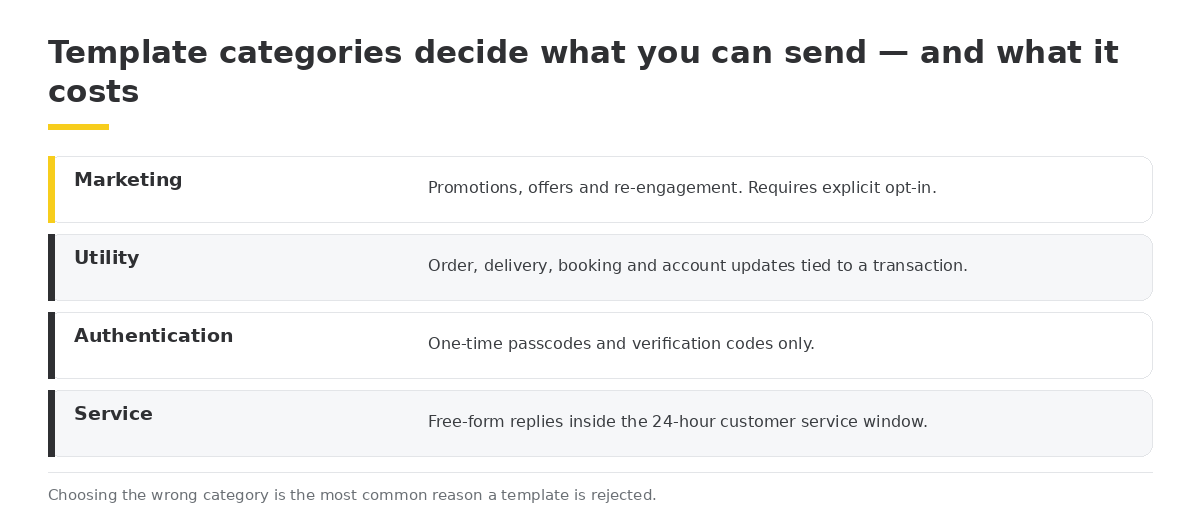
Meta currently uses these template categories. Match your message intent to the right one before you submit it for approval.
| Template category | What it is for | Hong Kong example |
|---|---|---|
| Marketing | Promotions, offers, announcements, re-engagement | A Lunar New Year promotion blast to opted-in retail customers |
| Utility | Transaction follow-ups tied to a specific action the customer took | An order-shipped update or appointment confirmation |
| Authentication | One-time passcodes and verification | A login OTP for an online brokerage account |
| Service | Replies inside the 24-hour customer service window | Answering an inbound customer question (no template needed) |
The distinction matters commercially as well as legally. Marketing templates are the most expensive category and the most scrutinised; utility and authentication templates are cheaper and approved more readily because they serve a transaction the customer already initiated. A campaign that dresses up a promotion as a “utility” message to save money risks rejection and account penalties. For automation that routes the right template at the right moment, see how imBee’s Chatbot & Automation ties templates to workflow triggers.
Under Part VIA of the Personal Data (Privacy) Ordinance (Cap. 486), a business must obtain the individual’s consent before using their personal data for direct marketing, must tell them what kinds of marketing the data will be used for, and must provide an opt-out channel that is honoured. The Privacy Commissioner for Personal Data (PCPD) enforces this, and breaches can carry criminal liability — this is not a soft guideline.
This is exactly where campaigns on the WhatsApp Business Platform pull ahead of broadcasts. Meta’s own policy requires that businesses obtain opt-in before sending template messages, so a compliant campaign workflow already captures and stores consent records. A BSP platform logs when and how each contact opted in, applies opt-out automatically, and keeps the audit trail the PCPD would expect to see. A manual broadcast list offers none of that documentation. For the full treatment, read our PDPO-compliant broadcast guide. Financial-services and healthcare senders should also confirm their messaging vendor is ISO/IEC 27001 certified, and brokerages should check obligations with the SFC and HKMA where client communications are regulated.
Meta has moved WhatsApp Business Platform billing toward a per-message pricing model, charged by template category, replacing the earlier conversation-based model. In broad terms, marketing templates cost the most, utility and authentication templates cost less, and service messages inside the 24-hour customer-care window are the cheapest or free. Exact rates vary by recipient country, so a campaign to Hong Kong numbers is priced on Hong Kong rates; confirm the current figures on Meta’s official WhatsApp pricing documentation before you budget, as Meta updates these periodically.
The practical point for a Hong Kong marketer: because every marketing template send has a unit cost, the value of analytics rises. A campaign that reports delivery and click data lets you cut wasted sends and prove return; a free broadcast that reaches an unknown fraction of your list and reports nothing cannot. For a deeper cost model see our WhatsApp Business API pricing in Hong Kong breakdown.
Choose a broadcast (WhatsApp Business app) if: you are a solo operator or very small business, your audience is under a few hundred regulars who have all saved your number, you do not need analytics, and you are not running formal direct-marketing campaigns that trigger PDPO obligations.
Choose a campaign (WhatsApp Business Platform via a BSP) if: you need to reach more than 256 people, you cannot guarantee every contact has saved your number, you need delivery and click analytics to prove ROI, you operate in a regulated vertical (financial services, healthcare, securities, money lending), or you need documented opt-in and audit trails for PDPO compliance.
For almost any Hong Kong marketing team with growth ambitions, the answer is the campaign path. The broadcast is a starter feature you outgrow the first time you try to message your whole customer base. The migration is straightforward: a BSP onboards your number to the WhatsApp Business Platform, imports and re-confirms opt-in, and gives your team a campaign console with templates, segmentation, and reporting in one place.
A broadcast is a convenience on a consumer app: free, capped at 256, blind to whoever never saved you, and impossible to measure. A campaign on the WhatsApp Business Platform is built for the job: unlimited opted-in reach, Meta-approved templates, full analytics, and the consent records the PDPO requires. For a Hong Kong marketer the moment you want to message your whole base, report on it, and stay on the right side of Cap. 486, you have already outgrown broadcasts.
What is the difference between a WhatsApp broadcast and a WhatsApp campaign?
A broadcast is a WhatsApp Business app feature that sends one message to up to 256 saved contacts with no analytics. A campaign runs on the WhatsApp Business Platform (API), uses approved templates, reaches unlimited opted-in contacts whether or not they saved your number, and reports delivery, read, and click metrics.
What is the difference between the WhatsApp Business API, WABA, and WhatsApp Cloud API?
They refer to the same product: the WhatsApp Business Platform. “WABA” is the WhatsApp Business Account, “WhatsApp Business API” is the older name, and “WhatsApp Cloud API” is Meta’s cloud-hosted version. Campaigns at scale run on this Platform, typically through a Business Solution Provider.
How many people can a WhatsApp broadcast reach?
A single broadcast list on the WhatsApp Business app holds a maximum of 256 contacts, and the message only reaches those who have saved your number. To message more people you need multiple lists, or you move to campaigns on the WhatsApp Business Platform, which have no fixed ceiling.
Do recipients have to save my number to receive a WhatsApp broadcast?
Yes. On the WhatsApp Business app, broadcast messages are only delivered to recipients who have saved your business number in their contacts. Campaigns on the WhatsApp Business Platform remove this requirement, reaching any contact who has opted in.
Is WhatsApp mass messaging legal in Hong Kong?
Yes, when done with consent. Under Part VIA of the PDPO (Cap. 486), businesses must obtain consent before using personal data for direct marketing, disclose how the data will be used, and honour opt-outs. Campaigns on the WhatsApp Business Platform capture and store this opt-in, which manual broadcast lists do not.
How much does a WhatsApp campaign cost?
WhatsApp broadcasts on the Business app are free. Campaigns on the WhatsApp Business Platform use per-message pricing by template category — marketing templates cost the most, utility and authentication less, and service messages least — with rates varying by recipient country. Check Meta’s pricing documentation for current Hong Kong rates.
Which template category should a promotional campaign use?
A promotion, offer, or announcement must use the Marketing template category. Using Utility or Authentication categories for promotional content risks template rejection and account penalties, so match the category honestly to the message intent.
Should a regulated Hong Kong business use broadcasts or campaigns?
Campaigns. Financial services, healthcare, securities, and money-lending firms need documented opt-in, audit trails, role-based access, and ideally an ISO/IEC 27001-certified vendor — all of which the WhatsApp Business Platform supports and the consumer Business app does not.
Ready to move from a 256-contact broadcast to measurable WhatsApp campaigns? Book a demo to see imBee’s Marketing Campaign & Broadcast module, or try imBee for free.
Last updated 30 May 2026.

Kelly S.
Content Team Lead, imBee
Kelly S. owns content strategy, product positioning, and customer education at imBee. Previously, Kelly led B2B SaaS content programs and supported go-to-market initiatives for customer engagement products. On the imBee blog, Kelly covers conversational commerce, omnichannel messaging, WhatsApp Business, customer experience, and strategies for scaling business communications.
Questions about anything in this article? Talk to our team.
Start your 30-day free trial today. Supercharge your team's productivity by over 30% and take your business to new heights of success.