What Is a Patient Engagement Platform, and Why APAC Providers Need One in 2026
Patient Engagement Platform vs SMS, Patient Portals, and Generic Chatbots
The 7 Capabilities Every Patient Engagement Platform Must Have
Patient Data Security and Compliance: PDPO, PDPA, and ISO 27001
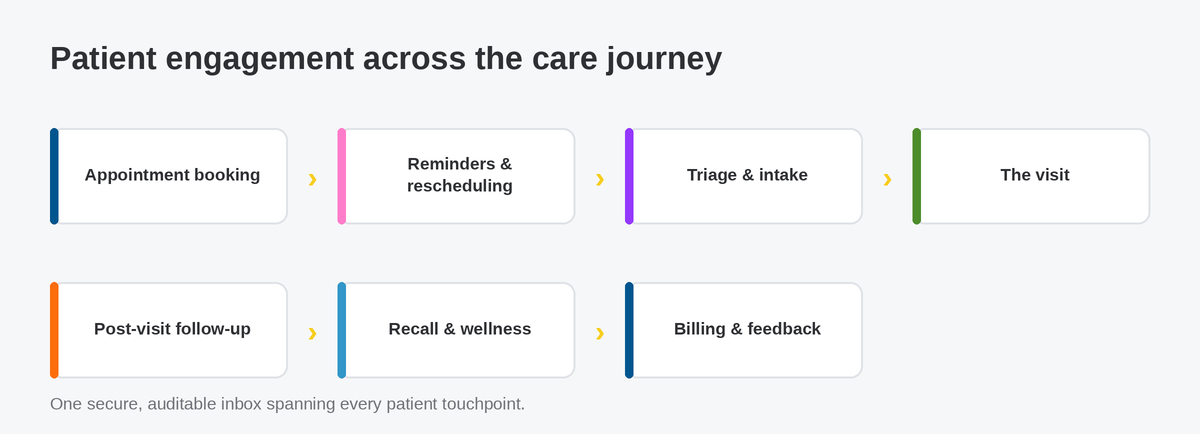
How APAC Healthcare Providers Use Patient Engagement Across the Care Journey
How to Choose a Patient Engagement Platform: A 2026 Evaluation Checklist
Patient Engagement Platforms: FAQ, Key Takeaways, and Next Steps
A patient engagement platform is software that unifies every conversation a healthcare provider has with a patient — appointment booking and reminders, triage and intake, post-visit follow-up, recall and wellness programmes, billing and feedback — across the messaging channels patients actually use, inside one secure, auditable inbox. It sits between your clinical systems (the electronic medical record, the practice-management or hospital-information system) and the patient’s phone, then layers automation and AI on top so a small front-desk team can handle a high volume of conversations without dropping any.
For providers across Asia-Pacific, the channel mix is the reason this category matters. Patients in Hong Kong, Singapore, Malaysia, and Indonesia live on WhatsApp, WeChat, and Instagram far more than on email or web portals, and they expect a reply in minutes, not days. A tool that only pushes one-way SMS, or a patient portal that assumes patients will log in, no longer matches how people communicate. The World Health Organization’s work on digital health frames the same shift: engagement happens on the channels patients prefer, or it does not happen at all.
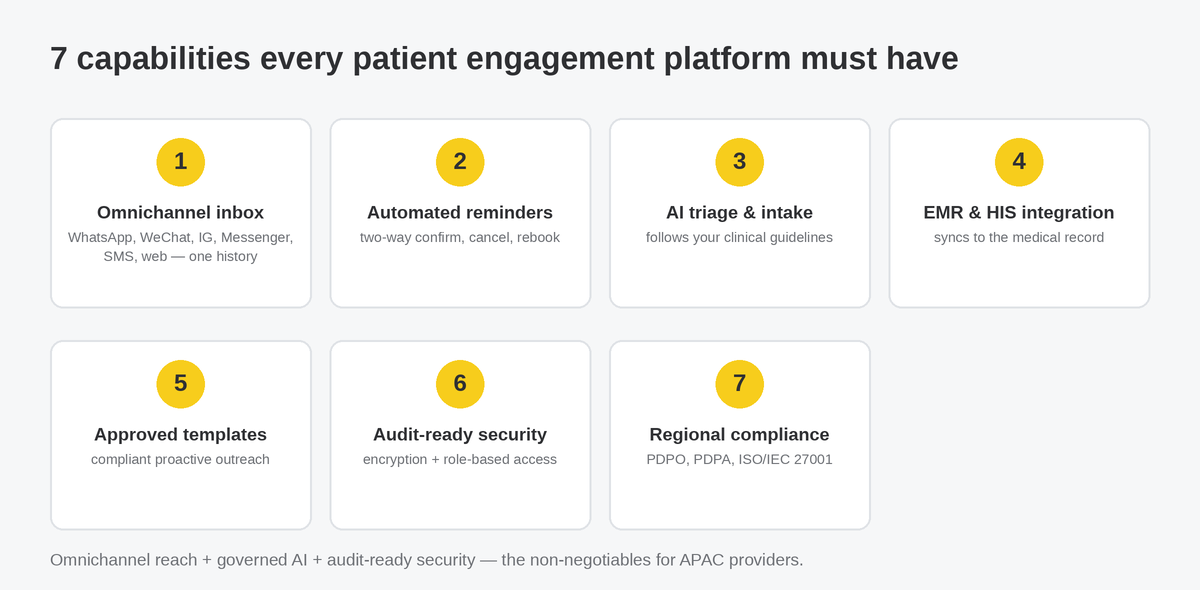
Here are the seven capabilities this guide covers — the checklist to hold any patient engagement platform against in 2026:
The rest of this article explains how the category differs from the tools you already run, what each capability should actually do, and how to evaluate vendors — with the security and compliance detail that APAC healthcare buyers are personally accountable for.
The three tools most clinics start with each solve a slice of the problem and leave the rest exposed. SMS is reliable for a single reminder but cannot hold a conversation, carries no rich media, and is priced per segment. Patient portals assume the patient will download an app or remember a password — adoption in most APAC markets stays low because patients already have WhatsApp open. Generic website chatbots answer FAQs but rarely connect to the record, escalate poorly to a human, and have no concept of clinical safety.
| Capability | SMS reminder tool | Patient portal | Generic chatbot | Patient engagement platform |
|---|---|---|---|---|
| Two-way conversation | Limited | Login required | Scripted only | Yes, on every channel |
| Channels patients prefer (WhatsApp, WeChat) | No | No | Web only | Yes |
| Proactive, opt-in outreach | Basic | No | No | Approved templates |
| AI triage bound to clinical guidelines | No | No | Rarely | Yes, governed |
| Syncs with EMR / HIS | Rarely | Native to one system | No | Via integration |
| Audit logs and access controls | Minimal | Varies | Minimal | Built in |
The pattern is clear: the older tools each cover one column and force staff to bridge the gaps by hand. A patient engagement platform consolidates the columns so the conversation, the record, and the compliance trail stay in one place. That consolidation is also where the operational return lives — fewer no-shows because reminders are two-way, shorter response times because every channel lands in one queue, and less administrative time lost to swivel-chairing between systems. For a deeper look at how a single inbox changes day-to-day operations, see our guide to the WhatsApp features every business should use in 2026.
Every patient channel — WhatsApp, WeChat, Instagram, Facebook Messenger, SMS, and web chat — should arrive in a single shared inbox with the full conversation history attached to the patient, regardless of which channel they used last. For Greater China and APAC providers, WeChat coverage is not optional; for everyone, WhatsApp is the anchor. Ask whether the platform is an official WhatsApp Business Platform partner, because that determines reliability and feature access.
A reminder that a patient can reply to — to confirm, cancel, or rebook — recovers the slot that a one-way SMS simply loses. The platform should send the reminder on the patient’s preferred channel, accept the reply, and write the outcome back to the schedule without a staff member retyping it.
This is where healthcare diverges sharply from retail. An AI assistant can collect symptoms, route urgent cases to a clinician, and complete intake forms before a visit — but only safely if it is governed by your clinical protocols and escalation rules rather than improvising from a generic model. The honest framing is that AI handles structured, repetitive intake and triage so clinicians spend their time on judgement; it does not replace clinical decision-making. We unpack that division of labour in balancing AI and human interaction in customer experiences.
If the conversation does not sync with the electronic medical record or hospital information system, you have created a second, unreconciled record. The platform should connect via API to your existing stack so patient identity, appointment status, and consent flags stay consistent across systems.
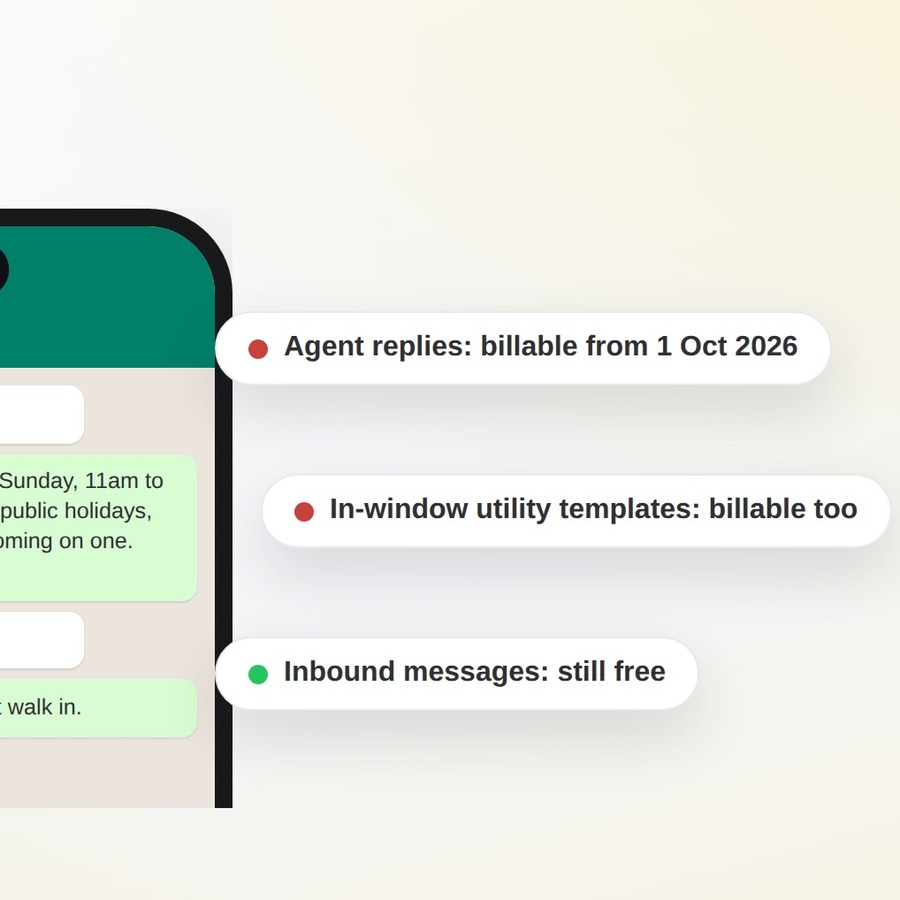
Proactive messages on WhatsApp must use pre-approved message templates (historically called Highly Structured Messages, or HSM), and they only reach patients who have opted in. Outside the 24-hour customer-service window, templates are the compliant way to send a reminder or a recall. A capable platform manages template approval, categorisation (utility, marketing, authentication), and opt-in records for you.
Encryption in transit and at rest, role-based access so a receptionist sees only what they need, and a complete, exportable message log are the minimum. In a regulated setting, “we can see who said what to which patient and when” is not a nice-to-have — it is what an auditor or regulator will ask for.
The platform must help you meet the Personal Data (Privacy) Ordinance (Cap. 486) in Hong Kong and its equivalents across the region, and it should be able to evidence its own security posture through certification such as ISO/IEC 27001. The next section covers exactly what that means market by market.
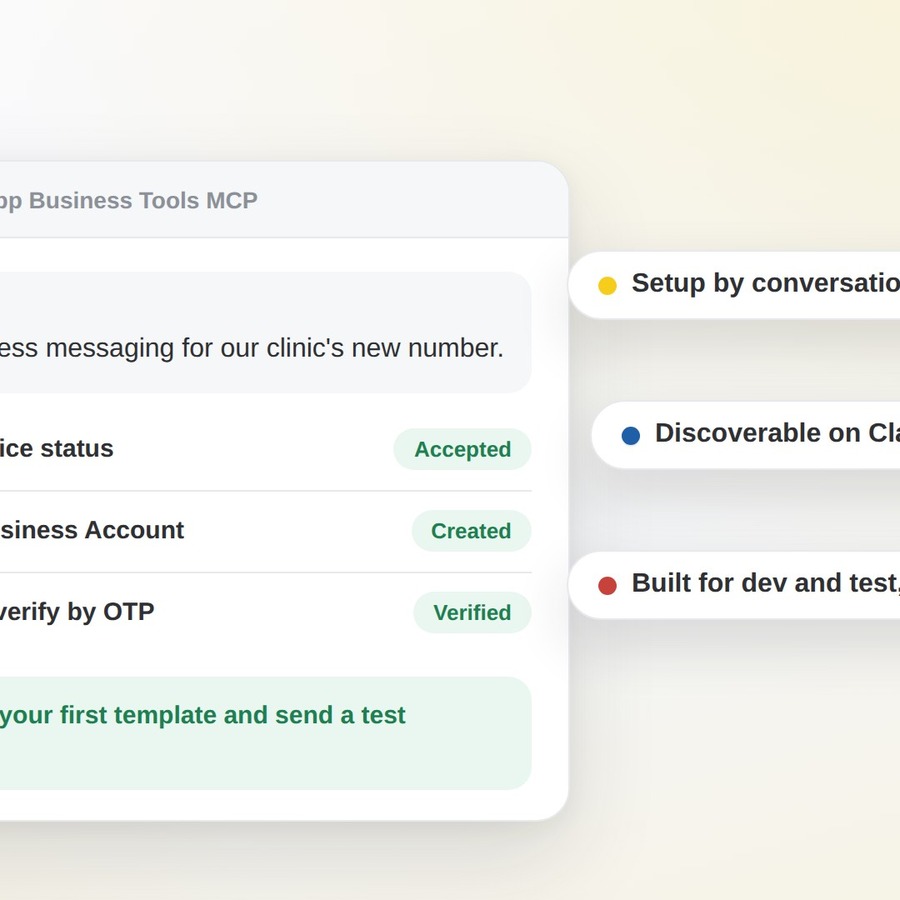
One naming note that trips up buyers: the WhatsApp Business Platform is also called the WhatsApp Business API, WABA, or the WhatsApp Cloud API — they refer to the same programmatic product that powers a patient engagement platform, distinct from the free consumer WhatsApp app. If you want that distinction in full, read WhatsApp Business explained: app vs API vs platform.
Compliance for patient messaging rests on three pillars: a lawful basis to message the patient (consent and purpose limitation), security controls proportionate to the sensitivity of health data, and the ability to evidence both. Here is how the main APAC markets frame the obligation.
| Market | Primary data law | Regulator | What healthcare providers must do |
|---|---|---|---|
| Hong Kong | Personal Data (Privacy) Ordinance, Cap. 486 (Part VIA governs direct marketing) | PCPD | Collect explicit consent, limit use to the stated purpose, secure the data, honour opt-out |
| Singapore | Personal Data Protection Act (PDPA) | PDPC | Consent, purpose limitation, protection and retention limits; data-breach notification |
| Malaysia | Personal Data Protection Act 2010 | JPDP | Consent for processing, security and retention principles, cross-border transfer rules |
| Indonesia | Personal Data Protection Law (UU PDP), Law No. 27/2022 | Authority under the Ministry of Communications | Lawful basis, data-subject rights, security obligations and breach reporting |
Across all four, the practical checklist is consistent: record opt-in before you message, keep messaging to the purpose the patient agreed to, restrict who can read conversations, retain records only as long as needed, and be ready to show your controls. In Hong Kong specifically, Part VIA of the PDPO governs direct marketing — wellness promotions and non-clinical offers need their own consent, separate from clinical communication.
Security certification is how a vendor proves the second pillar without asking you to take their word for it. ISO/IEC 27001 is the international standard for an information security management system; a provider that holds it has had its controls independently audited. imBee is ISO 27001-certified, which means enterprise-grade security is part of the platform from day one rather than a line item on a roadmap — the detail is in imBee’s commitment to security and ISO 27001 certification. For healthcare and financial-services buyers, that certification is usually a procurement gate, not a bonus. Providers should also align with local clinical-governance guidance, such as that issued by the Hong Kong Hospital Authority and the Department of Health.
| Care stage | What happens | Best channel | Automated or human |
|---|---|---|---|
| Pre-visit | Booking, confirmations, reminders, prep instructions | WhatsApp, WeChat, SMS | Automated, with human fallback |
| Intake | Registration forms, history, insurance, triage questions | WhatsApp Flows, web chat | Automated, clinician-reviewed |
| In-visit | Queue position, room-ready alerts, wayfinding | WhatsApp, SMS | Automated |
| Post-visit | Follow-up, results notification, e-prescription alerts, aftercare | WhatsApp, secure web | Mixed |
| Ongoing | Recalls, chronic-care check-ins, wellness and vaccination reminders | WhatsApp, WeChat | Automated, opt-in |
| Administrative | Billing, payment links, feedback and CSAT surveys | WhatsApp, SMS | Automated |
A few concrete pictures of how this plays out across the region. A private hospital in Singapore can run intake before arrival using a form-in-chat flow, so registration is complete and triaged before the patient sits down — cutting waiting-room congestion and freeing reception. A specialist clinic in Hong Kong can send results-ready notifications on WhatsApp with a secure link rather than playing phone tag, and let patients rebook a follow-up by replying. A dental or optical chain can run recall and wellness programmes on opt-in templates, recovering the revenue that lapses when patients simply forget their six-month check.
The thread running through all of it is that proactive, two-way messaging on the patient’s own channel does the work that one-way reminders and login-gated portals cannot. Missed appointments are a well-documented drain on clinic capacity worldwide; the mechanism that reduces them is not a louder reminder but an easier reply. When the reminder, the reschedule, and the record update happen in one thread, the slot gets refilled instead of lost.
Run every shortlisted vendor through these checks before a demo flatters you into skipping them:
This is the point where the category and a specific product meet. imBee was built for exactly this profile of buyer — a unified omnichannel inbox spanning WhatsApp, WeChat, Instagram, and more; an enterprise AI assistant, imBee AI, that answers from your own guidelines rather than a generic model; ISO 27001-certified security; and 300-plus integrations to connect the stack you already run. The point of naming it is not the pitch but the shape: a patient engagement platform for APAC healthcare needs all seven capabilities and the compliance posture together, not a messaging widget with a few of them.
Key takeaways. A patient engagement platform unifies appointment reminders, triage, follow-up, recalls, and billing across WhatsApp, WeChat, SMS, and web chat in one secure inbox. It beats standalone SMS, patient portals, and generic chatbots because it is two-way, runs on the channels APAC patients actually use, and keeps the conversation, the record, and the compliance trail in one place. The seven capabilities to insist on are omnichannel messaging, automated reminders, governed AI triage, EMR integration, approved templates, audit-ready security, and PDPO / PDPA / ISO 27001 compliance.
What is a patient engagement platform?
It is software that unifies every patient conversation — booking, reminders, triage, follow-up, recalls, and billing — across the channels patients use, such as WhatsApp, WeChat, and SMS, in one secure, auditable inbox. It connects to your EMR and adds automation and AI so a small team can manage a large volume of conversations compliantly.
What is the difference between a patient engagement platform and a patient portal?
A portal is a destination patients must log into, usually tied to one clinical system, and adoption is typically low in APAC. A patient engagement platform meets patients on the messaging apps they already use, supports two-way conversation across channels, and works proactively rather than waiting for the patient to sign in.
Is WhatsApp compliant for patient messaging in Hong Kong?
It can be, when used through the WhatsApp Business Platform with explicit patient consent, purpose limitation, and proper security. Compliance depends on how you handle the data under the PDPO (Cap. 486), not on WhatsApp alone. Part VIA additionally governs direct-marketing messages such as wellness promotions, which need separate consent.
What is the difference between the WhatsApp Business API, WABA, and WhatsApp Cloud API?
They name the same thing. The WhatsApp Business Platform — also called the WhatsApp Business API or WABA — is the programmatic product for organisations; the WhatsApp Cloud API is Meta’s cloud-hosted way of accessing it. All are distinct from the free consumer WhatsApp app and the small-business WhatsApp Business app.
Do patient engagement platforms reduce no-shows?
They reduce the friction that causes no-shows. A two-way reminder a patient can answer to confirm or rebook recovers slots that one-way SMS loses. Missed appointments are a documented drain on capacity, and the mechanism that helps is an easier reply on the patient’s preferred channel, not a louder reminder.
Is patient data on these platforms secure?
It should be protected by encryption in transit and at rest, role-based access controls, and complete message logs. The clearest external proof is independent certification such as ISO/IEC 27001, which means a provider’s security controls have been audited rather than merely asserted. Treat that certification as a procurement requirement for health data.
Can AI safely handle patient inquiries?
AI can safely handle structured, repetitive work — intake, FAQs, routing, and first-line triage — when it is governed by your clinical guidelines and escalates anything outside them to a clinician. It supports, rather than replaces, clinical judgement. Generic, ungoverned chatbots are not appropriate for clinical contexts.
How much does a patient engagement platform cost in APAC?
Pricing usually combines a platform subscription with WhatsApp’s own conversation-based charges, so total cost depends on conversation volume and the channels you enable. Insist on transparent, forecastable pricing, and ask vendors to model your real volumes rather than quoting a headline per-message rate.
If you are evaluating how a unified, AI-ready inbox would work for your clinics or hospital, book a demo with imBee and we will map it to your patient journey, or try imBee for free to see the omnichannel inbox first-hand.
Last updated 18 June 2026.

Start your 30-day free trial today. Supercharge your team's productivity by over 30% and take your business to new heights of success.