Why Allotment Day Is the Busiest Hour in a Hong Kong Brokerage
What an IPO Notification Programme Actually Has to Deliver
SMS, Email, App Push or WhatsApp: What Reaches a Retail Client on Results Day?
What to Look For in an IPO Notification Platform
Consent, Records and Supervision: What the SFC and the PDPO Expect
How to Run the First Deal Without Overloading the Desk
What IPO Alerts Cannot Fix
A mid-sized brokerage in Sheung Wan takes several thousand retail subscriptions across a single Main Board offer. The subscription window itself is uneventful. Then the allotment results are published, and within twenty minutes the client service line has a queue of callers asking a version of the same four questions: was my application successful, how many shares did I get, when is the balance refunded, and when can I sell.
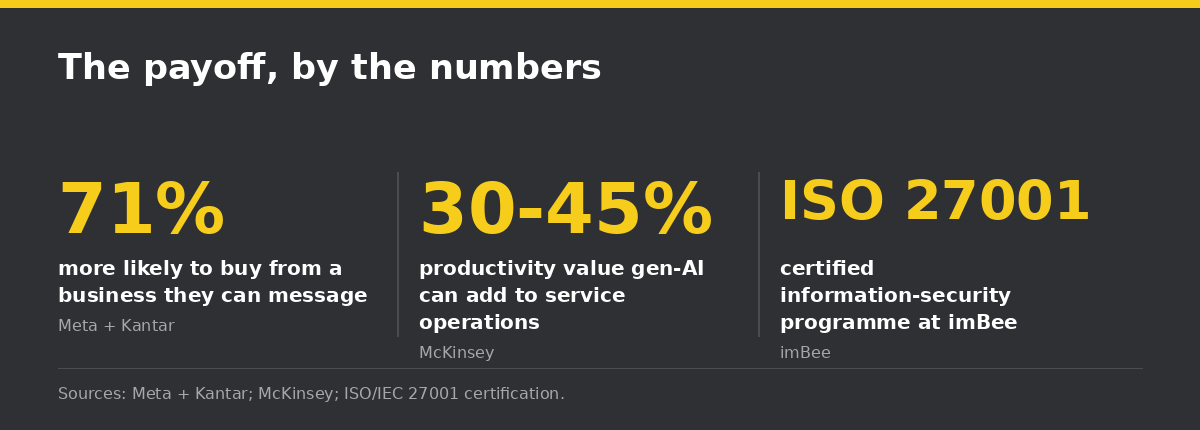
The payoff, by the numbers
Before the detail, here is why this is worth the team’s time:
None of those questions are difficult. Every answer already sits in the brokerage's own records before the first call lands. The problem is distribution. A team of client-facing staff is answering identical questions one conversation at a time, in the narrow window where clients care most and where a slow answer is remembered for the next deal.
Hong Kong's IPO timetable has raised the stakes rather than lowered them. Since HKEX introduced its FINI platform for new listings, the settlement cycle for Hong Kong IPOs has been compressed to T+2 from the much longer window the market ran on for years. Less time between pricing, allotment and dealing means less slack for a brokerage that plans to answer client questions reactively.
This is the operational problem an IPO notification programme solves. It is not a marketing exercise. It is the deliberate, templated delivery of information the client is already entitled to, on a channel they will actually open, before they pick up the phone.
Treating IPO messaging as a single alert is the most common design mistake. A retail client experiences a new listing as a sequence of decision points, and each one has a different urgency, a different audience and a different regulatory character.
The offer opens. This is the only genuinely promotional moment in the sequence, and it is the one that carries the heaviest consent burden. Telling a client that a new offer is available, with the closing date and the lot size, is an invitation to subscribe. It reaches a broad list rather than a specific client's account, so it needs a marketing-grade opt-in and a working opt-out.
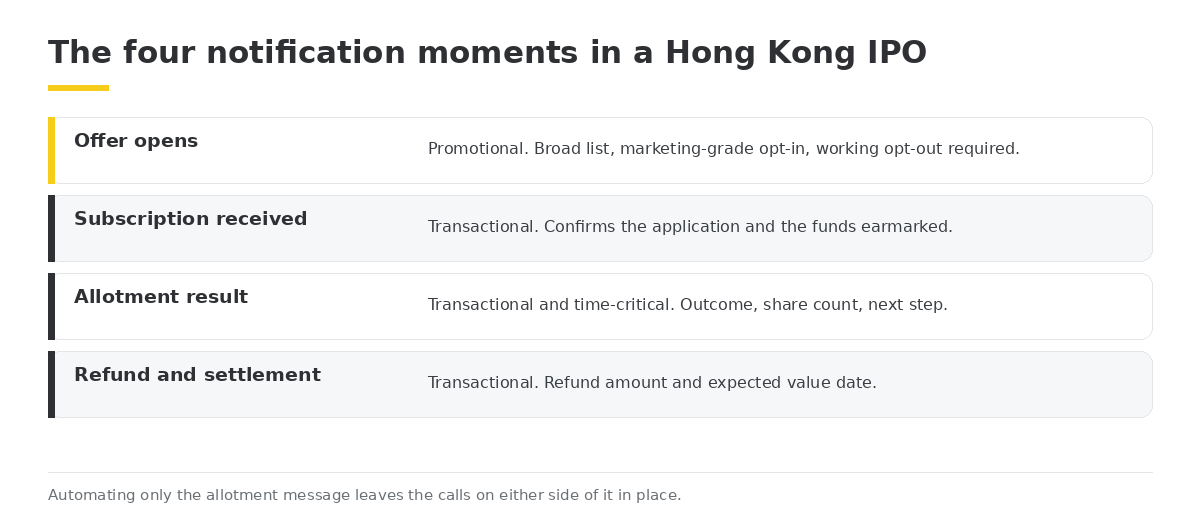
The subscription is received. A confirmation that the application has been accepted and the application money earmarked is transactional. It goes to one named client about one instruction they gave. It is short, it is expected, and it removes a whole category of anxious follow-up calls.
The allotment result is published. This is the message that decides how the deal feels to the client. It has to state the outcome plainly, give the number of shares allotted, and say what happens next. It also has to arrive close to the official announcement, because a client who reads the result on a news site before hearing from their broker has learned something about the broker.
Funds are returned and the position settles. Refunds of unsuccessful or partially successful applications generate the second wave of calls. A short message confirming the refund amount and the expected value date closes the loop.
Automating only the third message is better than nothing, but it leaves the calls on either side of it in place. The value comes from covering the whole sequence with one template set and one audit trail.
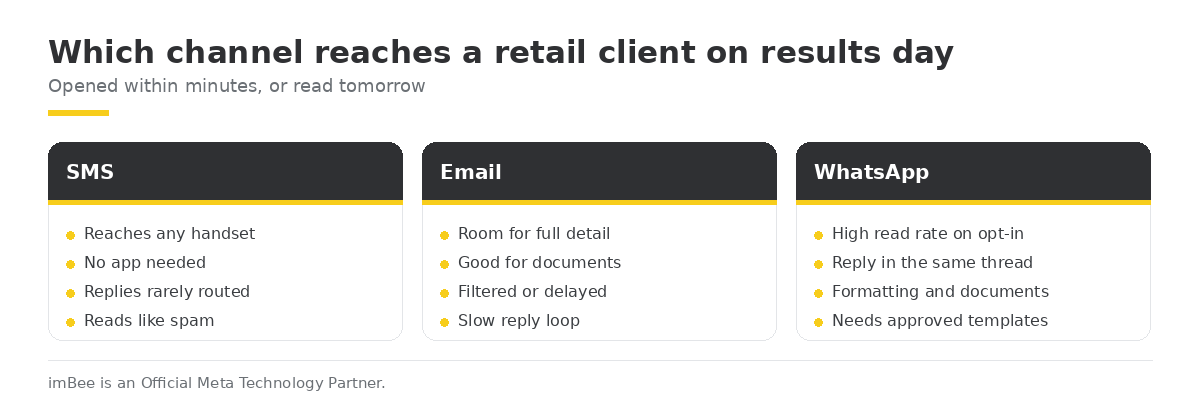
Most Hong Kong brokerages already have three channels available and use them badly: SMS for anything urgent, email for anything long, and an app push notification that a large share of clients have quietly switched off. The right comparison is not cost per message. It is whether the message is opened inside the window where it changes the client's behaviour.
| Channel | Strength on results day | Where it fails | Best use |
|---|---|---|---|
| SMS | Reaches any handset, no app or account needed | No rich formatting, replies rarely routed to a human, easily mistaken for spam | A one-line fallback for clients with no messaging consent |
| Room for the full allotment table and disclosures | Transactional mail is filtered or read hours later | The formal confirmation and any documents | |
| App push | Free at the margin, ties back to the account | Depends on the app being installed and notifications enabled | Clients who are already active app users |
| High read rate on opt-in messages, replies land in the same thread, supports formatting and documents | Requires opt-in and pre-approved templates | Subscription, allotment and refund confirmations |
On the WhatsApp Business Platform, an allotment result is sent as an approved Utility template, because it relates to a transaction the client has already entered into. The announcement that a new offer has opened is a Marketing template, with a different consent expectation and a different price. Mixing the two — sending an offer announcement inside a Utility template because it is cheaper — is the most common reason a brokerage's templates are rejected or its quality rating falls.
Cost is a live consideration in 2026. Meta has moved its rate card to per-message pricing for template messages, and from 1 October 2026 service messages and utility templates sent inside the customer service window become billable rather than free. A brokerage that plans to send four templates per client per deal should model that arithmetic before it commits to volumes.
Every messaging vendor can send a bulk message. The differences show up on the second deal, when someone asks who authorised a template change, or why 300 clients received a result twice.
Template governance with an approval trail. An IPO message contains numbers that a client will act on. You need to know who drafted a template, who approved it, and which version was live when a given message was sent.
Variables that come from the record, not a spreadsheet. Allotment numbers pasted by hand into a broadcast tool will eventually be pasted into the wrong row. The template variables should be filled from the system of record for the subscription.
A reply path that reaches a licensed person. Clients will answer an allotment message with questions about selling. That reply must land in a monitored, assignable inbox where a licensed representative can respond, not in a no-reply void.
Role-based access and named accounts. Shared logins make it impossible to say who saw a client's holdings. Access should be per user, with permissions that match the person's licensing.
Exportable, complete records. If the regulator asks for every communication with a client about a specific offer, that should be an export, not a project.
Traditional Chinese and English in the same workflow. A Hong Kong retail book is bilingual. Running two disconnected template sets in two tools is how the Chinese version ends up a version behind.
| Question to ask the vendor | What a good answer looks like |
|---|---|
| How are template variables populated? | Directly from the subscription record through an integration, with a dry-run preview |
| Who can approve a template? | A named approver role, with the change history retained |
| Where do client replies go? | A shared inbox with assignment, tagging and full history per client |
| How is access controlled? | Named user accounts with role-based permissions and login records |
| How do we retrieve a client's message history? | Self-service export covering all channels for a defined date range |
| What happens if a send fails midway? | Per-message delivery status and a safe resend that will not duplicate |
imBee sits in this category as an Official Meta Technology Partner, with an omnichannel inbox, role-based access, retention controls and audit logging across WhatsApp, WeChat and the other channels a Hong Kong retail book uses. Working with 10,000+ enterprises across 60+ industries has made one thing consistent: the platforms that survive a busy quarter are the ones where the reply loop was designed before the first broadcast.
A brokerage sending client notifications in Hong Kong is operating inside two frameworks simultaneously, and they ask different questions. Personal data law asks whether you were allowed to use the client's contact details for this purpose. Securities regulation asks whether you can produce the communication later, and whether it was supervised.
Under the Personal Data (Privacy) Ordinance (Cap. 486), the six data protection principles govern how contact details are collected, used, kept secure and retained. Using a client's mobile number to confirm a subscription they submitted is a use directly related to the purpose of collection. Using the same list to announce an unrelated offer is direct marketing, and Part 6A of the Ordinance sets specific requirements for that, including notifying the client and giving them a route to opt out.
On the securities side, licensed corporations are expected to keep records of client communications and to be able to produce them. The Securities and Futures (Keeping of Records) Rules (Cap. 571O) set the retention framework, and SFC guidance on external electronic data storage means that if those records sit with a third-party provider, the licensed corporation must still be able to give the regulator access to them. Confirm the current retention period and the specific arrangements with your compliance function rather than accepting a platform's default.
| What a reviewer will ask | What you need to be able to show |
|---|---|
| Was the client's consent obtained for this channel? | A timestamped consent record and the route it came through |
| Was this message transactional or promotional? | Template category, content and the client relationship it relates to |
| Who sent it, and who approved the wording? | Named user attribution and a template approval history |
| Can you retrieve every message about this offer? | A complete, exportable communication log per client and per deal |
| How long are the records kept, and where? | A documented retention period and a data-location record for the provider |
| Who could see the client's data? | Role-based permissions and access logs |
imBee's platform provides role-based access, retention settings and audit logging so a licensed corporation can support these obligations. The brokerage remains the data user under the Ordinance and the regulated entity under its licence; no platform assumes those responsibilities on your behalf. Anyone who tells you otherwise is selling.
The sequence below front-loads the two decisions that stall most rollouts: which clients you are actually allowed to message, and who answers when they reply.
Audit the consent you hold today. Mobile numbers collected years ago for account opening were often collected for calls and statements, not for messaging. Separate the clients you can message transactionally from those you can also message about new offers, and start capturing a clean messaging opt-in at account opening and at every client review.
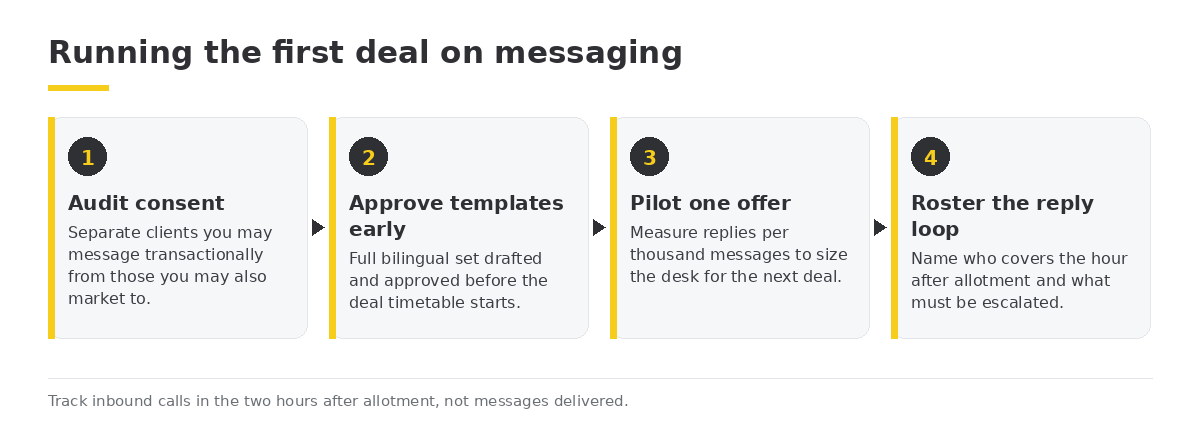
Build and approve the template set before the deal, not during it. Templates require approval, and a deal timetable is not the moment to discover that a wording change resets the clock. Draft the full set — offer open, subscription received, allotment result, refund confirmed — in both English and Traditional Chinese, and put them through internal compliance review together.
Pilot on one offer with one client segment. Choose a single, well-understood offer and a segment large enough to be representative but small enough that the desk can absorb the replies. The point of the pilot is to measure reply volume per thousand messages, which is the number that determines staffing for the next deal.
Roster the reply loop explicitly. Decide who covers the hour after the allotment announcement, what a licensed representative may answer in writing, and what has to be escalated to a call. Publish the routing rules before the send, not after the first difficult question.
Instrument the right measure. Messages delivered is a vanity number. Track inbound call volume in the two hours after the allotment announcement, compared with your last comparable deal. That is the figure that pays for the programme.
Review the templates after the deal closes. Look at which messages produced a clean acknowledgement and which produced a follow-up question. The questions tell you exactly what the template failed to say, and the second version is always shorter than the first.
Notifications remove the friction of asking. They do not change the underlying economics of a deal, and a brokerage that expects them to will be disappointed at the first review.
They do not make an unpopular allocation popular. A client who applied for a large position and received a single board lot is disappointed regardless of how elegantly they are told. What good messaging changes is whether they also feel ignored.
They do not replace suitability and licensing obligations. A templated message cannot give advice. The moment a client asks whether they should hold or sell, the conversation belongs to a licensed representative, and the platform's job is to route it there quickly with the full history attached.
They do not fix a data pipeline that is late. If allotment numbers reach the client-facing systems hours after the public announcement, no channel saves you. The messaging layer is only as timely as the record it reads from.
They do not create consent retrospectively. A client who never opted in cannot be messaged because the deal is important. The cheapest long-term fix is almost always better consent capture at onboarding, which raises the reachable share of the book for every future offer.
| Symptom after the first deal | Likely cause | Where the fix sits |
|---|---|---|
| Call volume unchanged | Message arrived after the public announcement | Data pipeline timing, not the channel |
| Low delivery rate | Consent never captured for messaging | Onboarding and client review process |
| Clients replying with advice questions | No routing to a licensed representative | Inbox routing and desk roster |
| Template rejected before the deal | Promotional content in a Utility template | Template category discipline |
| Chinese version out of date | Two template sets in two tools | Single bilingual template library |
| Duplicate messages to some clients | Manual list handling between systems | Integration with the subscription record |
Set these limits out before the procurement conversation. IPO notifications are a strong, measurable fix for a narrow and expensive problem: the predictable spike of identical questions in the hour after allotment. They are not a substitute for a timely data pipeline, and they will not paper over a client book you never obtained permission to message.
What is an IPO allotment notification?
It is a message telling a client the outcome of their IPO subscription: whether the application succeeded, how many shares were allotted, and what happens to the unused application money. Brokerages send it immediately after the official allotment results are published, so clients do not have to call in to find out.
Can Hong Kong brokerages send IPO alerts on WhatsApp?
Yes, provided the client has opted in and the message is sent through the WhatsApp Business Platform using an approved template. A subscription or allotment confirmation is a Utility template because it relates to a transaction the client entered into. An announcement that a new offer has opened is Marketing, and carries a different consent expectation.
What is the difference between a Utility and a Marketing template here?
A Utility template concerns an existing transaction: subscription received, allotment result, refund issued. A Marketing template promotes something the client did not specifically request, such as news that a new offer is open. They differ in consent requirements and in price, and sending promotional content inside a Utility template is a common cause of template rejection.
How quickly should the allotment message go out?
As close to the official announcement as your data pipeline allows. The value of the message is that it reaches the client before they check a news site or call the desk. If allotment data reaches your client-facing systems hours late, fixing that timing matters more than changing the messaging channel.
What records does the SFC expect for client messaging?
Licensed corporations are expected to keep records of client communications and produce them on request. The Securities and Futures (Keeping of Records) Rules (Cap. 571O) set the framework, and SFC guidance on external electronic data storage means records held with a third-party provider must still be accessible to the regulator. Confirm current periods with your compliance function.
Does the PDPO treat an IPO alert as direct marketing?
Not usually. Confirming a subscription or an allotment for a client who applied is a use directly related to the purpose the data was collected for. Announcing a new offer to a broad client list is direct marketing, and Part 6A of the Personal Data (Privacy) Ordinance (Cap. 486) sets specific notification and opt-out requirements for that.
How has FINI changed the timing pressure on brokerages?
HKEX's FINI platform compressed the Hong Kong IPO settlement cycle to T+2, well short of the timetable the market ran on previously. Less time between pricing, allotment and the start of dealing leaves brokerages less slack to answer client questions reactively, which is why templated notifications have moved from convenience to necessity.
Do we still need SMS if we use WhatsApp?
Usually yes, as a fallback. Not every client will opt in to messaging, and a short SMS remains the only channel that reaches a handset with no app, account or consent to a messaging platform. The practical pattern is messaging for the clients who consented, SMS for the remainder, both driven from the same record.

Kelly S.
Content Team Lead, imBee
Kelly S. owns content strategy, product positioning, and customer education at imBee. Previously, Kelly led B2B SaaS content programs and supported go-to-market initiatives for customer engagement products. On the imBee blog, Kelly covers conversational commerce, omnichannel messaging, WhatsApp Business, customer experience, and strategies for scaling business communications.
Questions about anything in this article? Talk to our team.
Discuss your channels, team and conversation handover needs in a product demo.