Why Volunteer Coordination Breaks on the Friday Before, Not on the Day
What Volunteer Coordination on WhatsApp Actually Involves
Personal WhatsApp, Groups, Broadcast Lists or the Business Platform?
What to Look For in a Volunteer Messaging Setup
Consent, Disclosure and Duty of Care Under the PDPO
Rolling It Out on One Programme First
What Messaging Cannot Fix
A programme manager at a Sham Shui Po food-support charity has forty volunteers rostered for Saturday morning. By Friday evening she has confirmations from twenty-two of them, and those confirmations are scattered across three WhatsApp groups, a handful of one-to-one threads, two SMS replies and a shared spreadsheet that one colleague updates and another forgets to open. She does not know whether the packing line will be short-handed until people arrive.
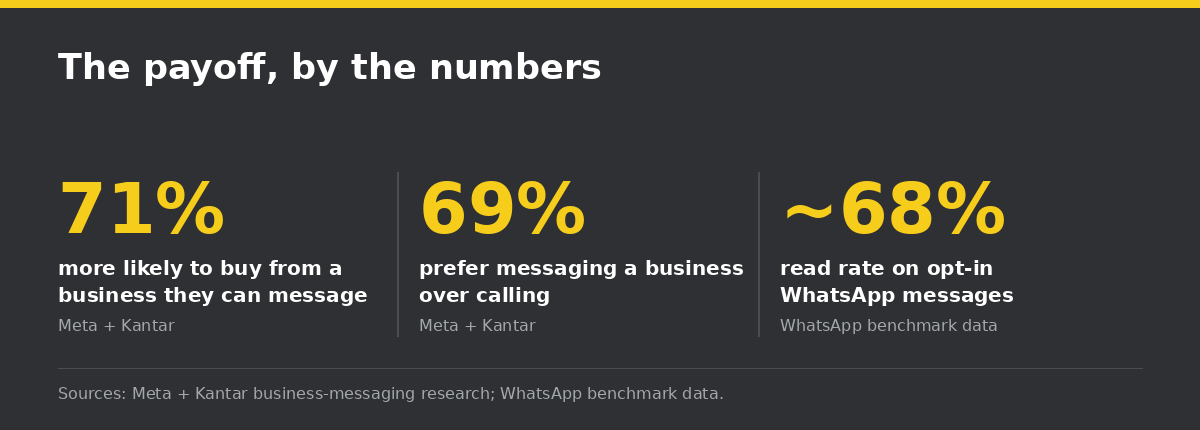
The payoff, by the numbers
Before the detail, here is why this is worth the team’s time:
Nothing in that description is a technology failure. The volunteers are willing, the roster exists, and everybody has WhatsApp. What is missing is a reliable loop: a message that reaches the right people, an easy way for them to answer, and a single place where the answers land.
Small NGOs feel this most acutely because coordination sits on one or two staff members who are also running the programme itself. Every hour spent chasing confirmations is an hour not spent on service delivery. And because volunteer effort is donated, the cost of poor coordination is invisible in the accounts — it shows up as burnout and attrition instead.
This guide covers what volunteer coordination on WhatsApp actually involves, how the four realistic setups compare, what Hong Kong's Personal Data (Privacy) Ordinance expects of you when you hold volunteer contact details, and how to roll a system out on one programme before it touches the whole organisation.
Most organisations start by thinking of WhatsApp as a faster way to send the shift list. In practice, a setup that saves a coordinator real hours does four separate things, and only the first is a broadcast.
It publishes the shift. The right people receive the right roster — not every volunteer on the books, and not the wrong site. Segmenting by programme, by skill and by availability window is what keeps message volume low enough that people keep reading.

It captures the reply. A one-way roster tells you nothing about who is coming. The volunteer needs to confirm, decline or ask a question without leaving the thread, and the answer has to reach whoever owns the roster rather than sitting unread in a personal phone.
It reminds and re-checks. A confirmation given three weeks out is not the same as a confirmation given the night before. Short, well-timed reminders convert silent no-shows into early declines, which is the only kind you can actually act on.
It keeps a record. Volunteer hours, briefings issued, safeguarding notices acknowledged, and who was told what before an activity — these matter for funder reporting and for your own duty of care. If the record lives in one staff member's handset, it leaves when they do.
Framed that way, the question stops being which app to use and becomes which setup can support all four jobs without turning a coordinator into a full-time message router.
Almost every Hong Kong NGO already uses at least one of these. Knowing where each one runs out of road saves an expensive migration later.
Personal WhatsApp on a staff phone works until the staff member takes leave. The organisation has no access to the history, no way to hand over, and no record if the person moves on. It also puts a volunteer's personal number and a colleague's personal number in the same private thread, which is a governance problem before it is a technical one.

WhatsApp groups are the default and they scale badly in a specific way: every participant can see every other participant's phone number. For a general-interest volunteer group that may be acceptable if people are told; for a group involving service users, young people or anyone with a safety concern, it is a disclosure you cannot take back. Groups also have a participant cap, and once a group is busy, the roster message is buried under chat within the hour.
Broadcast lists in the consumer app solve the privacy problem — recipients cannot see each other, and replies come back privately. The catch is decisive: a broadcast only reaches people who have saved your number in their own contacts. Most volunteers will not have. Delivery quietly fails for a large share of the list, and the sender gets no signal that it happened.
The WhatsApp Business Platform removes those limits. Messages are sent from a verified business number, opt-in is explicit, several coordinators can work the same inbox with assignment and handover, and the conversation history belongs to the organisation. In exchange, outbound messages outside an open conversation window must use an approved template, and messages are charged under Meta's published rate card rather than being free.
| Setup | Who can see whom | Reply handling | Where it breaks |
|---|---|---|---|
| Personal WhatsApp | One-to-one, staff number exposed | Fine, but trapped on one handset | Staff leave, no handover, no record |
| WhatsApp group | Everyone sees every number | Buried under chat | Disclosure risk, participant cap, noise |
| Broadcast list | Recipients cannot see each other | Replies arrive privately | Only delivers to people who saved your number |
| WhatsApp Business Platform | One-to-one from a verified number | Shared inbox with assignment | Template approval and per-message cost |
For a small volunteer pool that already has the coordinator saved, a broadcast list is a reasonable starting point. Beyond roughly one programme, or the moment service users are involved, the exposure and delivery problems make the Business Platform the sensible base.
imBee is an Official Meta Technology Partner and connects the WhatsApp Business Platform to a shared team inbox, so coordination survives a staff change rather than living on a personal phone.
Run any shortlisted option through the same set of questions, and weight them for an organisation where the coordinator is also the programme lead.
Can several people work the same conversation? Assignment, internal notes and a visible owner per thread are what stop two staff answering the same volunteer differently.
Can you segment without rebuilding lists by hand? Tagging volunteers by programme, language, site and availability is the difference between a message people read and one they mute.
Does it support Traditional Chinese and English in one workflow? Most Hong Kong volunteer pools are mixed, and forcing a coordinator to maintain two parallel systems guarantees one falls behind.
Is consent recorded, not assumed? You need to show when a volunteer agreed to be contacted and through which route, especially if you later want to send anything beyond operational messages.
Can you export the record? Funder reporting on volunteer hours and activity is easier when the conversation history and tags can leave the tool in a usable format.
What happens on a staff change? If offboarding means a personal phone walks out of the building with the volunteer relationships on it, the tool has not solved the original problem.
| Requirement | Why it matters for an NGO | What good looks like |
|---|---|---|
| Shared inbox | Coordination outlives one staff member | Named users, assignment, internal notes |
| Segmentation | Fewer, more relevant messages | Tags by programme, site, language, skill |
| Bilingual workflow | Mixed volunteer pools are the norm | One inbox, both languages, no parallel system |
| Consent record | Evidence of what you may send | Timestamped opt-in with the collection route |
| Export | Funder and board reporting | Structured export of activity and tags |
Cost matters, but it is rarely the deciding factor at NGO volume. The deciding factor is whether the setup reduces coordinator hours enough to be worth the change.
Hong Kong's Personal Data (Privacy) Ordinance (Cap. 486) applies to charities and NGOs in the same way it applies to a commercial organisation. The six data protection principles cover how you collect volunteer data, how accurate you keep it, how long you retain it, what you use it for, how you secure it, and how a volunteer can access it.
Two points bite hardest in volunteer coordination. The first is purpose. A phone number collected on a sign-up form for shift coordination has been collected for that purpose; using the same list to solicit donations is a different use, and direct marketing carries specific requirements including the individual's ability to opt out. Keeping the two lists conceptually separate is easier than untangling them after a complaint.
The second is disclosure. Adding a volunteer to a group chat reveals their phone number to every other member. If that group also contains service users, minors, or people who may be at risk, the exposure is meaningful and it is not reversible. Ask before you add, and default to one-to-one messaging where the roster does not require people to talk to each other.
| Question you should be able to answer | What you need to hold |
|---|---|
| Did the volunteer agree to be messaged? | A timestamped opt-in and the form or route it came from |
| Was this message within the stated purpose? | Operational content tied to a real shift, kept apart from fundraising |
| Who inside the organisation can see it? | Named accounts with permissions, not a shared login |
| How long do you keep inactive volunteer data? | A written retention period, applied on a schedule |
| Can a volunteer get a copy or ask for deletion? | A documented process with an owner and a response time |
| Who was exposed to whom? | A deliberate decision about groups versus one-to-one |
imBee provides role-based access, retention controls and audit logging so an NGO can support these obligations in practice. The organisation remains the data user under the Ordinance and sets its own policies; no platform takes that responsibility on your behalf.
Charities registered in Hong Kong also answer to funders and, where they hold tax-exempt status, to the Inland Revenue Department's expectations on governance. A messaging record that can be produced on request is easier to defend than a recollection of what was sent.
Volunteer coordination is a habit before it is a system. Changing the habit for one programme is achievable; changing it for the whole organisation in a month is not.
Pick the programme with the most repetitive roster. A weekly service with a stable volunteer pool gives you a clean read on reply rates within a fortnight. A one-off annual event does not.

Re-collect consent properly at the next touchpoint. Existing numbers were often given verbally or on paper for a different purpose. Add a clear opt-in line to the sign-up form and to the next briefing, and note the date.
Write the four messages before you send any. Shift offer, confirmation, day-before reminder, thank-you. Keeping the set small forces clarity and makes template approval straightforward.
Name the person who answers. Replies arrive within minutes of the first send. Decide who covers weekday evenings and weekend mornings before you turn it on, and say in the message when a volunteer can expect an answer.
Measure confirmations, not sends. The number that matters is confirmed attendance as a share of roster slots, and how early declines arrive. Message delivery counts tell you nothing about whether the packing line will be staffed.
After a month, review which messages produced clean confirmations and which produced follow-up questions. The questions are a list of what your template failed to say — usually the meeting point, what to wear, and who to look for on arrival.
Coordination tools address the friction between an existing volunteer and an existing shift. They do not address why people stop coming, and buying software to solve a recruitment problem is a common and expensive misdiagnosis.
They do not fix a shift nobody wants. If a slot is at an awkward hour, hard to reach by public transport, or unclear about what the volunteer will actually do, reminders will not fill it. The fix is shift design.
They do not fix a thin volunteer pipeline. Messaging works on the people you already have. Recruitment lives in partnerships, schools, corporate programmes and word of mouth, and none of that is a broadcast.
They do not fix a briefing that only exists verbally. If safeguarding, safety and site instructions are given ad hoc on the day, moving the roster to WhatsApp just moves the gap. Write the briefing once, attach it, and record acknowledgement.
They do not replace the relationship. Volunteers stay because someone noticed they came. Automation should free the coordinator to make those calls, not substitute for them.
| Symptom | Likely cause | Where the fix sits |
|---|---|---|
| Roster sent, few confirmations | One-way channel or unmonitored replies | Reply loop and a named owner |
| Declines arrive too late to backfill | No reminder in the 24-48 hour window | Reminder timing |
| Same shifts always short | Shift design or access barrier | Programme design, not messaging |
| Volunteers mute the channel | Untargeted broadcasts to everyone | Segmentation by programme and site |
| Knowledge lost when staff leave | Coordination on a personal handset | Shared inbox owned by the organisation |
Being clear about this before a procurement conversation keeps the evaluation honest. WhatsApp coordination is a strong fix for confirmation and briefing friction. It is not a recruitment strategy, and it will not rescue a shift that was not worth showing up for.
What is the best way to manage volunteers on WhatsApp?
For a small, stable pool, a broadcast list works if volunteers have saved your number. Beyond one programme, or wherever service users are involved, the WhatsApp Business Platform is the sensible base because it gives you a shared inbox, recorded opt-in, one-to-one delivery from a verified number, and history the organisation owns.
Why do WhatsApp broadcast lists not reach everyone?
A broadcast message is only delivered to recipients who have saved your number in their own phone contacts. Most volunteers never do. The sender receives no warning that delivery failed, so a roster can appear to have gone out while a large share of the list never saw it.
Is it a privacy problem to put volunteers in a WhatsApp group?
It can be. Every participant in a group can see every other participant's phone number, which is a disclosure of personal data. That may be acceptable for a general volunteer group where people have been told, but it is a real risk where the group includes service users, minors or anyone with a safety concern.
Does the PDPO apply to charities and NGOs in Hong Kong?
Yes. The Personal Data (Privacy) Ordinance (Cap. 486) applies to organisations that collect and hold personal data regardless of whether they operate for profit. The six data protection principles cover collection, accuracy, retention, use, security and access, and they apply to volunteer contact details as much as to customer records.
Can we use our volunteer list to ask for donations?
Treat that as a separate use. Contact details collected to coordinate shifts were collected for that purpose, and fundraising is direct marketing with its own requirements, including a clear opt-out. Keeping consent for coordination and consent for fundraising separately recorded is far easier than untangling them after a complaint.
How many reminders should we send before a shift?
Most organisations settle on three touches: the shift offer, a confirmation when the volunteer accepts, and a short reminder the day before. The day-before message is the one that matters operationally, because it is the last point at which a decline still leaves time to backfill the slot.
What does it cost to run volunteer messaging on the WhatsApp Business Platform?
Messages are charged under Meta's published rate card, and the price depends on the message category and market, so check the current pricing documentation before modelling volume. At typical NGO rostering volumes the cost is usually modest compared with the coordinator hours saved, but it is not zero.
What should we do when the coordinator leaves?
If coordination ran on a personal phone, plan for the history and the relationships to leave with them. A shared team inbox on a business number avoids that: conversations, tags and notes stay with the organisation, and a new coordinator picks up the thread rather than reintroducing themselves to every volunteer.

Kelly S.
Content Team Lead, imBee
Kelly S. owns content strategy, product positioning, and customer education at imBee. Previously, Kelly led B2B SaaS content programs and supported go-to-market initiatives for customer engagement products. On the imBee blog, Kelly covers conversational commerce, omnichannel messaging, WhatsApp Business, customer experience, and strategies for scaling business communications.
Questions about anything in this article? Talk to our team.
Start your 30-day free trial today. Supercharge your team's productivity by over 30% and take your business to new heights of success.